Autumn cauliflower, white or color in the vegetable garden
Brassica oleracea
- Exposures
- Sun, Half-shade
- Hardiness (USDA)
- 9b (-3.9°C ≤ T° < -1.1°C)
- Lifecycle
- Biennial
- Foliage
- Evergreen
- Family
- Brassicaceae
- Genus
- Brassica
- Species
- Brassica oleracea
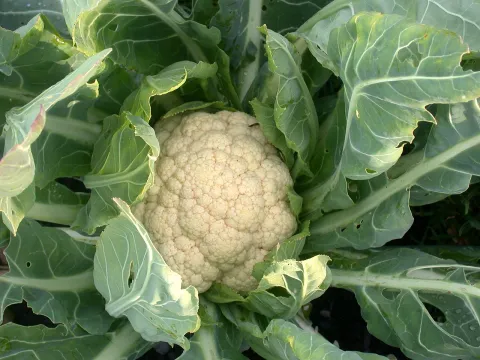
It's not just trees that take on extraordinary colors in the fall. Cauliflower (Brassica oleracea) does too! While most varieties of fall cauliflower have white heads, there are now much more colorful varieties available. Plant them in the spring for a harvest and an explosion of colors from September through December!
How can you recognize fall cauliflower (Brassica oleracea)?
Fall cauliflower (Brassica oleracea) has a bushy growth habit. When mature, this biennial vegetable plant grows up to 80 cm tall with a maximum spread of 60 cm.
The rosette of grayish-green leaveswith serrated edges stands upright close to the ground. The leaf blades can reach 40 cm in length.
The head (or flower head) forms at the center of the foliage. Botanically speaking, it is a floral meristem: a cluster of dividing cells arranged in a geometric pattern where each tiny cluster faithfully replicates the overall shape of the vegetable. While white remains the traditional color of the late season, the head also comes in yellow, green, or purple, with flower clusters that are sometimes rounded and sometimes conical.
When cauliflower is not harvested, it goes to seed. It then develops a flower stalk, adorned with yellow or white flowers that have 4 petals and 4 sepals.
Which varieties of fall cauliflower should you plant in your vegetable garden?
Cauliflower group of fall cauliflowers includes many varieties:
- 'Neckarperle': a hardy giant with exceptional vigor, renowned for its dense, massive heads that can exceed 2 kg;
- 'Merveille de toutes saisons': highly prized by gardeners for its versatility, it produces a very firm white head that keeps exceptionally well after harvest;
- 'Romanesco': easily recognizable by its soft green, pyramid-shaped florets arranged in a spiral;
- 'Freedom': a compact, white-headed variety for gardeners in a hurry. It's ready for harvest just 73 days after transplanting;
- 'Graffiti': its purple head, which turns green when cooked, is ready for harvest 80 days after sowing;
- 'Flora Blanca': witha dense, white head. An early-maturing variety, this cauliflower is ready for harvest 2 to 3 months after sowing.
Is fall cauliflower toxic?
Fall cauliflower is not toxic. While the head is commonly eaten, the leaves are also edible.
However, this vegetable is intended for human consumption only. Rich in fiber and sulfur, it can be difficult for our four-legged friends to digest. It's best to avoid feeding it to your dog or cat.
Our care tips
Sunlight causes the apple to turn yellow. To keep it white, pinch off two to three leaves above the top when it measures 5 to 8 cm.
 Watering
Keep the soil cool and moist, but not soggy.
Water, preferably with rainwater, at the foot of your Brassica oleracea.
 Harvest
When the head of your Autumn cauliflower is well compacted, you can harvest.
Cut the top off flush with the soil using a knife. Keeping a ring of leaves around the fruit helps it stay fresh longer autumn cauliflower.
 Planting
When the risk of frost has passed, it's time to plant.
Choose a sunny location. If you live in a region where summers are very hot, prefer semi-shade. Autumn cauliflowers do not tolerate heat well.
Two weeks before planting, work the soil with a grelinette or spading fork. Decompact and aerate the soil. Add compost or manure to enrich the substrate.
Dig a hole the size of the root ball. Plant your Brassica oleracea plants in a line, at least 50 cm apart. If your soil retains water, form a mound and plant at the top. This will allow excess water to run off more easily.
Water to encourage rooting. You can also mulch to keep the plants cool and prevent weeds from appearing.
 Sowing
Once the risk of frost has passed, you can sow your Brassica oleracea seeds.
Fill a bowl or cups with potting soil for seedlings and plantations. Moisten the soil.
Plant your seeds, spacing them 4 cm apart and covering them with one to two centimetres of substrate.
Water regularly to keep the soil moist. Place your seedlings away from the cold, in a greenhouse or indoors for example.
Frequently asked questions
What to use cauliflower with in the vegetable garden?
Cauliflower goes well with celery, bush beans, potatoes or tomatoes. However, avoid planting it near turnips or radishes. Cauliflower attracts pests that are particularly harmful to these species. And don't plant your cabbage with other cabbages. Plants in the same family consume the same nutrients and attract the same diseases.
When to harvest cauliflower?
Harvesting takes place between 4 and 7 months after sowing, depending on the variety. Cauliflower is harvested when the head is firm and compact.
Diseases / Threats

Information
- Lifecycle
- Biennial
- Foliage
- Evergreen
- Exposures
- SunHalf-shade
- Substrates
- Calcareous earthHumus soil
- Planting method
- Open ground
- Category
- Vegetable
- Tags
- ThirstyEdible vegetable
- Origin
- Southern Europe
- Hardiness (USDA)
- 9b (-3.9°C ≤ T° < -1.1°C)
- Leaf color
- Dark green
- Flower colors
- WhiteYellow
Discover plants from the same family
Cauliflower
Brassica oleracea
Winter cauliflower
Brassica oleracea
Spring cauliflower
Brassica oleracea
Summer cauliflower
Brassica oleracea
Find out more
Find all our tips in the Monstera application