Dracaena cinnabari, a rare and legendary tree
Dracaena cinnabari
- Exposures
- Sun, Half-shade
- Hardiness (USDA)
- 10a (-1.1°C ≤ T° < 1.7°C)
- Lifecycle
- Perennial
- Foliage
- Evergreen
- Family
- Asparagaceae
- Genus
- Dracaena
- Species
- Dracaena cinnabari
Socotra, an island in the Arabian Sea, in the Gulf of Aden, is home to over 800 species, some of which exist nowhere else. Among them, the Dracæna cinnabari or Socotra dragon-fly. Its slow growth, shrinking territory and the greed of goats make it a vulnerable species.
How to recognize the Socotra Dragon Boat?
In its early years, the Socotra Dragon Boat has bright green, triangular stems. Like the dragon tree, it grows in the shape of a parasol or umbrella, but only produces new branches every 10 to 15 years. Some trees, several hundred years old, reach heights of 12 meters.
The dichotomously branched trunk is topped by a network of branches that support the crown of greenery. At the tips of the youngest branches, facing skywards, are the dark-green leaves. Like palms, they are arranged in a rosette. They measure up to 60 centimetres long and only 3 centimetres wide.
In March, clusters of white or green flowers appear at the end of the branches. Flowering only takes place on specimens that are at least 15 years old.
Although the Socotra dragon tree produces small orange berries, it is best known for its sap. This red resin has earned it the nickname of "bleeding tree" or "dragon's blood tree". Legend has it that after Hercules killed Ladon, the 100-headed dragon, the mythical creature's blood spilled out. It is said to have given rise to the different species of dragon trees. Harvested once a year, the sap is used for its antibacterial and anti-inflammatory properties, and as a colorant for varnishing violins, for example.
Our care tips
Plenty of sun, but without burning the leaves, regular watering, but without drowning the roots... Even if the plant is suitable for beginners, caring for your Socotra dragon tree requires rigor and moderation.
 Watering
Cinnabari dragon trees appreciate moderate, regular watering. Between two applications of water, leave the potting soil to dry out by two or three centimetres. Check this simply by touching the soil.
Always use water at room temperature to avoid thermal shock, which can damage the roots.
Be sure to remove any standing water in the saucer or planter.
 Misting
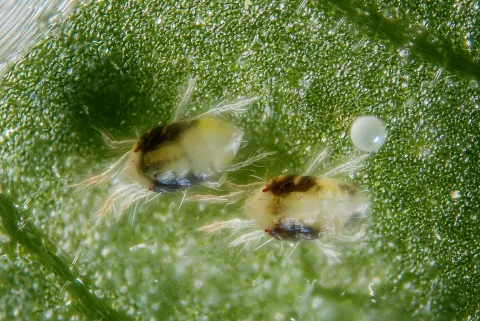
Fogging helps to increase humidity and prevent attacks by mites or red spiders. Spray foliage with non-calcareous water at room temperature.
 Repotting
In spring, transfer your Dracaena cinnabari to a larger pot, so that it can continue to grow.
In a pierced pot larger than the previous one, place a bed of clay balls, gravel or pebbles. Cover with the substrate. You can mix a special potting soil for green plants or houseplants with sand or compost.
Remove your plant from its container. To help the roots take hold, gently loosen the root bun. Plant in the center of the pot and top up with potting soil.
To improve humidity, place the pot on a dish filled with moist clay balls.
To improve humidity, place the pot on a dish filled with moist clay balls.
 Cleaning
Dust accumulating on leaves slows down the photosynthesis process. To ensure that your Socotra dragon tree receives sufficient light, clean its foliage with a damp cloth.
This operation also prevents mites from settling in.
This operation also prevents mites from settling in.
 Prune
Cut dead leaves with a sharp, clean tool.
 Planting
Once the last spring frosts have passed, you can plant.
Cinnabari dragon trees tolerate mild winters. If you live in the south of France or by the sea, you can plant them in the ground.
Choose a bright location, but without direct sunlight. Make sure the soil is well drained. If the soil in your garden is heavy or retains moisture, plant them at the top of a mound or on a slope.
After loosening the soil, dig a hole three times the size of your Socotra dragon treepot. Place a layer of clay balls or gravel and transplant. Fill in with a mixture of ordinary soil and sand, or even potting soil for citrus and Mediterranean plants.
Protect the base with a mineral mulch (pebbles, gravel, pebbles, slate, etc.) before watering abundantly.
 Taking cuttings
Propagation by cuttings is carried out during the strong growth phase, generally in spring and early summer.
To take cuttings from your Socotra dragon tree, use a clean, sharp tool such as pruning shears to remove a branch about fifteen centimetres long.
Remove the leaves from the base, leaving only a few at the top. You can dip the other end in cuttings hormone.
Plant your graft in a pierced pot containing a mixture of rich potting soil (horticultural potting soil, potting soil for seedlings, special potting soil for cuttings, etc.) and sand. Place them in a bright spot, but away from direct sunlight.
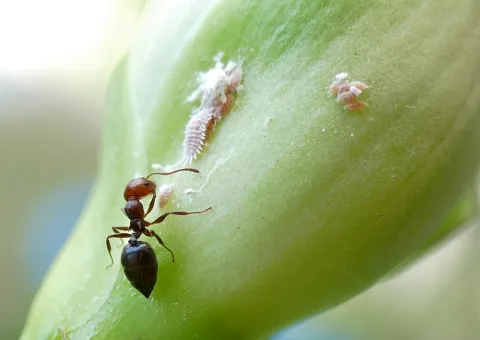
Diseases / Threats
Information
- Lifecycle
- Perennial
- Foliage
- Evergreen
- Exposures
- SunHalf-shade
- Substrates
- Calcareous earthHumus soilSandy soil
- Planting methods
- Open groundIn potsIn tubsPlanter
- Category
- Tree
- Tag
- Cold-sensitive
- Origins
- Western AsiaIndian Ocean
- Hardiness (USDA)
- 10a (-1.1°C ≤ T° < 1.7°C)
- Leaf color
- Dark green
- Flower colors
- WhitePale green
- Fruit color
- Orange
Discover plants from the same family

Song of India
Dracaena reflexa var. angustifolia
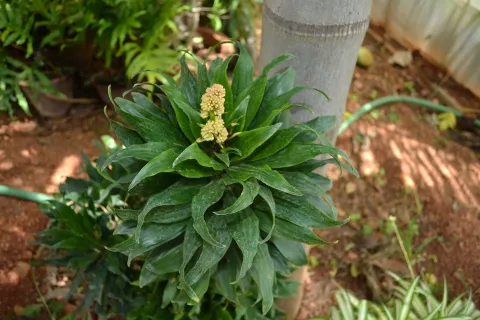


Dragon tree
Dracaena draco
Find out more
Find all our tips in the Monstera application