Nine tips for maintaining your closed terrarium
Article for :Beginner and plant killerExperienced plant lover

Article summary
Popular wisdom says you don't get something for nothing. While this adage may hold true for sports records or exams, it doesn't always apply to gardening. The terrarium is proof of this. By placing your plants in a jar, you can grow a lush tropical garden without wearing yourself out. You still need to know a few simple steps that will help you care for your closed terrarium.
Choosing the Right Location
Terrariums are kept indoors. They're undemanding and thrive in a room with a temperature between 16 and 27 °C.
The spot should be bright so the plants get plenty of light. But avoid direct sunlight. Behind the glass walls, the temperature is higher than it is outdoors. Excessively strong sunlight will cause the temperature to rise and turn your terrarium into a sauna. The magnifying effect can also scorch the leaves. In the winter, you can leave your terrarium near a window, but in the summer, move it slightly away to prevent overheating and sunburn.
Once your terrarium is in place, rotate it regularly. Plants tend to grow toward the light. By rotating your terrarium a quarter turn every month, you allow each plant to enjoy the sun and ensure harmonious growth in your glass garden.
Going Through an Adjustment Period
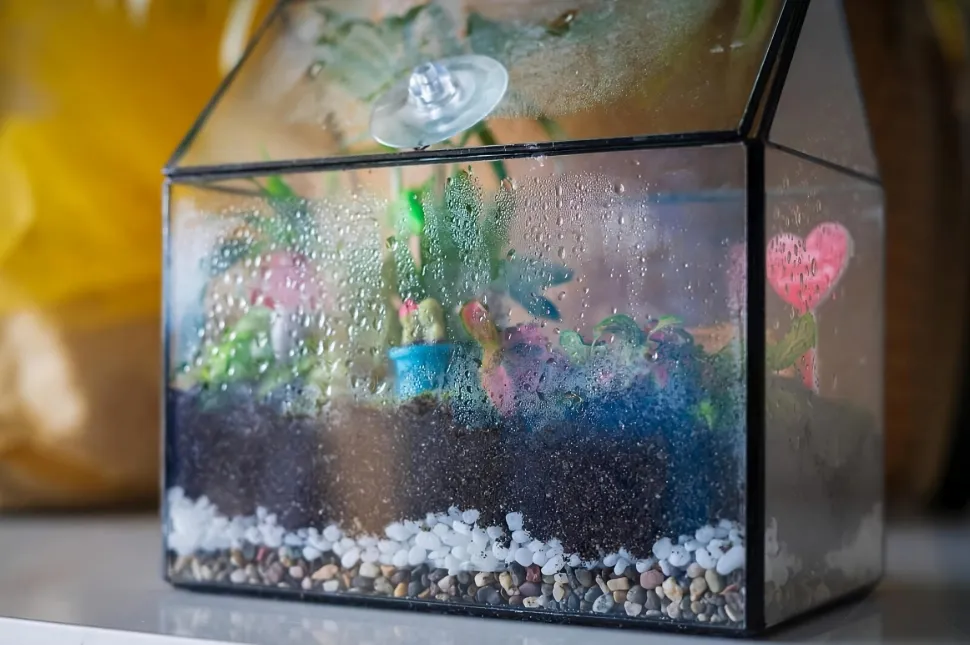
For the first few days, your terrarium may be fogged up—Photo by Ellinnur / Canva
Now that you've brought your terrarium home, there's no question of letting it sit idle on a shelf. If you do nothing, you risk ending up with a dripping mess—or, conversely, a dry container.
During the first few weeks, the plants go through an adjustment or balancing phase. They need to get used to living together in an enclosed space. They also need to acclimate to the temperature and light levels of their new environment.
If water beads up on the outside of the walls or if condensation prevents you from seeing inside the terrarium, this means there is too much humidity. Open the lid for a day to allow the excess water to escape. After 24 hours, close the lid and continue monitoring. If the humidity remains too high, ventilate again. Condensation should be present, but it shouldn't cause fogging or droplets on the outside.
Is your terrarium as dry as the planet Tatooine? It needs water. Water it, but remember: it's easier to add water than to remove it. The safest approach is to use a spray bottle to mist the base of the plants. Opt for rainwater and avoid tap water. The lime it contains disrupts the terrarium's ecosystem.
On average, it takes a terrarium about fifteen days to reach equilibrium. After this adjustment period, continue to monitor your mini-world. If you notice a disruption in humidity levels, repeat the process. Also repeat the balancing phase every time you change an element of your terrarium.
Water Sparingly
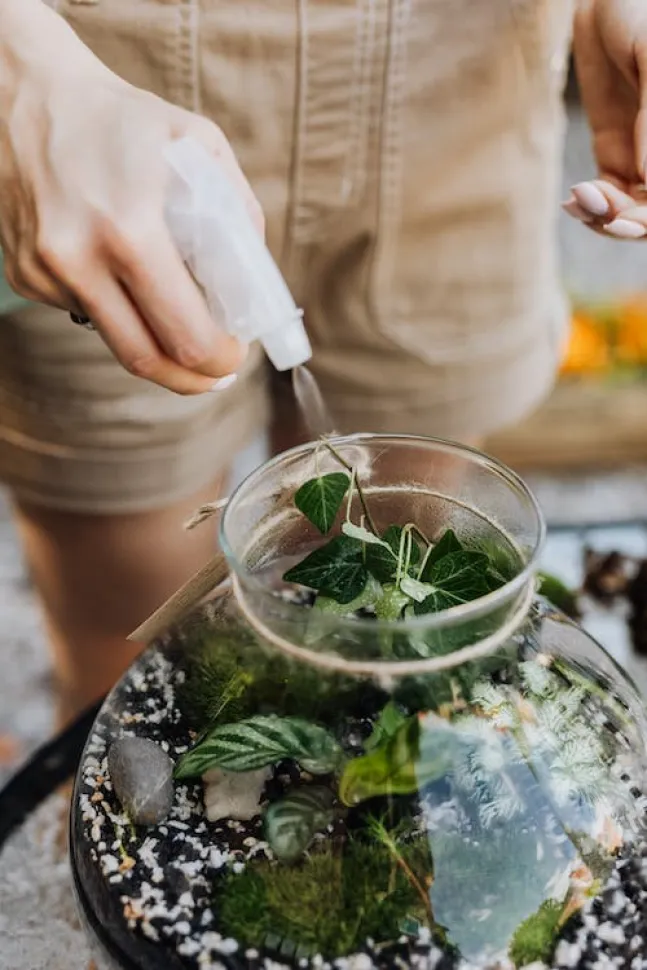
Watering with a misting device prevents overwatering – Photo by Karolina Grabowska / Pexels
Closed terrariums require much less water than potted plants or those growing in the ground. Evaporation from the leaves produces condensation, which is absorbed by the roots. This cycle repeats itself indefinitely—or almost indefinitely. When the water runs low, you need to water the plants.
The absence of condensation is the first sign that your terrarium needs water. Other symptoms may also alert you, such as:
- Moss that becomes lighter in color, turns white, or turns yellow;
- Potting mix that loses its brown color and lightens;
- Plants that are wilting.
When you notice any of these signs, mist the substrate with your spray bottle. Start with one or two sprays per plant and leave the terrarium open for 24 hours. Then close the lid. If there's still no condensation, water again. As during the acclimation period, use rainwater. It provides nutrients without disrupting the ecosystem's balance. If you don't have any, try demineralized water.
Depending on the species you've chosen, the size of the terrarium, and its exposure, watering is needed two to four times a year. If you're worried about forgetting, set up your own reminder inthe Monstera app. That way, you'll receive a notification prompting you to check on your plants and water them.
Ventilate regularly
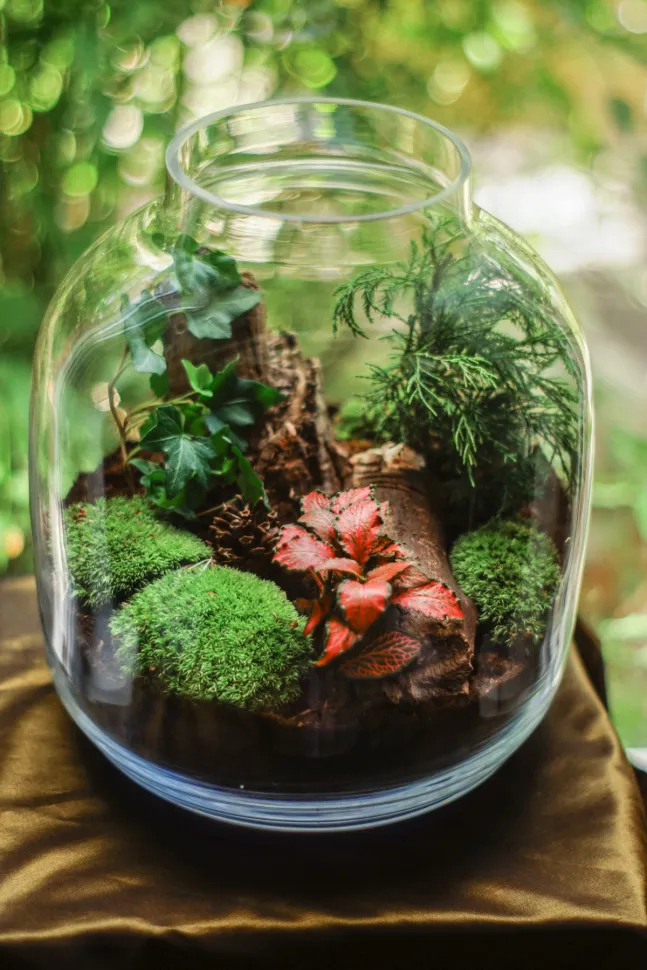
Ventilating helps regulate condensation and temperature
Ventilation is your best defense against high humidity or excessive heat. When there's too much condensation and you can no longer see the plants inside the terrarium, remove the lid for a few hours until the droplets on the outside and the fog inside have cleared.
Also remember to ventilate your terrarium when the temperature exceeds 28°. Even if the plants in your terrarium are tropical varieties that thrive in heat, they're not immune to sudden spikes in temperature. By opening the jar completely or leaving it slightly ajar during the day, you can lower the temperature by a few degrees.
Prune and pinch back to maintain the harmony of your terrarium
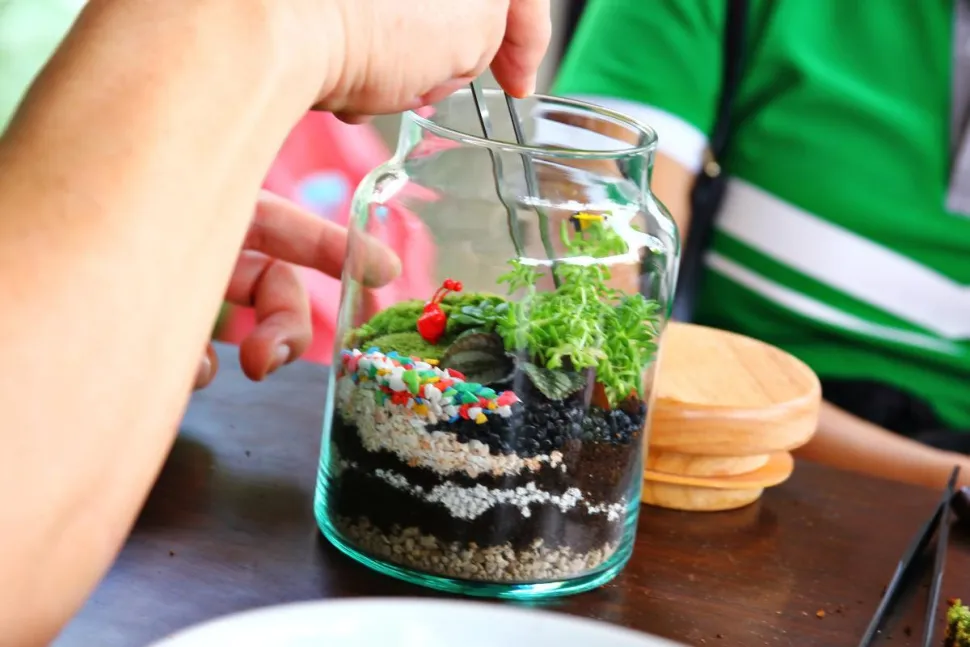
Arm yourself with pruning shears and patience to trim the plants in your terrarium – Photo by Aphithana Chitmongkolthong / Canva
Even when enclosed, your plants are still alive. They grow, shed leaves, and produce new shoots. To maintain the harmony of your arrangement and allow air to circulate, you should prune them one to three times a year. Again, you can set up a personalized reminder onthe Monstera app to make sure you don't forget—or put off until tomorrow—this key step in caring for your terrarium.
When pruning, use clean, sharp tools. This helps prevent the spread of disease and promotes healing in the plants. If the opening of your terrarium is too small to fit your hand and even the smallest pair of pruning shears, use garden shears and aquarium scissors instead.
But what should you prune? Take a close look at your terrarium to determine where to cut. Is your Calathea lancifolia brushing against the lid, and are its stems curving? Cut off the parts that have grown too tall just above a node. Are the leaves of your Hypoestes phyllostachya touching the glass walls? Remove them! They risk rotting and contaminating all the other plants.
Once you've thinned out your mini garden, move on to densifying it. Pinch the tips of the stems on trailing plants, such as ficus pumila and fittonia albivenis. This technique forces the plant to produce new branches and maintain its compact shape.
You're probably wondering what to do with yellowed or dried-out leaves. This question sparks debate, with two opposing camps. Some let the leaves die off and don't pick them up once they've fallen. Over time, they decompose and provide nutrients to the soil. Others choose to remove yellowing leaves to preserve the aesthetic appeal of the arrangement and prevent the rest of the plant from rotting.
Pruning, like watering, alters the balance of your closed terrarium. To help the plants heal and adapt more easily, leave your terrarium open for 24 hours after pruning.
Cleaning the Sides
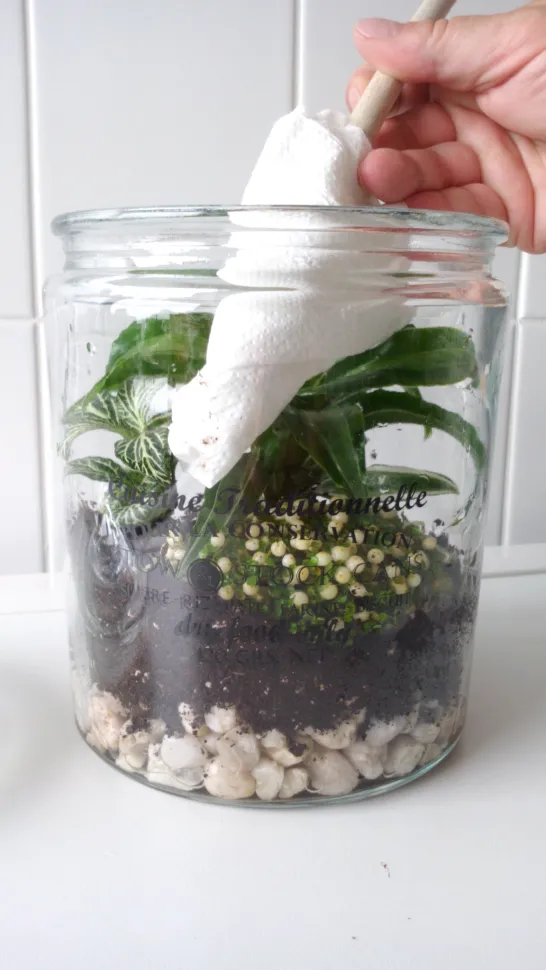
Use a paper towel or microfiber cloth to avoid leaving streaks – Photo by Jungle Rebel / Flickr
The walls of your humid terrarium must remain clean. This is essential for the plants to absorb as much light as possible and carry out photosynthesis. A quick wipe with a microfiber cloth is enough to clean both the inside and outside. Do not add any chemicals—you'll kill the plants.
Are you a bit of a neat freak who can't stand seeing potting mix on the rocks, algae stains on the walls, or mold residue on your plants? Grab a brush with a long handle to do a little cleaning inside your terrarium.
Watch for Pests and Parasites
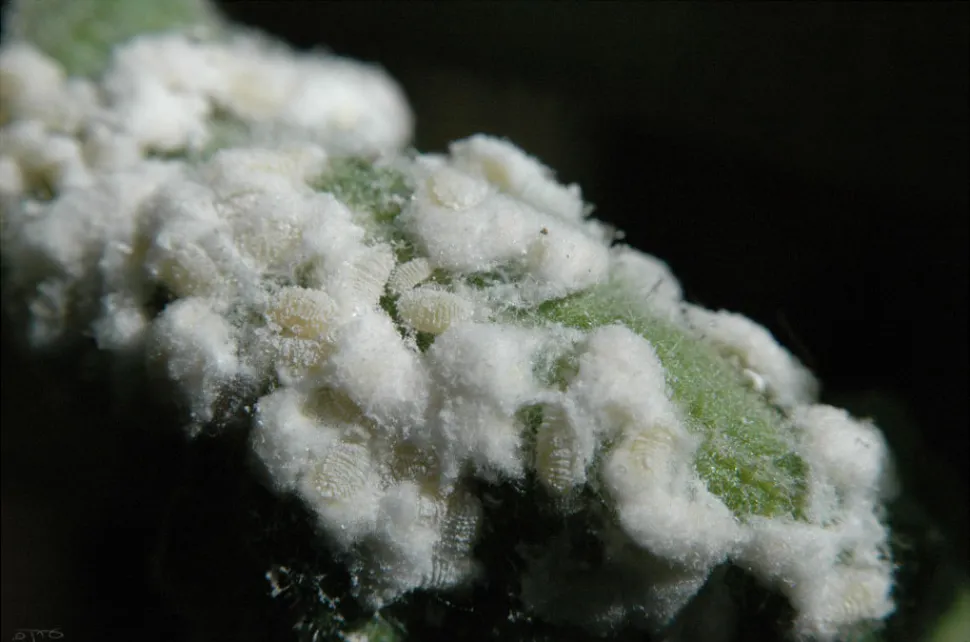
Scale insects and their honeydew can wreak havoc in a terrarium – Photo by Eran Finkle – Flickr
Even in a closed, self-contained environment, you're not immune to pest infestations. Fruit flies often appear. They won't harm your plants. If their presence bothers you, place a sticky trap under the lid to attract and capture them.
Mealybugs and spider mites may take up residence in your Dwarf fan palm or Ficus microcarpa microcarpa without being invited. If you notice small white spots on your plants' foliage, spray the leaves with a mixture of water and liquid soap. You may need to repeat this several times to get rid of them.
Have you found slugs and snails in the potting soil? Remove them before they devour the leaves. Centipedes and earthworms, on the other hand, are harmless. But they'll surely be delighted to regain their freedom!
Finally, mushrooms may start to pop up. While they add a rather attractive wild touch, it's best to remove them as soon as you spot them. They'll multiply and take over your arrangement.
Replacing Wilted Plants

If a plant dies, replace it to maintain the balance of your terrarium – Photo by Lucy Serafi / Wikipedia
When well-maintained, a terrarium can last for several years. But not all the plants in it have the same lifespan. Over the years, you may need to replace some of them.
This usually starts with the mosses, which eventually turn white and dry out. Don't panic! Remove the withered moss and replace it with fresh moss! Soak your new moss in lukewarm water for a few minutes and plant it in place of the old one. Press it down firmly to ensure it takes root.
Has your Asparagus fern or bonsai died? In that case, gently remove it. You can swap out your plant for one of the same variety or a different species (to choose one, read our article Which plants to choose for a closed terrarium?”). This option is highly recommended if the poor plant has died prematurely! Re-work the hole so it matches the size of the root ball, and plant the new one. Spray the base with a little rainwater to speed up rooting.
After each planting, leave your terrarium open for at least one day to regulate humidity.
Repotting Plants That Have Outgrown Their Pots
In a humid environment, certain plants—such as ferns, Hypoestes, or Aralia (Polyscias fruticosa)—will grow rapidly. If their leaves take up all the space or touch the sides or lid, it means they've outgrown your terrarium.
The first step is to prune the stems and branches to restore a size that fits within the terrarium.
However, if you've chosen a container that's clearly too small or if you want to give them more space, you can try repotting them. To do this, get a larger clear jar with an opening wide enough to fit your hand inside. Place a layer of gravel or clay pellets at the bottom, followed by a substrate suited to your plants' needs. Potting soil for houseplants will work, but some brands also offer special terrarium soil. Remove your plants from the old terrarium and plant them in the new one. Add your decorative elements and start the acclimation process all over again!
Find out more
 Plants toxic to cats and dogs: varieties to avoid in the garden and indoors
 Seaside garden: which spray-resistant plants to plant?
 Vegetable gardening: 10 mistakes that ruin your harvests