Seaside garden: which spray-resistant plants to plant?
Article for :All parent plants
Key points to remember
- Protect your garden with a windbreak hedge (tamarisk, eleagnus).
- Improve sandy soil with compost and mulch.
- Structure your garden into zones to shelter the most fragile species.
- Rely on sure values, resistant to wind, sea spray and drought: lavender, oyat, agapanthus, santolin.
Living in a house with a garden by the sea is like being on vacation all year round. But not for your plants! Between the sea spray that burns the leaves, the wind that blows relentlessly and the sandy soil that holds nothing back, the coastline gives them no rest. Do you dream of a lush, easy-to-maintain garden? It's possible, as long as you choose varieties that are resistant to sea spray and follow a few rules.
Understanding coastal constraints
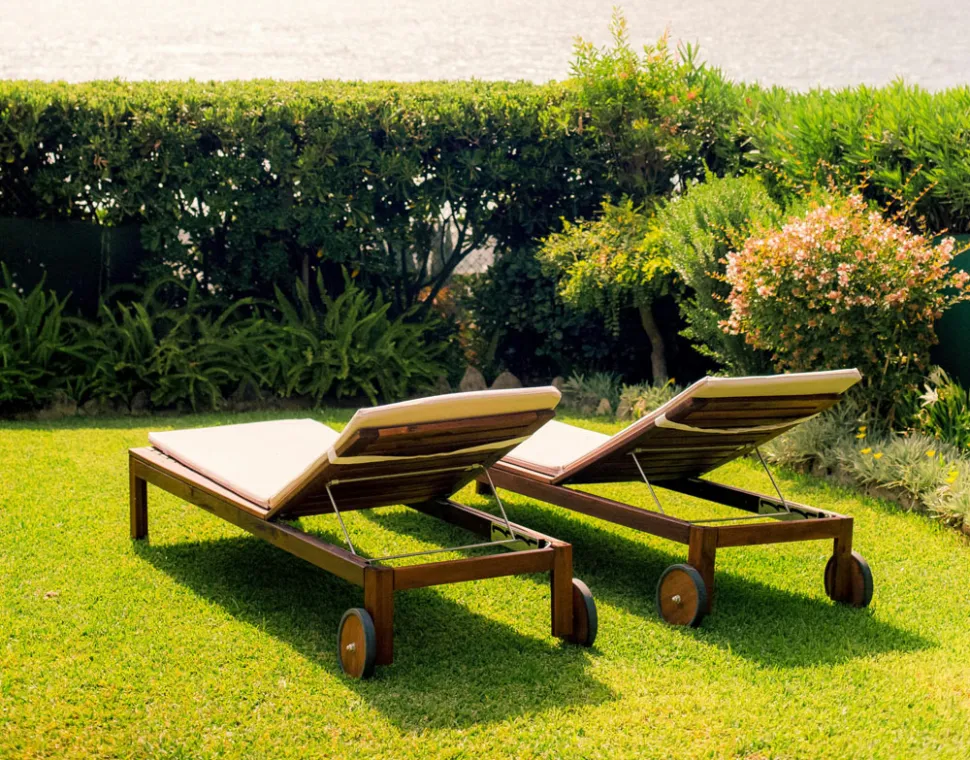
Wind and salt are the main enemies of seaside plants – Photo by Marios Potsis / Pexels
Coastal areas (especially the Atlantic and Mediterranean coasts) offer a milder climate than elsewhere, with fewer frosts and higher temperatures than inland. This makes it possible to plant tropical or hardy plants in the open ground.
On the other hand, seaside gardens face certain constraints that are not found far from the coast.
Sea spray: constant salt stress
Salt-laden sea spray settles on the leaves. As a result, they dry out, burn and fall off.
To limit the damage, rinse plant foliage after a strong gust of wind, to rid it of spray.
Wind: an uncool double effect
Wind, which is stronger at the seaside, has a dual effect on your garden. It :
- Breaks branches and coats plants;
- Increases the cold and dries out the soil.
You need to protect your plants to counteract these mechanical and thermal effects. More frequent watering is also necessary to combat the drying out of the soil, which is accelerated by the sea wind.
Poor, draining soil
By the sea, soils are generally sandy. As a result, they are poor in nutrients and barely retain water.
This means more frequent watering and tilling than elsewhere.
How do you organize your seaside garden?
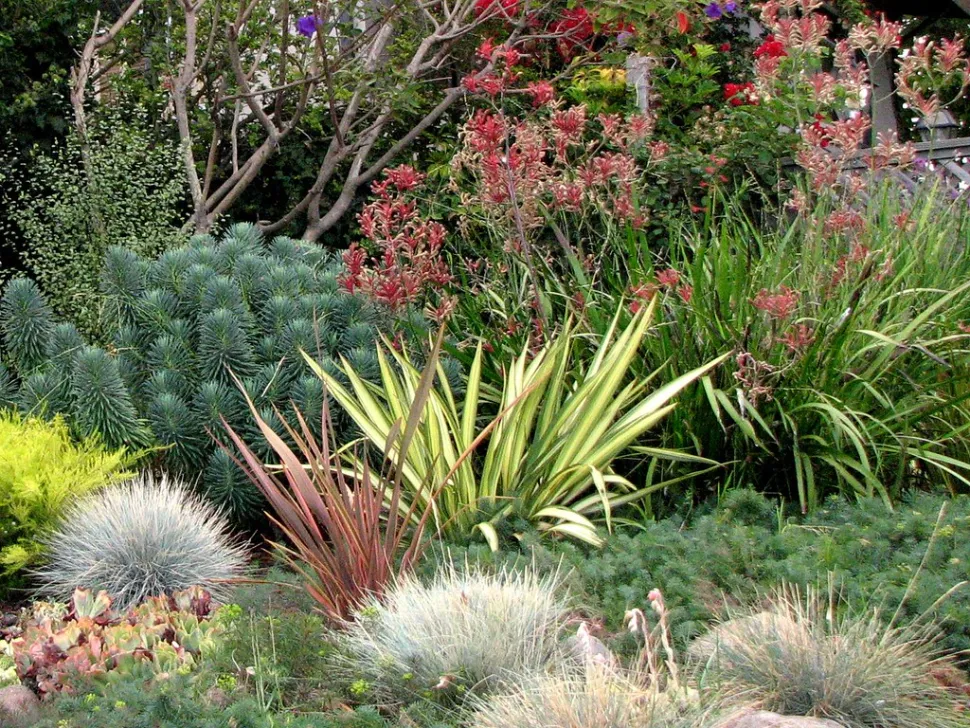
With a little method, you can plant almost anything in your seaside garden – Photo by Sean A. O'Hara / Flickr
Before choosing the plants that will flourish in your seaside garden, you need to think about its layout. An intelligent layout will help limit the impact of sea winds and salt.
Structuring the garden: the three-zone strategy
Whatever the shape or exposure of your garden, organize it into three zones. This helps create protected zones, where more fragile species can be planted.
- The seafront (0 to 200 m): the area closest to the sea becomes a natural shield to break the force of the first gusts. This is where you'll find halophilic (salt-loving) plants.
- The heart of the garden: this area is protected by halophilic plants. Plant more varied species that are less resistant to sea spray and wind.
- Sheltered areas: behind a wall, a hedge or in a corner, these spaces offer milder conditions for more fragile plants.
Windbreaks: your best ally
A windbreak hedge filters the wind over several times its height while letting light through, whereas a wall blocks it and then creates whirlwinds and turbulence.
To make a success of your windbreak hedge :
- Plant it where it is most exposed to the wind (often at the edge of the garden);
- Use several different species, adding at least 2/3 evergreen or marcascent foliage (whose leaves dry out but remain on the tree in winter);
- Plant your hedge in two rows (for better protection) and in a zigzag pattern (to better filter the sea breeze and let light through).
Design ideas for your seaside garden
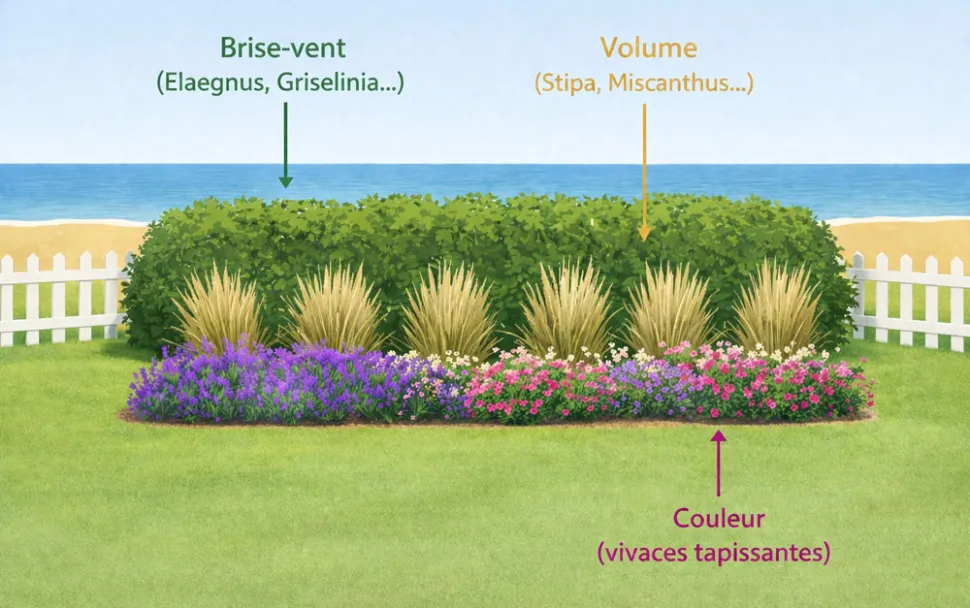
Structure your garden in several zones to protect the most fragile plants.
Here's an example for your seaside garden:
1. At the bottom (Windbreak): a dense, hardy hedge (such as Elaeagnus or Griselinia) to absorb most of the salt.
2. In the middle (Volume): supple shrubs and grasses (Stipa or Miscanthus type) that undulate without breaking.
3. Front (Color): Tapering perennials and fleshy groundcovers that maintain soil moisture.
Final tip: we recommend planting in a staircase, facing the prevailing wind. This directs air upwards and protects the most fragile plants.
The best plants for a seaside garden
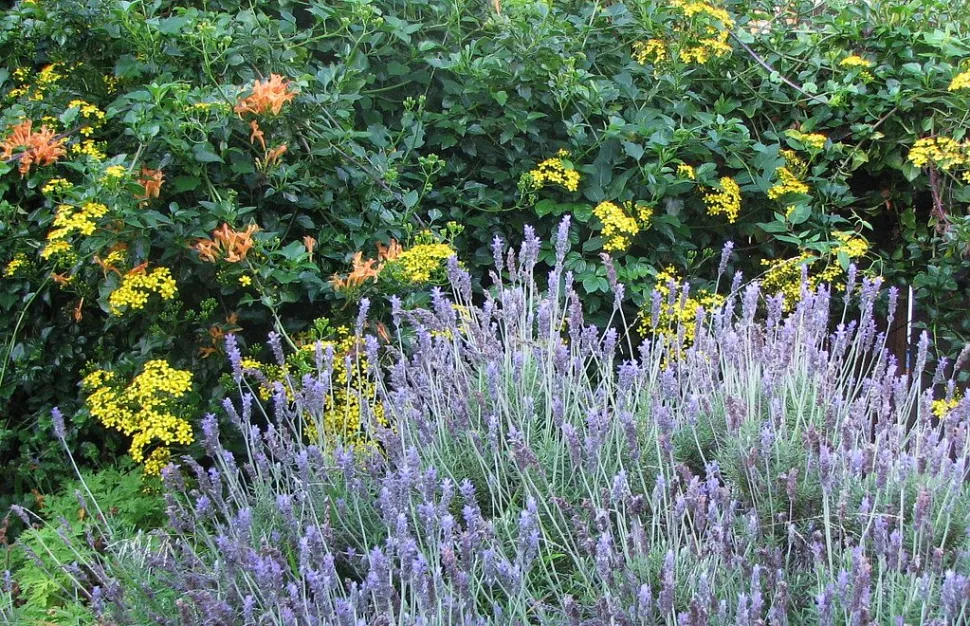
Lavender thrives in seaside gardens, even if they don't face the Mediterranean – Photo by Sean A. O'Hara / Flickr
The plants that best resist sea spray and are suitable for a seaside garden have several characteristics:
- Flexible stems: like reeds, they bend but don't break in the sea wind;
- Compact or creeping habit to reduce wind resistance;
- Tough, waxy, silver-gray or hairy foliage to limit evaporation and dehydration;
- Needles or small leaves to reduce exposure to sea spray;
- A deep root system to draw water and stabilize the soil.
Hardy shrubs
Shrubs act as windbreaks and protect the rest of the garden. But beyond their practicality, they are also highly aesthetic.
Hardy, halophilic and easy to care for, Tamaris are the stars of the seaside. What's best about these rounded shrubs? Their pink, red or white spring blossoms, which contrast with their gnarled trunks.
Combine with other species, such as :
- Eleagnus: choose an evergreen species such asEleagnus pungens, with green leaves spotted with yellow;
- Escallonia: this fast-growing shrub is covered with white or pink flowers in summer;
- Arbutus (Arbutus unedo): produces white or pink flowers and small, round, red fruits;
- Sea buckthorn (Hippophae rhamnoides): flowering and honey-producing, this thorny shrub is also hardy.
Perennials and flowering plants
In the heart of your garden, create beds of hardy, drought-resistant perennials that add color, such as :
- Lavender (Lavandula) ;
- Gaura (Gaura) ;
- Yarrow (Achillea);
- Santolinia (Santolina).
Mediterranean flowers, such as Agapanthus and Cistus, add variety.
Grasses
We love to see them dancing in the breeze. But grasses aren't just for show. They help stabilize the soil. Several species are adapted to poor soil, sand and the constraints of a seaside garden:
- Oyat (Ammophila): dark-green evergreen foliage and golden-beige spikes to delight the eye, strong underground stems to hold the soil.
- Angel hair (Stipa): behind the fragility of its delicate, silky spikes lies a robust, undemanding plant;
- Festuca glauca: a compact habit and bluish foliage that doesn't mind the sun.
Ground cover plants
Ground cover plants limit erosion and conserve moisture. To combine business with pleasure, try :
- Perennial purslane (Delosperma): pink, white, purple, yellow... Its flowers come in almost every color. They thrive just as well in blazing sun as in poor soil;
- Erigeron karvinskianus: their daisy-like white, pink or purple flowers bloom from April to November. They can even appear in winter, when temperatures are mild!
- Creeping thyme (Thymus serpyllum and Thymus praecox): forms a dense carpet and is an excellent alternative to lawns in coastal gardens. The icing on the cake: it blooms between May and August, with red, mauve or pink flowers.
Adapted exotic plants
Take advantage of the milder climate to grow exotic species with low hardiness, such as :
- Palms: choose a wind-resistant variety, such as Trachycarpus ;
- Yucca: graphic and well-suited to well-drained soils, it'll need very little once established;
- Agaves (Agavea): plain or two-tone, their rosette gives a tropical garden feel to any space.
Plants to avoid
If you live just a few minutes from the sea or ocean, avoid plants that are :
- Acidophiles, such as Japanese maple, azaleas, rhododendrons and magnolias. In chalky soil, their foliage turns yellow and they need moist soil to flourish;
- Salt-sensitive, like fuchsias and impatiens: they risk drying out, blackening and failing to flower;
- With fragile or tender foliage, such as Coleus Plectranthus scutellarioides), most ferns and begonias: the sea wind will tear their leaves.
Is it possible to plant a vegetable garden by the sea?
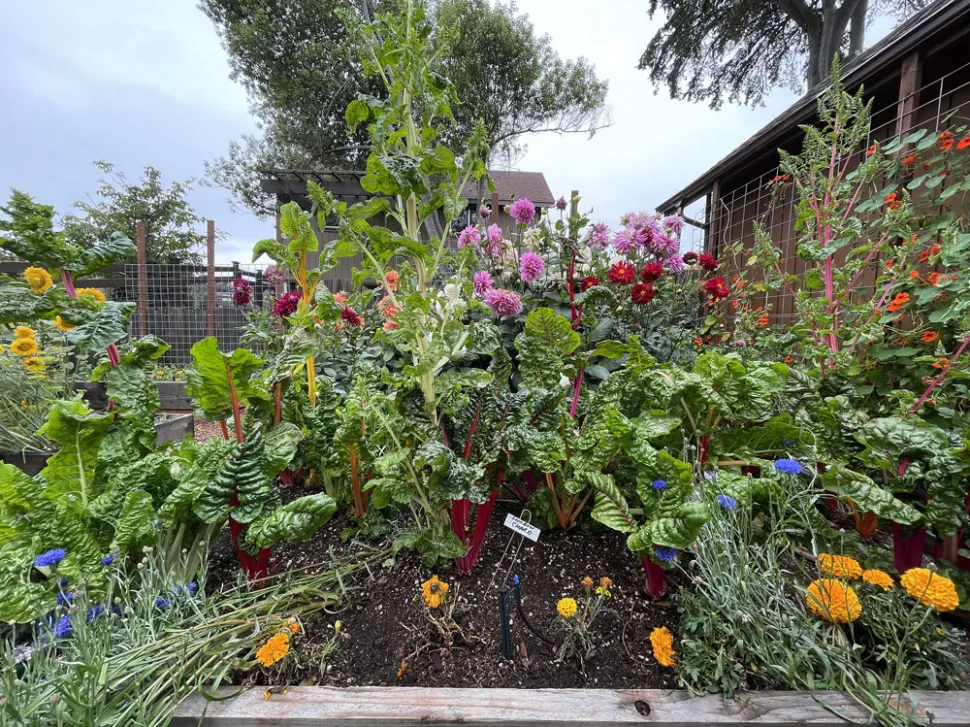
Flowers are always a vegetable garden's ally – Photo by Sarah Stierch / Flickr
Yes, it's entirely possible to have a vegetable garden by the sea. But, as with your garden, you need to respect the constraints of climate and soil.
The easy solution is to set up vegetable patches. This way, you can control the quality of the soil and protect your vegetables from the wind, thanks to the use of windbreaks.
But you can also plant in the open ground, provided you amend the soil and install protection against gusts of wind.
Which vegetables are best for a seaside garden?
Some vegetables are naturally more tolerant of saline conditions:
- Leafy vegetables: cabbage, chard and spinach;
- Root vegetables: leeks and asparagus (which love sandy soil);
- Aromatics: Rosemary (Salvia rosmarinus), Common thyme (Thymus vulgaris) and Sage, whose essential oil-protected foliage is resistant to sea spray.
Monstera tips for a thriving coastal garden
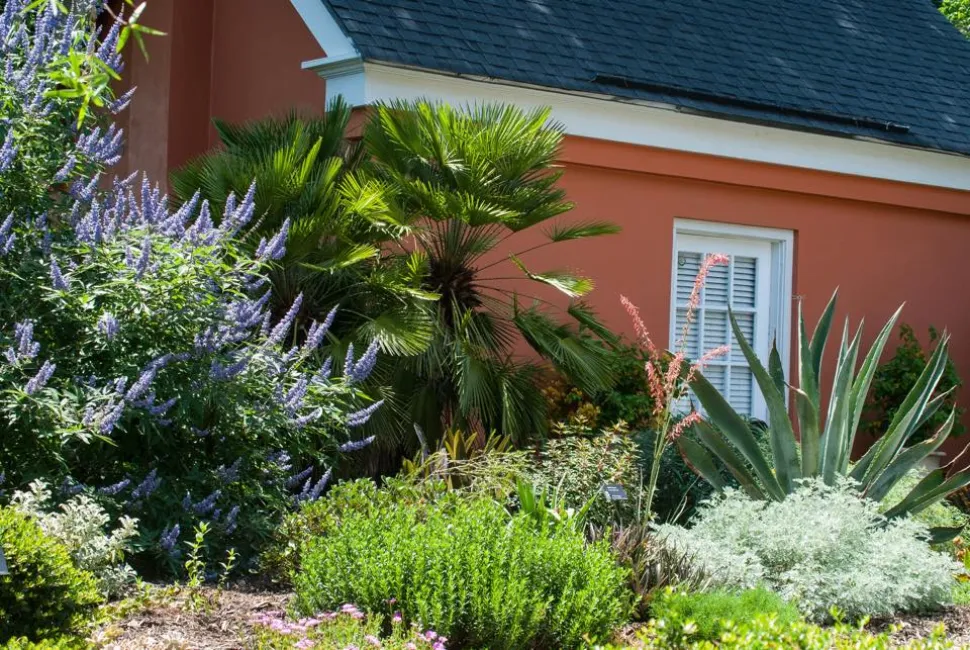
Less demanding plants can also make a big impact – Photo by Norman Winter / Wikipedia
Here are the golden rules for a beautiful seaside garden:
- Amend the soil: seaside soils are often poor. Add compost or manure to enrich the soil and improve its water-holding capacity;
- Mulch: mulching is your best ally against drying out due to wind. You can use organic mulch, which will enrich the soil as it decomposes, or mineral mulch, which will stay in place through storms.
- Choose young plants: small plants adapt much better to their environment. A plant purchased young will develop a stronger root system and wind resistance than a large plant already trained in a sheltered nursery.
- Plant densely: by planting close together (while respecting the needs of each species), you create a mass effect where plants protect each other. It's the strength of the collective in the face of the elements.
- Pruning: regular pruning maintains a compact, stocky habit. By making the branches denser, you reduce wind resistance and encourage the growth of new leaves, which are more resistant than the old salt-affected ones.
Looking for an easy-to-maintain seaside garden?
Download the Monstera app for personalized advice, weather-adapted watering reminders and planting ideas for your region.
Frequently asked questions
How do I create a seaside garden?
Start by installing a windbreak hedge to protect your garden from gusts of wind and sea spray. Then amend the soil with compost to improve water retention. Finally, select plants adapted to salt and wind, and organize your garden into zones to shelter the most sensitive varieties.
Which plants to plant in a seaside garden?
Choose hardy plants that can withstand wind, salt and poor soil. Grasses (oyat, stipa), evergreen shrubs (eleagnus, tamarisk) and Mediterranean perennials (lavender, rockrose, agapanthus) are particularly well-suited. Local species remain the most reliable.
Which plants are resistant to sea spray?
Spray-resistant plants have thick, waxy or silvery foliage that limits the effects of salt. Among the most effective are tamarisk, sea buckthorn, santolin, rosemary and oyat. They are ideal for the most exposed areas of the garden, in the front line facing the sea.
 Plants toxic to cats and dogs: varieties to avoid in the garden and indoors
 Vegetable gardening: 10 mistakes that ruin your harvests
 Vegetable garden on a balcony: how to create a productive vegetable garden in the city?