Ananas comosus, the cultivated pineapple
Ananas comosus
- Exposures
- Sun, Half-shade
- Hardiness (USDA)
- 11a (4.4°C ≤ T° < 7.2°C)
- Lifecycle
- Perennial
- Foliage
- Evergreen
- Family
- Bromeliaceae
- Genus
- Ananas
- Species
- Ananas comosus
Other name:Bromelia comosa
Criticized on pizza, celebrated by Pikotaro, and brought to life by SpongeBob—does the pineapple even need an introduction? Known as Ananas comosus in Latin, this variety from the Bromeliaceae family comes to us from South America. It is grown in our latitudes as a houseplant.
How can you recognize Ananas comosus?
Ananas comosus is a herbaceous perennial plant. It grows up to 1.5 meters in all directions. Is your apartment too small to accommodate it, but you dream of having a tropical plant? Treat yourself to the miniature version, ananas comosus var. Microstachys. This cultivar does not exceed 60 centimeters in height.
The rosette of leaves conceals a short green stem. Thick and stiff, the leaves are lanceolate. The largest ones exceed one meter in length. The botanical variety has dark green foliage. However, there are plants with colored leaf blades, such as ananas comosus bracteatus.
Pineapples bloom after six years of cultivation. The inflorescence consists of a multitude of blue flowers arranged in a spike. Flowering occurs in late summer or early fall.
The fruit is a cylinder 20 to 30 centimeters tall. It is covered by a hard rind with hexagonal patterns. Brown, yellow, or green in color, it protects the yellow, sweet, and fibrous flesh. The fruit, also known as a pineapple, is topped by a crown of green leaves. Smaller than those surrounding the stem, these leaves measure between 10 and 15 centimeters long.
The fruit is edible, and the rest of the plant is not toxic, whether through contact or ingestion. Ananas comosus poses no danger to humans or animals.
Our care tips
The Ananas comosus the plants sold in garden centers, with their fruit, are already mature. So you won't need to repot your plant. However, place the pot on a dish filled with moist clay balls to increase humidity.
 Watering
Water when the soil is dry, for about three centimeters. Use room-temperature, non-calcareous water, preferably rainwater. When watering, avoid wetting the leaves.
Thirty minutes after watering, drain off any stagnant water in the saucer. It may rot the roots.
To improve humidity, place your Ananas comosus with your other plants or place its pot on a dish of moist clay balls.
 Misting
Spray foliage with non-calcareous water at room temperature. In addition to increasing humidity, misting prevents the appearance of undesirable insects.
 Repotting
Every year in the spring, repot your Ananas comosus to give it more space.
Your Ananas comosus likes to be cramped. Repot it into a pot with drainage holes that is barely larger than the root ball.
Line the bottom of the pot with a well-draining substrate. You can use potting mix for bromeliads or for cacti and succulents. You can also make your own growing medium by mixing equal parts:
- potting mix for houseplants;
- bark;
- coconut fiber;
- perlite;
- sphagnum moss.
Plant your Ananas comosus in the center and add the substrate. Pack it down and water to encourage root growth.
Place your pot on a tray of moist clay pellets to improve humidity.
 Fertilization
To promote the growth of your Ananas comosus, apply fertilizer in spring and summer.
Dilute green plant fertilizer with water.
 Cleaning
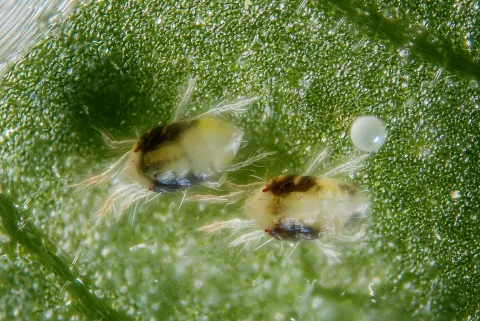
Clean the leaves with a clean wet sponge. This removes dust and improves photosynthesis. It's also a way of preventing mite infestations.
 Prune
To encourage the growth of your Ananas comosus, prune regularly.
Remove yellowed leaves. They will not regain their color and are no longer useful to the plant. You can remove them by hand or with clean pruning shears.
 Taking cuttings
The best time to take cuttings is after your Ananas comosus has bloomed.
Wait until the shoots are at least a third of the size of the main plant before removing them. Separate them with your hands or a clean, sharp instrument (pruning shears or scissors). Be sure to keep some roots for each cutting.
Prepare a pierced pot adapted to the size of your cutting.
Pour a layer of potting soil for cacti and succulents or for bromeliads into the bottom. You can also make your own growing medium by mixing equal parts of potting soil for green plants, bark, sphagnum moss, perlite and coconut fibre.
Plant your Ananas comosus and add substrate. Tamp to remove air bubbles and water to encourage rooting.
Your plant appreciates humidity. Place the pot on a saucer filled with moist clay balls to increase humidity.
Diseases / Threats
Information
- Lifecycle
- Perennial
- Foliage
- Evergreen
- Exposures
- SunHalf-shade
- Substrates
- Humus soilSandy soil
- Planting method
- In pots
- Categories
- Fruit treeIndoorHerbaceous
- Tag
- Edible fruit
- Origin
- South America
- Hardiness (USDA)
- 11a (4.4°C ≤ T° < 7.2°C)
- Leaf color
- Dark green
- Flower color
- Blue
- Fruit colors
- YellowBrown
Discover plants from the same family

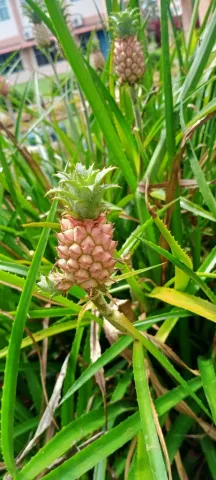
Ananas comosus bracteatus
Ananas comosus var. bracteatus

Pink quill
Tillandsia cyanea
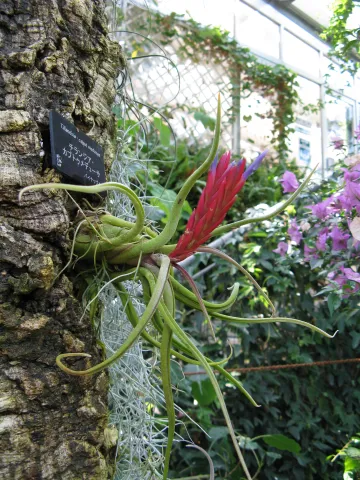
Medusa's head
Tillandsia caput-medusae
Find out more
Find all our tips in the Monstera application








