Tillandsia caput-medusae, a jellyfish plant that likes to live upside down
Tillandsia caput-medusae
- Exposures
- Sun, Half-shade
- Hardiness (USDA)
- 11a (4.4°C ≤ T° < 7.2°C)
- Lifecycle
- Perennial
- Foliage
- Evergreen
- Family
- Bromeliaceae
- Genus
- Air plant Tillandsia
- Species
- Medusa's head Tillandsia caput-medusae
Tillandsia caput-medusae comes to us from Mexico and Costa Rica. This member of the Bromeliaceae family is unlike any other plant. Epiphytic, it has no roots and needs no soil. What's more, it prefers to live upside down! This makes the jellyfish head an excellent choice for indoor hanging baskets.
How to recognize Tillandsia caput-medusae?
Tillandsia caput-medusae grows to 40 centimetres in height and up to 50 centimetres in diameter. Its distinctive habit resembles the hair of a Gorgonian. This is why it is often referred to as a jellyfish-headed plant.
Evergreen foliage grows in a rosette from a pseudobulb. The thick, tapering leaves are 25 centimetres long and curved like gutters. Dark green, they are covered with fine gray hairs. These give the leaf blades a silvery hue.
In spring and summer, the jellyfish head blooms. Red, digitate inflorescences first appear. Young specimens have a single inflorescence, but older specimens may have up to seven spikes. The flowers, pale mauve tubes with purple corollas measuring three centimetres, have stamens and pistils protruding.
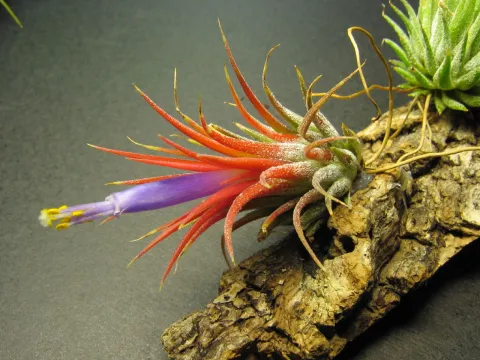
Like the pink quill or tillandsia ionantha, Tillandsia caput-medusae is a daughter of the air: it absorbs humidity and purifies the atmosphere. But beware: the jellyfish head is not a solitary creature. Its pseudobulb houses a colony of ants. These insects protect it from threats and help feed it.
Our care tips
Medusa's head is an epiphytic plant. It requires special watering and repotting techniques.
 Watering
Your Tillandsia caput-medusae does not draw water from its roots, but from its leaves.
Mist the foliage with room-temperature water to nourish your Tillandsia caput-medusae. Its favorite meal? Recovered rainwater. It provides all the nutrients it needs for healthy growth. If you don't have any, you can use bottled water with a low mineral content.
If you notice water stagnating in the heart of the plant, blot it gently with absorbent paper.
To find out if you're watering your Tillandsia caput-medusae sufficiently, look at the foliage. Rolling leaf blades are a sign that the plant is thirsty. Conversely, yellowing and drooping leaves indicate excess water.
 Repotting
Your Tillandsia caput-medusae has no roots. This epiphytic plant requires special repotting. Simply place it on its support: a piece of wood, a stone, a shell... Don't use glue or nails to fix it. It attaches itself naturally to the material.
 Fertilization
Fertilizer is an essential source of nutrients for your Tillandsia caput-medusae. Top up spray water with orchid fertilizer.
 Prune
Remove spent flowers before they set seed. Their production exhausts the plant.
 Taking cuttings
Propagation by cuttings is carried out during the strong growth phase, generally in spring and early summer.
The mother plant produces suckers. Separate them using a clean knife. Then let them dry for 24 to 48 hours in the open air, until a callus forms at the base.
Prepare a pot filled with a mixture of potting soil, peat moss, and pine bark. The pot does not need to have drainage holes. Place your cutting in the center.
Place your cutting in a heated room, in a bright spot, but out of direct sunlight. Mist it regularly, just as you would a mature plant.
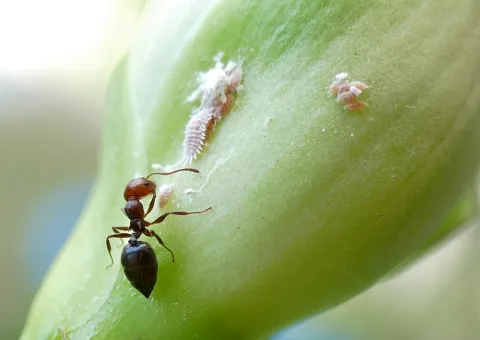
Diseases / Threats
Information
- Lifecycle
- Perennial
- Foliage
- Evergreen
- Exposures
- SunHalf-shade
- Categories
- IndoorHerbaceousHanging plants
- Tags
- BeginnerSmall pot
- Origin
- Central America
- Hardiness (USDA)
- 11a (4.4°C ≤ T° < 7.2°C)
- Leaf color
- Light green
- Flower colors
- RedViolet
Discover plants from the same family

Pink quill
Tillandsia cyanea

Spanish moss
Tillandsia usneoides
Find all our tips in the Monstera application