Ananas comosus var. microstachys, the dwarf pineapple
Ananas comosus var. microstachys
- Exposures
- Sun, Half-shade
- Hardiness (USDA)
- 11a (4.4°C ≤ T° < 7.2°C)
- Lifecycle
- Perennial
- Foliage
- Evergreen
- Family
- Bromeliaceae
- Genus
- Ananas
- Species
- Ananas comosus
Other names:Ananas nanus, Acanthostachys ananassoides, Ananas ananassoides, Ananas ananassoides var. typicus, Ananas comosus var. ananassoides, Ananas microstachys, Ananas microstachys var. typicus, Ananas sativus var. microstachys
If SpongeBob wanted to become a minimalist and live in a tiny house, he could easily move into an Ananas comosus var. Microstachys. This cultivar is a dwarf variety of Ananas comosus. It doesn't grow taller than 60 centimeters, and its fruit is smaller than a pen.
How can you recognize the dwarf pineapple (Ananas comosus var. Microstachys)?
A bushy herbaceous plant, Ananas comosus var. Microstachys measures barely 60 centimeters in height and 90 centimeters in spread.
Ananas comosus var. Microstachys forms a flared rosette of leaves. The foliage conceals the central stem, which supports the inflorescence and then the fruit.
The bright green leaves have spiny margins. Long and stiff, they resemble swords.
The small tubular flowers are clustered in a spike at the top of the stem. White in color, they have purple tips and are borne on pink bracts.
The yellow or golden fruit weighs no more than 100 grams. Conical in shape, it is crowned with green leaves. This miniature pineapple is edible. However, it is so small that it contains very little juice or flesh.
Ananas comosus var. Microstachys is not toxic. It is safe to touch or eat. Nevertheless, be careful when handling it! Its leaves can be sharp or prickly!
Our care tips
Ananas comosus var. Microstachys the plants sold in garden centers, with their fruit, are already mature. So you won't need to repot your plant. However, place the pot on a dish filled with moist clay balls to increase humidity.
 Watering
Water when the soil is dry, for about three centimeters. Use room-temperature, non-calcareous water, preferably rainwater. When watering, avoid wetting the leaves.
Thirty minutes after watering, drain off any stagnant water in the saucer. It may rot the roots.
To improve humidity, place your Ananas comosus var. Microstachys with your other plants or place its pot on a dish of moist clay balls.
 Misting
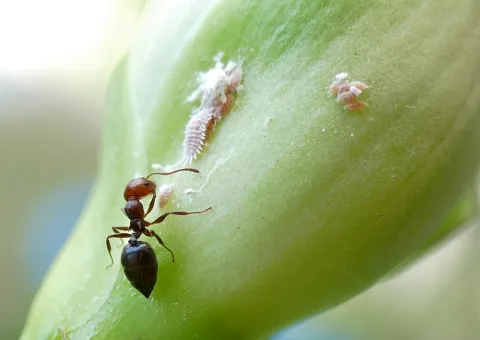
Spray foliage with non-calcareous water at room temperature. In addition to increasing humidity, misting prevents the appearance of undesirable insects.
 Repotting
Every year in the spring, repot your Ananas comosus var. Microstachys to give it more space.
Your Ananas comosus var. Microstachys likes to be cramped. Repot it into a pot with drainage holes that is barely larger than the root ball.
Line the bottom of the pot with a well-draining substrate. You can use potting mix for bromeliads or for cacti and succulents. You can also make your own growing medium by mixing equal parts:
- potting mix for houseplants;
- bark;
- coconut fiber;
- perlite;
- sphagnum moss.
Plant your Ananas comosus var. Microstachys in the center and add the substrate. Pack it down and water to encourage root growth.
Place your pot on a tray of moist clay pellets to improve humidity.
 Fertilization
To promote the growth of your Ananas comosus var. Microstachys, apply fertilizer in spring and summer.
Dilute green plant fertilizer with water.
 Cleaning
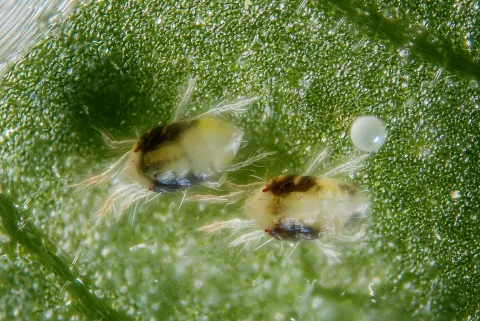
Clean the leaves with a clean wet sponge. This removes dust and improves photosynthesis. It's also a way of preventing mite infestations.
 Prune
To encourage the growth of your Ananas comosus var. Microstachys, prune regularly.
Remove yellowed leaves. They will not regain their color and are no longer useful to the plant. You can remove them by hand or with clean pruning shears.
 Taking cuttings
The best time to take cuttings is after your Ananas comosus var. Microstachys has bloomed.
Wait until the shoots are at least a third of the size of the main plant before removing them. Separate them with your hands or a clean, sharp instrument (pruning shears or scissors). Be sure to keep some roots for each cutting.
Prepare a pierced pot adapted to the size of your cutting.
Pour a layer of potting soil for cacti and succulents or for bromeliads into the bottom. You can also make your own growing medium by mixing equal parts of potting soil for green plants, bark, sphagnum moss, perlite and coconut fibre.
Plant your Ananas comosus var. Microstachys and add substrate. Tamp to remove air bubbles and water to encourage rooting.
Your plant appreciates humidity. Place the pot on a saucer filled with moist clay balls to increase humidity.
Diseases / Threats
Information
- Lifecycle
- Perennial
- Foliage
- Evergreen
- Exposures
- SunHalf-shade
- Substrates
- Humus soilSandy soil
- Planting method
- In pots
- Categories
- Fruit treeIndoorHerbaceous
- Tag
- Edible fruit
- Origin
- South America
- Hardiness (USDA)
- 11a (4.4°C ≤ T° < 7.2°C)
- Leaf color
- Light green
- Flower colors
- WhiteRoseViolet
- Fruit colors
- YellowBrown
Discover plants from the same family
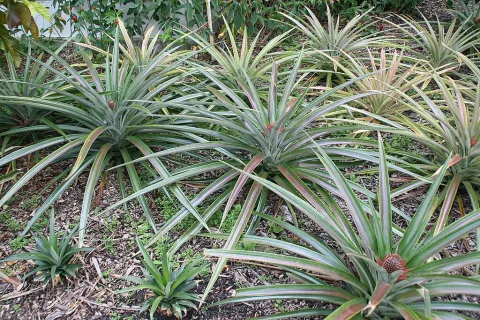

Ananas comosus bracteatus
Ananas comosus var. bracteatus

Pink quill
Tillandsia cyanea
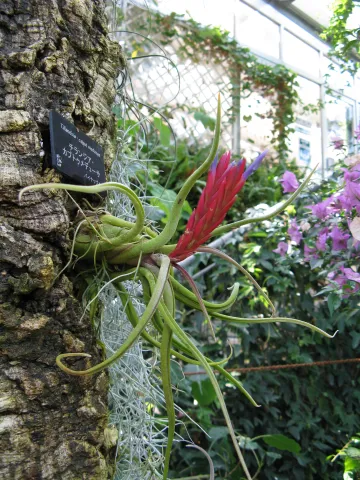
Medusa's head
Tillandsia caput-medusae
Find out more
Find all our tips in the Monstera application