Campsis radicans, the Virginia bignone
Campsis radicans
- Exposure
- Sun
- Hardiness (USDA)
- 8a (-12.2°C ≤ T° < -9.4°C)
- Lifecycle
- Perennial
- Foliage
- Deciduous
- Family
- Bignoniaceae
- Genus
- Bignone Campsis
- Species
- Virginia bignone Campsis radicans
Other names:Bignonia radicans, Gelseminum radicans, Tecoma radicans
While it is considered invasive in the southern United States, elsewhere the Virginia bignone (Campsis radicans) is grown in the garden as an ornamental plant. It is much sought-after for its colorful, nectar-bearing blooms.
How to recognize Virginia bignone (Campsis radicans)?
Virginia bignone (Campsis radicans) is a woody shrub with a climbing or upright habit. It forms a rounded clump measuring up to 5 meters in all directions.
Its brown-barked stems can reach 10 m. They have adventitious roots. Like spikes, they enable it to cling to a wall or support for climbing.
Although Virginia bignone is relatively fast-growing, don't count on it to form a hedge that will protect you from prying eyes. Indeed, its dark green foliage is deciduous. In autumn, the leaves, composed of 7 to 11 lanceolate leaflets, fall off.
The plant is best cultivated for its flowering. This takes place in summer and lasts until early autumn. Flowers bloom in clusters of 7 to 10 at the tips of the stems. The trumpet-shaped flowers, with their long tubular calyx, are usually orange. But some varieties have salmon-colored flowers or yellow margins. But color doesn't matter! The nectariferous bloom attracts butterflies and pollinators.
In October, the flowers wither and turn into brown pods, 7 to 10 cm long. Each pod contains around a hundred seeds, which are dispersed by the wind.
Is Virginia bignone (Campsis radicans) toxic?
Virginia bignone is toxic to humans and animals, as are the various hybrids it has given rise to Bignone Campsis × tagliabueanax tagliabuana in particular). Its sap is irritating and causes itching if it comes into contact with the skin. The whole plant (leaves, seeds, flowers) is also toxic if ingested.
Our care tips
Is your Campsis radicans wearing out and flowering less abundantly? Cut back the branches to 30 or 50 cm to give it a new lease of life.
 Watering
Virginia bignone needs a regular supply of water. But, like many plants, the plant cannot tolerate excess. Check that the potting soil has dried on the surface (two to three centimetres) before watering. If this is the case, use non-calcareous water at room temperature. You only need to moisten the root ball, not the soil.
Don't forget to drain off any stagnant water in the saucer or planter. It could rot the roots.
 Repotting
Install your Campsis radicans in a perforated pot. You can add a bed of clay balls or gravel to optimize drainage.
If you have provided a trellis or stake, you can arrange it in the pot now.
Line the bottom of your container with a draining substrate. You can use universal potting soil or garden soil with a few handfuls of sand.
Plant your Campsis radicans. If you want your plant to climb a wall or tree, orient the root ball towards the support. Add substrate, but stop a few centimetres before the edge, to form a watering trough.
Guide the vines towards their support. Pack and water generously to remove air bubbles and encourage rooting.
 Fertilization
To promote the growth of your Campsis radicans, apply fertilizer in spring and summer.
Apply flowering plant fertilizer to stimulate flowering.
To promote the growth of your Campsis radicans, apply fertilizer in spring and summer.
Apply a dose of compost at the foot of the plant.
 Prune
Prune
Your Campsis radicans is a vigorous plant. You don't have to prune it, but it will prevent the plant from becoming invasive.
Locate the main branches that form the structure against the wall, pergola or support. You don't need to prune them, unless you want to rebalance the silhouette.
Instead, remove
- Dead or weak branches;
- Branches that intertwine in the center and block light;
- Stems growing in the wrong direction;
- Shoots at the base, if you want to control development.
Your Campsis radicans blooms on this year's shoots. You can therefore cut back the previous year's lateral stems (which have already flowered) above the 2nd or 3rd bud without compromising flowering.
Always use a clean, sharp tool to facilitate healing and prevent the spread of disease.
 Planting
When the risk of frost has passed, it's time to plant.
Soak the root ball of your Campsis radicans to rehydrate it. Leave it in the water until there are no more air bubbles.
Dig a hole 40 cm deep. You can place clay balls or gravel at the bottom for better drainage.
Plant your Campsis radicans, with the surface of the root ball level with the ground. Fill in with garden soil. You can add a little sand if your soil is heavy.
Guide the stems on their supports to show them the way.
Mulch the soil to keep the stems cool. Tamp and water to encourage rooting.
 Taking cuttings
Cutting is carried out during the strong growth phase, generally in spring and early summer.
Locate a healthy, flowerless stem. It should be semi-woody, but still flexible.
Cut a ten- to fifteen-centimetre section just below a node. Use clean, sharp secateurs to facilitate healing.
Remove the lower leaves and keep only the upper pair.
Pour potting soil into a bucket. Plant your cutting in the center.
Cover with a transparent bag or place in a mini greenhouse. Propagation works best under cover. Set up in a bright room with a temperature of at least 20°.
Mist the substrate to keep it moist, and aerate for a few minutes a day.
Frequently asked questions
Does the bignone lose its leaves in winter?
Most bignone varieties have deciduous foliage and lose their leaves in winter. There are, however, some evergreen species, such as the bignone with tendrils(Bignonia capreolata).
Why isn't my bignone blooming?
The bignone flowers when it is at least 3 or 4 years old. If your plant doesn't flower, it's probably because it's too young. Other reasons, such as poor soil or lack of light, may also explain the absence of flowering. Finally, bignone flowers on the current year's branches. Pruning too late can prevent flowers from appearing.
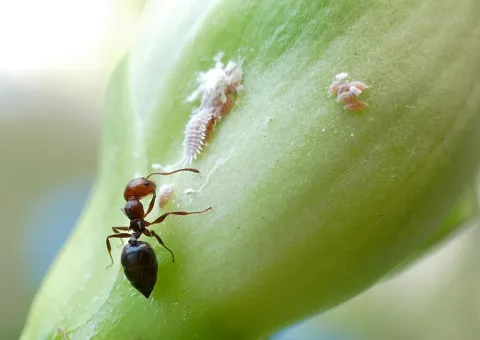
Diseases / Threats
Information
- Lifecycle
- Perennial
- Foliage
- Deciduous
- Exposure
- Sun
- Substrates
- Calcareous earthHumus soilSandy soil
- Planting methods
- Open groundIn potsIn tubs
- Tags
- BeginnerInvasiveFloweryToxic
- Origin
- North America
- Hardiness (USDA)
- 8a (-12.2°C ≤ T° < -9.4°C)
- Leaf color
- Dark green
- Flower color
- Orange
- Fruit color
- Brown
Discover plants from the same family
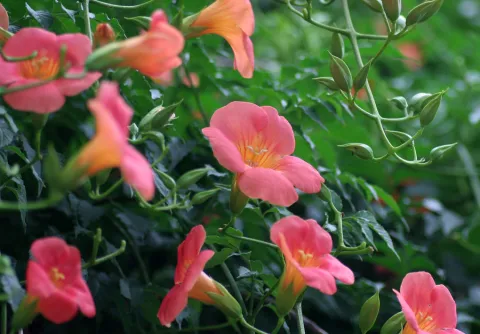
Chinese bignone
Campsis grandiflora
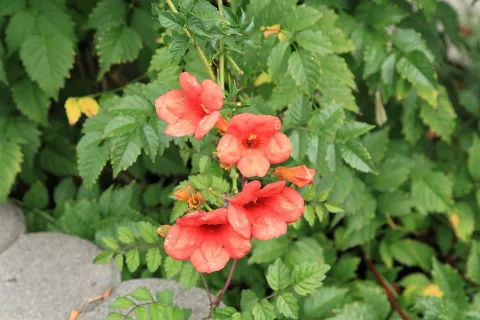
Bignone Campsis × tagliabueana
Campsis × tagliabueana
Find out more
Find all our tips in the Monstera application