Flowers Japanese honeysuckle Lonicera japonica

Yellow-white flowers Japanese honeysuckle Lonicera japonica

Honeysuckle leaf Lonicera Japonica

Toxic black berries honeysuckle Lonicera japonica

Japanese honeysuckle Lonicera japonica
Contents
Find all our tips in the Monstera application


Japanese honeysuckle, the tree of gold and silver
Contents
Find all our tips in the Monstera application
Scientific classification
Family
Caprifoliaceae
Type
Honeysuckle - Lonicera
Species
Japanese Honeysuckle - Lonicera japonica
Other names:Caprifolium japonicum, Nintooa japonica, Caprifolium brachypodum, Caprifolium chinense, Lonicera brachypoda, Lonicera aureoreticulata, Lonicera chinensis
Japanese honeysuckle (in Latin, Lonicera japonica) perfumes our summer evenings with its citrusy blossoms. This plant, which grows wild in China, Japan, Korea and Taiwan, belongs to the Caprifoliaceae family.
How to recognize Japanese honeysuckle (Lonicera japonica)?
Japanese honeysuckle is a climbing shrub with a flexible, spreading habit. Highly branched, it can reach up to 10 meters in height and spread.
Its voluble stems wrap easily around all kinds of supports (trees, fences, trellises). In the wild, they can even choke neighboring plants. The young, reddish, slightly pubescent branches contrast with the older, brownish, hollow branches.
Japanese honeysuckle retains its green foliage allyear roundin mild climates. Elsewhere, it is semi-evergreen. The oval to lanceolate leaves are 3 to 8 cm long and 2 to 4 cm wide. Fine hairs grow on the vein and underside of the leaf blade.
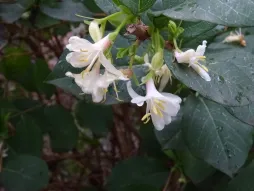
Japanese honeysuckle blooms from May to October, in three successive waves. Highly fragrant, its scent is similar to that of orange blossom, attracting bees and pollinating insects. The slender, elongated tubular flowers feature a conical calyx, oval bracts and long, protruding stamens. As with wood Honeysuckle (Lonicera periclymenum subsp. Periclymenum), their color changes over time: white when they first open, they gradually turn yellow.
After flowering, globular berries appear, first green, then black when ripe.
Is Japanese honeysuckle toxic?
The toxicity of Japanese honeysuckle (Lonicera) remains poorly documented. It is strongly recommended not to eat the plant, and to remain vigilant in the presence of young children and pets.
While the berries can be eaten without danger by birds, they are toxic to humans and most animals. Ingestion can cause digestive problems of varying severity: diarrhoea, stomach ache, nausea or vomiting.
It would appear, however, that climbing honeysuckles, such as Japanese honeysuckle, are less harmful than certain shrubby species.
Our maintenance tips
If your Lonicera japonica is balding, prune it severely at the beginning of winter. The plant will recover in spring.
 Watering
Water the base of your Lonicera japonica when the soil has dried by about three centimetres. Your plant likes rainwater, but will also tolerate mains water.
Don't let water stagnate in the planter or saucer. It will rot the roots.
 Repotting
In spring, transfer your Lonicera japonica to a larger pot, so that it can continue to grow.
Get a tub or pot with holes at least 50 centimetres deep. You can place clay balls or gravel at the bottom to optimize drainage.
Pour in a layer of universal potting soil. A mixture of garden soil and planting mix may also be suitable. Plant your Lonicera japonica. Add substrate, compact and water generously.
Your Lonicera japonica is a climber. Give it something to climb on (pergola, trellis, fence). Guide the branches along the support to show them the way.
Re-pot your plant to give it more space and stimulate growth.
Get a pierced pot suitable for the size of your cutting. You can make a drainage layer at the bottom with clay balls or gravel. Fill your pot with potting soil for seedlings and plantations. Plant your cutting and water generously.
If you're growing your plant as a climber and its size allows it, install your support and guide the branches to show them the way.
If you're growing your plant as a climber and its size allows it, install your support and guide the branches to show them the way.
 Fertilization
You can stimulate the growth of your plant during its growth phase, in spring and summer, with fertilizer.
Fertilize your Japanese honeysuckle every month. Use a flowering plant fertilizer to stimulate flowering.
 Prune
Prune
Using shears or pruning shears, cut back dead, diseased or damaged branches.
If your Lonicera japonica is very dense, you can also remove the most tangled branches to control the shape and let light penetrate to the heart of the plant.
Finally, prune flower-bearing branches to encourage new growth. Always cut above a bud or group of healthy leaves.
 Plantation
A few days before planting, prepare the soil over an area approximately four times the size of the root ball of your Lonicera japonica:
- Spade ;
- Remove stones and weeds;
- Add compost and universal potting soil to enrich the soil.
Soak the root ball of your Lonicera japonica to rehydrate it. Dig a hole slightly deeper than the root ball. If you've provided a trellis or stake for your plant to climb, install it now.
Plant your Lonicera japonica. The surface of the rootball should be flush with the ground. Fill in, compact and water. Guide the stems over the support to help them climb.
If you're planting several specimens, to make a hedge, for example, it's advisable to spacethem at least 50 centimetres apart andplant only one plant per square metre.
 Cutting
Choose a healthy, vigorous branch of the year, about 20 centimeters long. It should have at least two layers of leaves.
Using a clean, sharp tool, prune flush with the lower leaves. Remove them. Prune a centimetre above the top leaves.
Pour a mixture of potting soil and sand into a pot whose hole has been plugged with a pebble. Push half the stem of your cutting into the center without watering.
Place the pot in a mini greenhouse; if you don't have one, you can cover the plant with a translucent bag or a cut bottle. Place your graft in a bright spot, without direct sunlight.
Every day, aerate for a few minutes to drain off condensation and mist.
Every day, aerate for a few minutes to drain off condensation and mist.
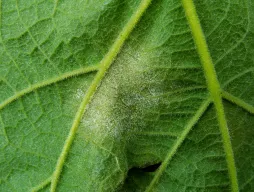
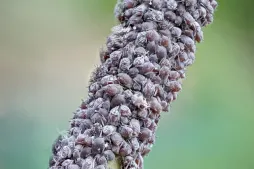
Diseases / Threats
Information
| Lifecycle | Perennial |
| Foliage | Semi-evergreen |
| Exposures | |
| Substrat | |
| Planting methods |
Open ground In pots In tubs |
| Categories | |
| Tags |
Beginner Flowery Rustic Toxic |
| Origin |
East Asia |
| Hardiness (USDA) | 7b (-15°C ≤ T° < -12.2°C) |
| Leaf color |
|
| Flower colors |
|
| Fruit colors |
|
Discover plants from the same family
Winter honeysuckle
Discover
Lonicera nitida
Discover
Wood honeysuckle
Discover
Tartarian honeysuckle
Discover
Find out more