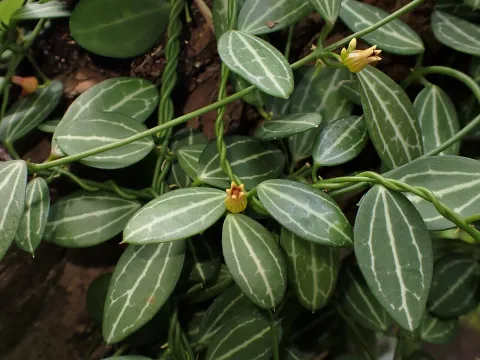
Dischidia nummularia, with leaves like coins
Dischidia nummularia
- Exposure
- Half-shade
- Hardiness (USDA)
- 11b (7.2°C ≤ T° < 10°C)
- Lifecycle
- Perennial
- Foliage
- Evergreen
- Family
- Apocynaceae
- Genus
- Dischidia
- Species
- Dischidia nummularia
Other names:Dischidia nummularia var. gracilis, Dischidia nummularia var. minor, Dischidia nummularia var. orbicularis, Dischidia nummularia var. rhombifolia
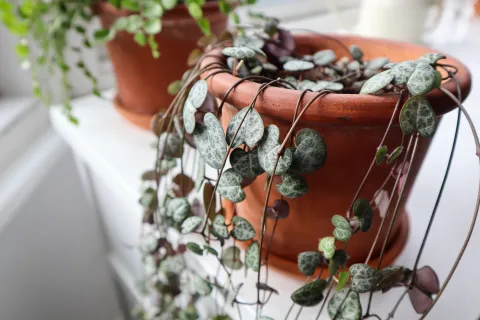
Its thousands of small leaves, round like coins, have earned it the name “String of Nickels” in the United States. Native to China, India, and Australia, this plant from the Apocynaceae family is a cousin of the Hoya kerrii.
How can you identify Dischidia nummularia?
Dischidia nummularia can grow up to 1.20 m tall with a spread of 40 cm. This epiphytic perennial develops long, climbing stems, which can also be grown as hanging plants.
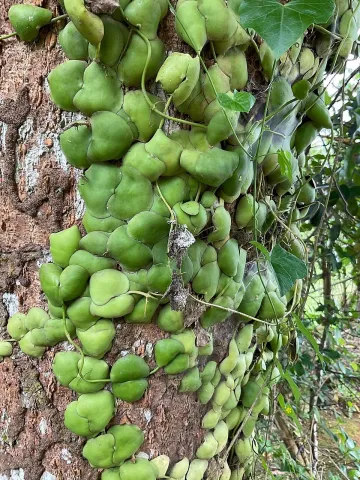
While the leaves of Dischidia ovata resemble tiny watermelons, those of Dischidia nummularia resemble lentils or coins. Jade-green, round, flat, and fleshy, they do not exceed 1.5 cm in diameter. The leaves almost completely cover the green stems, so numerous and densely arranged are they.
Flowering requires a significant temperature difference between day and night, as with the Snail Plant (Dischidia vidalii). It therefore rarely flowers indoors. In the wild, small white flowers bloom.
Is Dischidia nummularia toxic?
There is little information available on the toxicity of Dischidia nummularia. It is believed to be slightly toxic to animals. If in doubt, prevent your dog or cat from nibbling on the plant, and wear gloves when pruning or repotting.
Our care tips
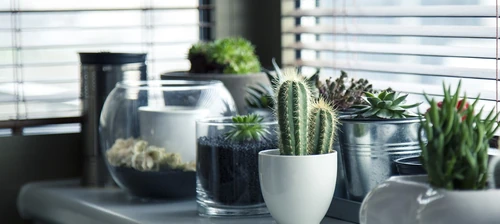
Your Dischidia nummularia thrives in humidity. That's why the plant is often sold in a glass vase to increase humidity. Be sure to clean it regularly so the plant gets enough light.
 Watering
Fill a large container with room-temperature water, then submerge your Dischidia nummularia's pot in it for 10 minutes. Remove it afterward and let the excess water drain completely before returning the plant to its place.
 Misting
Spray foliage with water at room temperature. Do not use tap water. It is often too hard and leaves marks on the leaves.
Misting temporarily increases humidity and combats the appearance of pests.
 Repotting
In spring, transfer your Dischidia nummularia to a larger pot, so that it can continue to grow.
Dischidia nummularia are epiphytic plants. You can grow them in a light, well-draining substrate such as sphagnum moss or a mix for epiphytic plants. You can also create your own growing substrate using:
- Potting mix for houseplants or for cacti and succulents;
- Pine bark or coconut fiber;
- Perlite or river sand.
Always use a pot with drainage holes so that excess water can drain out during watering. Place a layer of substrate at the bottom, set your Dischidia nummularia in place, then fill in with the rest of the mixture. Gently pack it down and water your plant thoroughly.
 Fertilization
You can stimulate the development of your plant during its growth phase, in spring and summer, with fertilizer.
You can also fertilize your Dischidia nummularia by adding a dose of orchid fertilizer to its watering bath.
 Prune
Dischidia nummularia Do not require pruning. Simply remove any yellowing leaves.
However, you can prune the plant to control its shape and growth. Shorten the stems using a clean, sharp tool.
 Taking cuttings
Propagation by cuttings is carried out during the strong growth phase, generally in spring and early summer.
Using a clean, sharp tool such as scissors or pruning shears, remove a ten- to fifteen-centimeter stem. Cut between two nodes and remove the leaves, leaving only the top pair.
Fill a pot with drainage holes with a growing medium suitable for epiphytic plants, then gently place your cutting inside.
Lightly pack the mixture around the cutting and water it thoroughly to ensure the potting mix is well moistened. Finally, place your cutting in a bright spot to stimulate its growth and promote root development.
Information
- Lifecycle
- Perennial
- Foliage
- Evergreen
- Exposure
- Half-shade
- Substrate
- Humus soil
- Planting methods
- In potsIn tubsPlanter
- Categories
- ClimberHanging plants
- Tag
- Beginner
- Origins
- Southeast AsiaAustralia
- Hardiness (USDA)
- 11b (7.2°C ≤ T° < 10°C)
- Leaf color
- Light green
- Flower color
- White
Discover plants from the same family
Find out more
Find all our tips in the Monstera application