Dischidia platyphylla, the ant plant
Dischidia platyphylla
- Exposure
- Half-shade
- Hardiness (USDA)
- 12b (12.8°C ≤ T° < 15.6°C)
- Lifecycle
- Perennial
- Foliage
- Evergreen
- Family
- Apocynaceae
- Genus
- Dischidia
- Species
- Dischidia platyphylla
In the Philippines, Dischidia platyphylla is a veritable bed-and-breakfast for ants. The oldest leaves serve as a refuge for the insects, and the nectar from the flowers is their favorite meal. Indoors, it's unlikely your plant will be quite so popular. But it will still delight you with its dense, colorful foliage.
How can you identify Dischidia platyphylla?
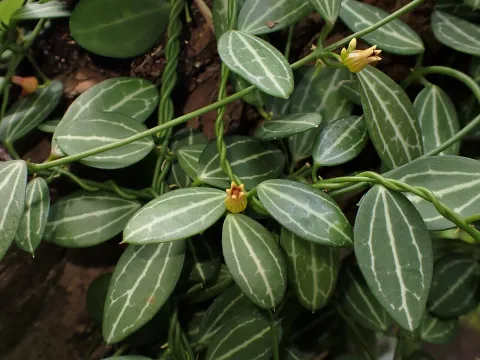
Dischidia platyphylla is a perennial epiphytic plant. It develops long, flexible, branching stems that can exceed 1.8 meters in length. If you're looking for a compact plant, look elsewhere and opt instead for Dischidia nummularia or Dischidia ovata!
The slender, fleshy stems have nodes and aerial roots. These highly branched vines are covered with green leaves that are purple on the underside. Round and flattened, they overlap along the stems and resemble roof tiles or shingles. They can measure up to 4 cm in diameter. Some of the older leaves turn into veritable shelters for ants, which can build their nests there.
In addition to providing shelter, Dischidia platyphylla also offers food to the insects. The clusters of white or cream-colored flowers produce nectar that is highly prized by ants. By visiting the flowers, the ants help with pollination.
Is Dischidia platyphylla toxic?
Dischidia platyphylla is not known to be toxic to animals or humans. However, like other plants in the Apocynaceae family, it produces a milky sap that can be irritating if it comes into contact with the skin or eyes. As a precaution, wear gloves when pruning and wash your hands after handling the plant.
Our care tips
Your Dischidia platyphylla thrives in humidity. That's why the plant is often sold in a glass vase to increase humidity. Be sure to clean it regularly so the plant gets enough light.
 Watering
Fill a large container with room-temperature water, then submerge your Dischidia platyphylla's pot in it for 10 minutes. Remove it afterward and let the excess water drain completely before returning the plant to its place.
 Misting
In its natural environment, dischidia platyphylla benefits from a high level of humidity. To reproduce its environment, mist the foliage with non-calcareous water at room temperature. Regular spraying also combats pest attacks.
 Repotting
Every year in the spring, repot your Dischidia platyphylla to give it more space.
Dischidia platyphylla are epiphytic plants. You can grow them in a light, well-draining substrate such as sphagnum moss or a mix for epiphytic plants. You can also create your own growing substrate using:
- Potting mix for houseplants or for cacti and succulents;
- Pine bark or coconut fiber;
- Perlite or river sand.
Always use a pot with drainage holes so that excess water can drain out during watering. Place a layer of substrate at the bottom, set your Dischidia platyphylla in place, then fill in with the rest of the mixture. Gently pack it down and water your plant thoroughly.
 Fertilization
To promote the growth of your Dischidia platyphylla, apply fertilizer in spring and summer.
You can also fertilize your Dischidia platyphylla by adding a dose of orchid fertilizer to its watering bath.
 Prune
Dischidia platyphylla Do not require pruning. Simply remove any yellowing leaves.
However, you can prune the plant to control its shape and growth. Shorten the stems using a clean, sharp tool.
 Taking cuttings
Propagation by cuttings is carried out during the strong growth phase, generally in spring and early summer.
Select a healthy stem with leaves. Separate it from the mother plant using a clean, sharp instrument.
Remove the leaves at the base.
Fill a pot with drainage holes with a growing medium suitable for epiphytic plants, then gently place your cutting inside.
Lightly pack the mixture around the cutting and water it thoroughly to ensure the potting mix is well moistened. Finally, place your cutting in a bright spot to stimulate its growth and promote root development.
Lightly pack the mixture around the cutting and water it thoroughly to ensure the potting mix is well moistened. Finally, place your cutting in a bright spot to stimulate its growth and promote root development.
Information
- Lifecycle
- Perennial
- Foliage
- Evergreen
- Exposure
- Half-shade
- Substrate
- Humus soil
- Planting methods
- In potsIn tubsPlanter
- Categories
- ClimberHanging plants
- Tag
- Beginner
- Origin
- Southeast Asia
- Hardiness (USDA)
- 12b (12.8°C ≤ T° < 15.6°C)
- Leaf color
- Light green
- Flower colors
- Light greenViolet
Discover plants from the same family

Find all our tips in the Monstera application








