Dischidia ovata, with leaves that look like watermelon slices
Dischidia ovata
- Exposure
- Half-shade
- Hardiness (USDA)
- 12a (10°C ≤ T° < 12.8°C)
- Lifecycle
- Perennial
- Foliage
- Evergreen
- Family
- Apocynaceae
- Genus
- Dischidia
- Species
- Dischidia ovata
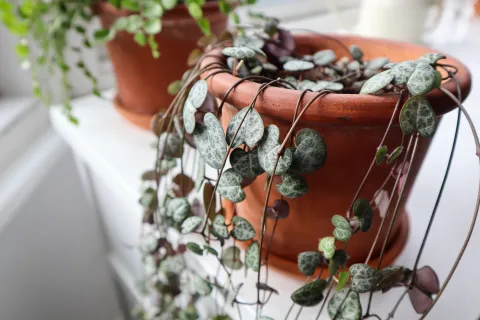
Peperomia Watermelon (Peperomia argyreia) isn't the only plant with foliage that looks like a watermelon! On the other side of the world, in Australia, grows Dischidia ovata. This variety of the Apocynaceae family has small green leaves striped with white that resemble the rind of the sweet fruit.
How can you recognize Dischidia ovata?
Dischidia ovata is a perennial epiphyte or lithophyte. Its climbing or trailing vines grow up to 90 cm long.
The green, twining stems cling to surfaces as they grow.
The oval, thick, and leathery leaves are no more than 5 cm long by 3 cm wide. They are green and crisscrossed with white veins. This pattern makes them resemble watermelon rind and has earned Dischidia ovata the nickname “watermelon Dischidia” or “Dischidia Watermelon.” The foliage takes on a pinkish or reddish hue when exposed to plenty of light.
The flowers grow in umbels of small cream or white blooms.
Is Dischidia ovata toxic?
Dischidia ovata is toxic, particularly to pets. Ingestion causes vomiting and diarrhea.
The plant also poses a risk upon contact. Its sap can cause skin irritation or burns to the mucous membranes. Wear gloves when pruning or repotting your plant.
Our care tips
Your Dischidia ovata thrives in humidity. That's why the plant is often sold in a glass vase to increase humidity. Be sure to clean it regularly so the plant gets enough light.
 Watering
Fill a large container with room-temperature water, then submerge your Dischidia ovata's pot in it for 10 minutes. Remove it afterward and let the excess water drain completely before returning the plant to its place.
 Misting
Spraying foliage with non-calcareous water (e.g. Mineral water or rainwater) helps to maintain humidity levels.
 Repotting
Every year in the spring, repot your Dischidia ovata to give it more space.
Dischidia ovata are epiphytic plants. You can grow them in a light, well-draining medium such as sphagnum moss or a mix for epiphytic plants. You can also create your own growing medium using:
- Potting mix for houseplants or for cacti and succulents;
- Pine bark or coconut fiber;
- Perlite or river sand.
Always use a pot with drainage holes so that excess water can drain out. Place a layer of growing medium at the bottom, set your Dischidia ovata in place, then fill in with the rest of the mixture. Gently pack it down and water your plant thoroughly.
 Fertilization
To promote the growth of your Dischidia ovata, apply fertilizer in spring and summer.
You can also fertilize your Dischidia ovata by adding a dose of orchid fertilizer to its watering bath.
 Prune
Dischidia ovata Do not require pruning. Simply remove any yellowing leaves.
However, you can prune the plant to control its shape and growth. Shorten the stems using a clean, sharp tool.
 Taking cuttings
Cutting is carried out during the strong growth phase, generally in spring and early summer.
Take branches about fifteen centimeters long. Remove leaves and flowers from the lower half of the stem.
Fill a pot with drainage holes with a growing medium suitable for epiphytic plants, then gently place your cutting inside.
Lightly pack the mixture around the cutting and water it thoroughly to ensure the potting mix is well moistened. Finally, place your cutting in a bright spot to stimulate its growth and promote root development.
Lightly pack the mixture around the cutting and water it thoroughly to ensure the potting mix is well moistened. Finally, place your cutting in a bright spot to stimulate its growth and promote root development.
Information
- Lifecycle
- Perennial
- Foliage
- Evergreen
- Exposure
- Half-shade
- Substrate
- Humus soil
- Planting methods
- In potsIn tubsPlanter
- Categories
- ClimberHanging plants
- Tag
- Beginner
- Origins
- Southeast AsiaOceania
- Hardiness (USDA)
- 12a (10°C ≤ T° < 12.8°C)
- Leaf colors
- Light greenWhite
- Flower colors
- WhiteCream
Discover plants from the same family


Find all our tips in the Monstera application








