Goeppertia concinna, Calathea leopardina
Goeppertia concinna
- Exposures
- Half-shade, Shade
- Hardiness (USDA)
- 12a (10°C ≤ T° < 12.8°C)
- Lifecycle
- Perennial
- Foliage
- Evergreen
- Family
- Marantaceae
- Genus
- Goeppertia
- Species
- Goeppertia leopardina Goeppertia concinna
Other names:Calathea concinna, Calathea leopardina var. concinna, Maranta concinna, Calathea chantrieri, Maranta chantrieri, Maranta leopardina, Phyllodes leopardina
Leopard is in, and not just on our clothes. Plants are getting in on the act too! Calathea leopardina (Latin: Goeppertia concinna), a plant native to Brazil, has a mottled pattern on its leaves that imitates the animal's fur.
How to recognize Calathea leopardina (Goeppertia concinna)?
Goeppertia concinna is an upright perennial. At maturity, Calathea leopardina measures 70 centimetres in height and 40 centimetres in spread.
Leaves fan out from a central stem. They are borne by a long stalk, as in calathea 'Medallion (Goeppertia veitchiana).
Elliptical leaves can reach 30 cm in length. The underside of the foliage is purple, while the upper surface is adorned with spots reminiscent of a leopard's coat. The bright green leaf blade is speckled with dark green on either side of the midrib.
Goeppertia concinna is a praying plant. When the sun goes down, the leaves change position from horizontal to vertical. This phenomenon, known as nyctinasty, is observed in many varieties of the Marantaceae family. It occurs thanks to the pulvinus, an organ located at the base of the leaf.
Calathea leopardina is cultivated for its decorative evergreen foliage. The plant rarely flowers indoors. In its native rainforests, it produces a spike of yellow or cream flowers.
Calathea leopardina is not toxic on contact or ingestion. You can grow it without risk and handle it without having to wear gloves.
Our care tips
Not very demanding, your Goeppertia concinna is content with a location without direct sunlight and plenty of humidity.
 Watering
Calathea leopardina fear excess water. To prevent root rot, allow the substrate to dry between waterings and remove any stagnant water from the saucer.
Water the soil preferably with rainwater. The soil should be moist but not soggy.
 Misting
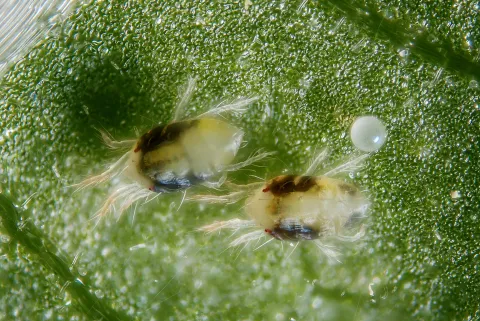
Calathea leopardina love humidity. Spray their foliage to increase humidity and combat pest invasion.
 Repotting
In spring, transfer your Goeppertia concinna to a larger pot, so that it can continue to grow.
Choose a pierced pot one-third larger than the previous one. Choose width rather than height to allow roots to develop. Choose a plastic or ceramic container rather than a clay one. The latter tend to absorb water more quickly.
Install a bed of clay balls and cover it with potting soil for indoor plants. Don't hesitate to mix in some perlite to optimize drainage. Then place the rootball and add potting soil until you reach a centimetre or two below the rim of the pot. Tamp down to avoid air bubbles.
 Fertilization
You can stimulate the development of your plant during its growth phase, in spring and summer, with fertilizer.
Dilute a liquid fertilizer for green plants with water.
 Cleaning
Remove dust from foliage with a clean, damp cloth. This will enable your plant to take full advantage of the sunlight.
 Prune
Prune
To remove yellowed, damaged or wilted leaves, cut them off at the base with a sharp, clean tool.
 Taking cuttings
Cutting is carried out during the strong growth phase, generally in spring and early summer.
Carefully dig up the plant. Observe its root system and locate the individual plants. Separate them, always keeping a stem with its leaves and roots.
Division can be done by hand. But if the roots are too tangled, you can cut them with a clean, sharp tool.
Get a pot with holes to suit the size of your seedlings. Line the bottom with clay balls or gravel to improve drainage.
Pour in a rich, light substrate, such as potting soil, and plant your cuttings. To help you, you can use a pencil to form a pilot hole.
Water to encourage rooting and eliminate air bubbles.
Diseases / Threats
Information
- Lifecycle
- Perennial
- Foliage
- Evergreen
- Exposures
- Half-shadeShade
- Substrate
- Humus soil
- Planting method
- In pots
- Categories
- IndoorRhizomeHerbaceous
- Tags
- Cold-sensitiveThirsty
- Origin
- South America
- Hardiness (USDA)
- 12a (10°C ≤ T° < 12.8°C)
- Leaf colors
- Dark greenLight green
- Flower colors
- YellowCream
Discover plants from the same family
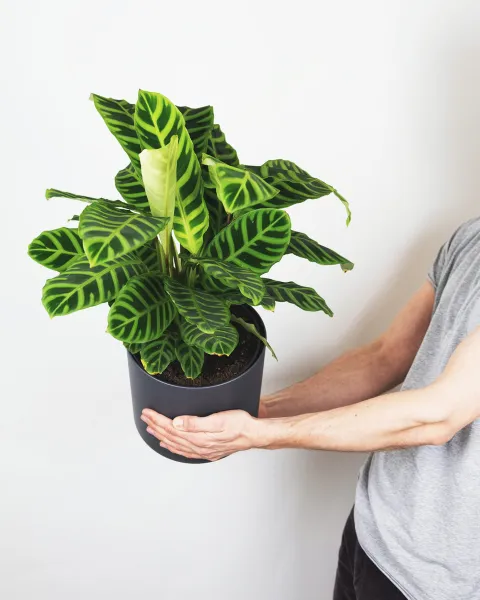
Zebra Calathea
Goeppertia zebrina
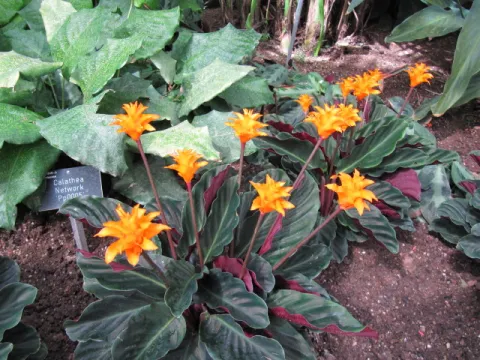
Calathea crocata
Goeppertia crocata
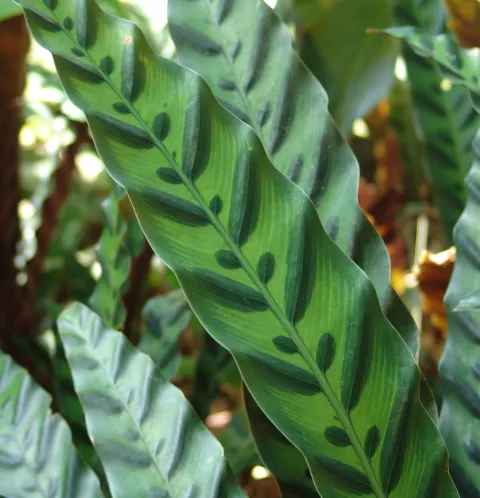
Calathea lancifolia
Goeppertia lancifolia
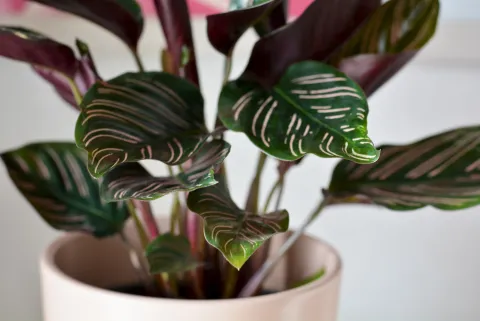
Calathea ornata
Goeppertia ornata
Find out more
Find all our tips in the Monstera application