Goeppertia crocata, flowering Calathea
Goeppertia crocata
- Exposures
- Half-shade, Shade
- Hardiness (USDA)
- 12a (10°C ≤ T° < 12.8°C)
- Lifecycle
- Perennial
- Foliage
- Evergreen
- Family
- Marantaceae
- Genus
- Goeppertia
- Species
- Goeppertia crocata
Goeppertia crocata or Calathea saffron belongs to the Marantaceae family. It grows in the tropical forests of South and Central America. Although this rhizomatous plant has luxuriant foliage, like that of alocasia zebrina, it is above all its flowers that set it apart.
How to recognize Goeppertia crocata?
This perennial grows to between 50 and 70 centimetres, with a dense, bushy habit. Its upright stems support the evergreen foliage typical of saffron Calathea.
With its oblong, purple leaves on the underside, flowering Goeppertia is sometimes confused with goeppertia makoyana. But the dark green blades are streaked rather than spotted, unlike those of the peacock plant.
Goeppertia crocata foliage brightens up our interiors all year round. However, it's in spring and summer, when it blooms, that the plant reveals all its beauty. Saffron-yellow or orange bracts appear at the end of the rigid petiole. These enclose the true flower, a compact spike of red or pink. Although in the tropics, Calathea saffron blooms every year, it takes some effort to get it to bloom again outside its natural environment.
In addition to its ornamental qualities, Goeppertia crocata is said to have pollution-removing properties. Another special feature: when night falls, the plant folds its leaves with a rustling sound. It unfurls them again when the sun rises.
Our care tips
Not very demanding, your Goeppertia crocata is content with a location without direct sunlight and plenty of humidity.
 Watering
Your Calathea crocata likes its soil to be moist. But it hates excess water. Water when the surface of the substrate is dry (about a centimetre).
Use room-temperature, non-calcareous water, such as rainwater.
Drain any water that collects in the saucer or planter. It may rot the roots.
 Misting
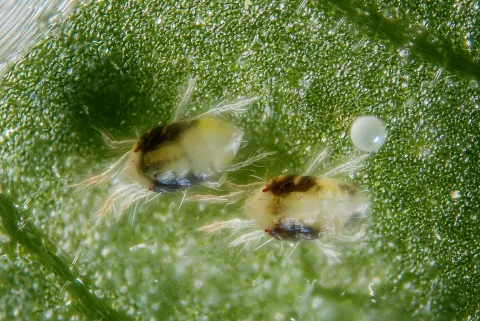
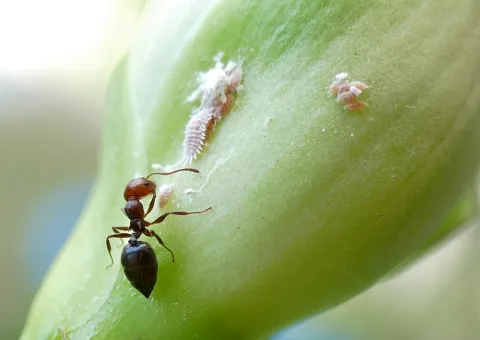
Spray foliage with non-calcareous water at room temperature. In addition to increasing humidity, misting prevents the appearance of undesirable insects.
 Repotting
Every year in the spring, repot your Goeppertia crocata to give it more space.
Obtain a pierced pot of a larger size than the previous one. Don't hesitate to choose a ceramic or plastic model. These materials retain moisture and allow you to space out watering. Your Calathea crocata also prefers a wide pot to a deep container to give it room to grow.
Line the bottom with gravel or clay balls for drainage. Then pour in potting soil for green plants. You can lighten it by adding perlite.
Plant your subject in the middle and fill in with substrate. Water for the first time to eliminate air bubbles and encourage rooting.
 Fertilization
To promote the growth of your Goeppertia crocata, apply fertilizer in spring and summer.
During the growing season, feed your Goeppertia crocata with fertilizer for green plants.
 Cleaning
Dust sometimes accumulates on the leaves of your Calathea crocata and interferes with photosynthesis.
You can gently clean the foliage with a sponge or a clean, wet cloth.
If your plant looks dirty, you can add some black soap to the water.
You can gently clean the foliage with a sponge or a clean, wet cloth.
If your plant looks dirty, you can add some black soap to the water.
 Prune
Cut back dry stems and wilted leaves. You can use a pair of scissors or pruning shears. Remember to clean them beforehand to prevent the spread of disease.
 Taking cuttings
Propagation by cuttings is carried out during the strong growth phase, generally in spring and early summer.
Carefully dig up your plant. Locate a rhizome with roots and several leaves on its periphery.
Carefully separate it from the others using your hands or a clean, sharp tool.
In a pierced pot, pour a layer of clay balls for drainage. Add potting soil for seedlings and planting.
Using a pencil, make a pilot hole and plant your cutting.
Water at room temperature to help the plant take root.
Diseases / Threats
Information
- Lifecycle
- Perennial
- Foliage
- Evergreen
- Exposures
- Half-shadeShade
- Substrate
- Humus soil
- Planting method
- In pots
- Categories
- IndoorRhizomeHerbaceousFlowery
- Tag
- Thirsty
- Origins
- Central AmericaSouth America
- Hardiness (USDA)
- 12a (10°C ≤ T° < 12.8°C)
- Leaf colors
- Dark greenPurple
- Flower colors
- YellowOrange
Discover plants from the same family
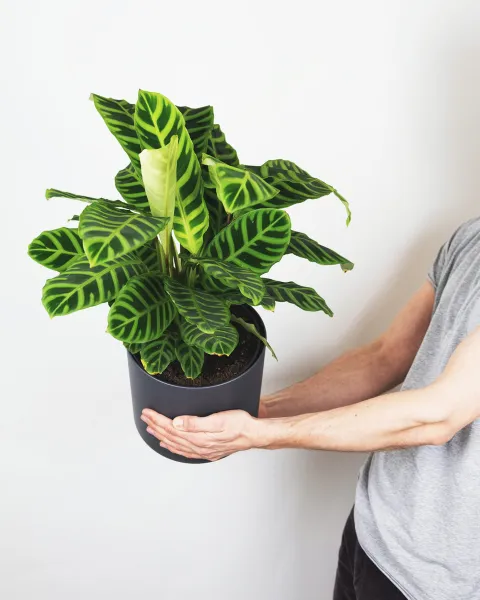
Zebra Calathea
Goeppertia zebrina
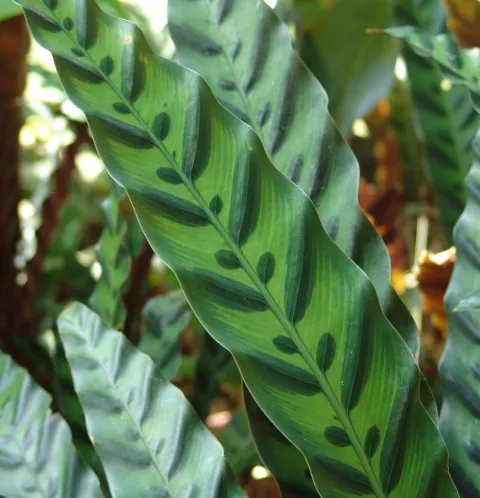
Calathea lancifolia
Goeppertia lancifolia
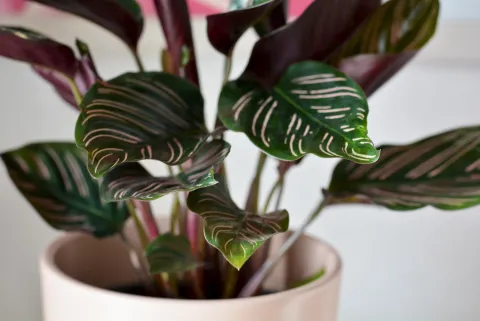
Calathea ornata
Goeppertia ornata
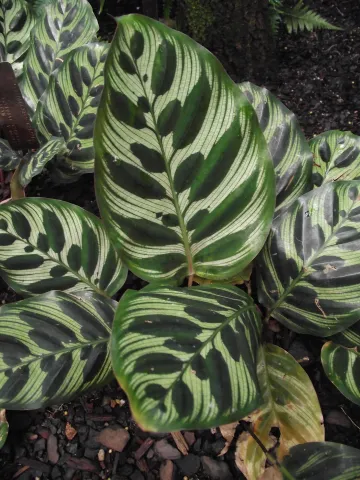
Calathea makoyana
Goeppertia makoyana
Find out more
Find all our tips in the Monstera application








