Climbing star jasmine

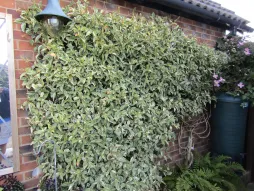
Star jasmine in a bed

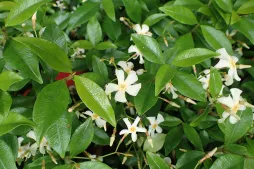
White star jasmine flowers

Star jasmine leaves
Contents
Find all our tips in the Monstera application


Trachelospermum jasminoides, the star jasmine
Contents
Find all our tips in the Monstera application
Scientific classification
Family
Apocynaceae
Type
Trachelospermum
Species
Star jasmine - Trachelospermum jasminoides
Other name:Rhyncospermum jasminoides
In life, appearances are often deceiving. In botany, you almost always have to beware of names! Star jasmine, whose real name is Trachelospermum jasminoides, does not belong to the Oleaceae family like pink jasmine or common jasmine. It's a member of the Apocynaceae family, native to Japan and Southeast Asia.
How to recognize star jasmine, Trachelospermum jasminoides?
Trachelospermum jasminoides is a compact climber. Star jasmine can reach six meters in all directions, and some of its vines exceed ten meters in length.
The woody stems are highly branched. They can also form aerial roots when they encounter moist soil. As with wisteria and honeysuckle, they can be easily clung to their supports. While young branches are covered with a fine down, older branches are hairless.
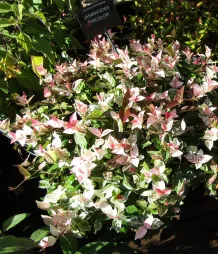
Dark green foliage lasts all year round. But it turns bronze in winter. Opposite, oval or elliptical leaves measure up to 15 cm long and 5 cm wide. Botanical star jasmine has single limbs. However, some varieties, such as trachelospermum jasminoides variegatum, have variegated cream foliage.
Star jasmine blooms in spring. Between May and June, it displays white flowers with a spicy fragrance. With their five lobes, the tubular flowers resemble stars or helices. They open in cymes at the tips of the branches.
Does your star jasmine have white flowers with yellow hearts? It's probably a horticultural variety, star Jasmine!
Two long, curved pods enclose the seeds. They are prolonged by a aigrette and covered with a fine down so that the wind can spread them more easily.
Star jasmine is toxic. It causes digestive problems if ingested. What's more, its sap contains alkaloids, a substance that is irritating to the skin. Remember to wear gloves for protection when pruning your plant.
Our maintenance tips
Star Jasmine are easy-care plants. Drought-resistant, they nevertheless need regular watering in pots and during the first few years.
 Watering
Star Jasmine like to keep soil moist, but not soggy. Water when the soil surface is dry (two to three centimetres).
Water the substrate with non-calcareous water, such as rainwater, at room temperature.
Allow the water to drain through the drainage holes before replacing the plant. Empty out any water stagnating in the saucer or planter. It may rot the roots.
 Repotting
Your Star jasmine is developing deep roots. Choose a pierced pot high enough (around 60 centimetres) to accommodate them.
Prepare a rich, light substrate. You can use commercially available potting soil for Mediterranean plants, or mix garden soil (2/3) with heather soil (1/3).
Pour the potting soil into your planter. If you have provided a support (trellis or stake), install it in your pot.
Then plant your Star jasmine. Fill the pot with potting soil. Make sure you stop a few centimetres short of the rim to avoid water overflowing when watering.
Water generously to encourage rooting, using water at room temperature.
The plant clings naturally to its support. But you'll need to give it a little help at the start. Wrap the branches around your pergola or trellis.
 Fertilization
You can stimulate the growth of your plant during its growth phase, in spring and summer, with fertilizer.
Bury a handful of compost at the foot of your Star jasmine.
You can stimulate the development of your plant during its growth phase, in spring and summer, with fertilizer.
Apply fertilizer for flowering plants or Mediterranean plants.
 Prune
Prune
Cut back dry, damaged branches using clean, sharp pruning shears.
Star Jasmine have sap that can cause skin irritation. Remember to wear gloves for protection!
 Plantation
Once the last spring frosts have passed, you can plant.
Soak the rootball of your Star jasmine in water at room temperature.
Find a sunny spot sheltered from the wind. Dig a planting hole as wide as it is high. Place gravel and compost at the bottom to optimize drainage.
Plant your Star jasmine and fill in with a mixture of universal potting soil, garden soil and compost. Form a watering basin and water copiously to encourage rooting.
Planning to climb your plant on a pergola or trellis? Wrap the first branches around the support to show them the way.
 Cutting
Cutting is carried out during the strong growth phase, generally in spring and early summer.
Take a branch about fifteen centimeters long. The stem should be semi-jointed, i.e. Still flexible and not yet woody. Cut below the node closest to the mother stem.
Remove the leaves at the base, keeping only the upper pairs.
Remove the leaves at the base, keeping only the upper pairs.
Plant your cutting in a mixture of sand and potting soil. Water to moisten the substrate.
The operation is more likely to be successful in a smothered environment. Cover the pot with a bell jar or translucent plastic bag. You can also place it in a clear plastic crate with a lid.
Place your cuttings in semi-shade.
Aerate every day for a minute or two to prevent rotting, and mist the substrate to keep it slightly moist.
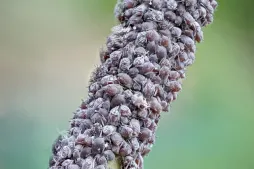
Disease / Threat
Information
| Lifecycle | Perennial |
| Foliage | Evergreen |
| Exposures | |
| Substrats | |
| Planting methods |
Open ground In pots In tubs |
| Categories | |
| Tags |
Beginner Flowery Toxic |
| Origin |
Southeast Asia |
| Hardiness (USDA) | 8b (-9.4°C ≤ T° < -6.7°C) |
| Leaf color |
|
| Flower color |
|
| Fruit color |
|
Discover plants from the same family