Mandevilla boliviensis, a mandevilla with white flowers
Mandevilla boliviensis
- Exposures
- Sun, Half-shade
- Hardiness (USDA)
- 11a (4.4°C ≤ T° < 7.2°C)
- Lifecycle
- Perennial
- Foliage
- Evergreen
- Family
- Apocynaceae
- Genus
- Mandevilla
- Species
- Mandevilla boliviensis
Other names:Dipladenia boliviensis, Dipladenia bella, Mandevilla bella, Mandevilla cereola, Mandevilla permixta, Mandevilla pittieri
As its name suggests, Mandevilla boliviensis grows in Bolivia. But this member of the Apocynaceae family is also found further north, in Costa Rica, Peru and Venezuela. It has also made a place for itself in our gardens, where its fragrant blooms last from spring to autumn.
How to recognize Mandevilla boliviensis?
Mandevilla boliviensis is an epiphytic, flowering plant. Its vines grow to over three meters long when trellised. But when it has no support to cling to, it forms a bush one metre high with a 40-centimetre spread.
The voluble stems are woody at the base, but flexible at the tip. They are covered with shiny, oval, alternate leaves. Elliptical to oblong, they measure up to ten centimetres in length and persist all year round.
Flowering lasts from spring to the onset of frost, as with mandevilla amabilis. The trumpet-shaped flowers have five white petals and a yellow heart. Fragrant, they bloom in groups of three or four at the end of the stems.
The flowers then give way to oblong fruits. They contain seeds topped by a tuft of hairs, designed to aid dispersal.
Is Mandevilla boliviensis toxic?
Mandevilla boliviensis is considered mildly toxic. Like many plants in the Apocynaceae family, it contains an irritating sap that can cause :
- Digestive disorders if ingested;
- Skin irritation on contact.
We therefore recommend keeping it out of the reach of children and pets, and wearing gloves when pruning.
Our care tips
Mandevilla boliviensis are cold-weather plants. Grow them in pots so you can bring them inside when it's cold.
You can also plant them in the ground and treat them as annuals: in this case, you'll need to renew them every year.
 Watering
Water your plant generously during the growing season.
Mandevilla boliviensis likes freshness. Watering should keep its roots cool and dry. In summer, wait until the soil surface has dried to one centimetre before watering. In winter, let the substrate dry out between watering.
Pournon-calcareous water (rainwater, for example) at room temperature over the soil.
Pournon-calcareous water (rainwater, for example) at room temperature over the soil.
After each watering, empty the stagnant water into the saucer.
Reduce watering during dormancy.
Mandevilla boliviensis do not tolerate limescale. Use rainwater or filtered water.
Water the base of the plant when the substrate is five centimetres dry. Then drain off any stagnant water in the saucer or planter.
 Misting
Mist foliage to increase humidity and repel pests. Always spray with rainwater. Tap water is too hard and leaves white marks on the leaves.
 Repotting
Place a drainage layer (clay balls, gravel) at the bottom of a pierced pot.
Pour in a bed of potting soil for flowering plants or geraniums. You can add perlite or sand to lighten it. If you want your plant to climb, install your stake.
Plant your Mandevilla boliviensis and add substrate. Stop a few centimetres before the edge to form a watering trough.
Water at room temperature to encourage rooting.
 Fertilization
You can stimulate the growth of your plant during its growth phase, in spring and summer, with fertilizer.
Apply a flowering plant or geranium fertilizer to encourage flowering.
 Prune
Prune
Remove the flowers when they have wilted to encourage the plant to bloom again.
Cut back the stems to three or four nodes so that your Mandevilla boliviensis branches out. This will also encourage flowering.
Caution: the plant is toxic! Wear gloves and rinse your shears after pruning!
 Planting
Once the last spring frosts have passed, you can plant.
Leave your Mandevilla boliviensis root ball to soak.
Dig a hole three times the size of the root ball. If you're planting several specimens, space them 20 to 30 centimetres apart. You can use stakes if you wish to grow your Mandevilla boliviensis as a climbing plant.
Plant your Mandevilla boliviensis. Fill in the hole with garden soil enriched with a little compost and water.
 Taking cuttings
Cutting is carried out during the strong growth phase, generally in spring and early summer.
Select a healthy stem at the top. Using clean, sharp pruning shears, remove a section about 15 centimetres long, without flowers and with several nodes.
Remove the leaves at the base. Keep only the top pair.
The plant is toxic. Wear gloves and clean tools after use.
Fill a bucket or pierced pot with potting soil for seedlings and cuttings. Make a hole in the center with a pick. Plant your Mandevilla boliviensis cutting and water.
Cuttings take better if they've been suffocated. You can place your pot in a transparent crate or cover it with a translucent plastic bag.
Remember to water regularly to keep the soil moist and aerate for a few minutes each day to prevent rotting.
Grow young shoots in the open air when the first signs of recovery appear.
Frequently asked questions
Which soil for Mandevilla?
Mandevilla needs a light, draining, fertile substrate. Offer it a soil composed of potting soil for flowering plants or geraniums, enriched with a little perlite. Soil that is too compact or waterlogged will cause root rot.
What's the difference between Mandevilla and Dipladenia?
In botany, there's no difference: Dipladenia is an old scientific name for the genus Mandevilla. All plants known today as Dipladenia are in fact Mandevilla.
Where should I place my Mandevilla?
Outdoors, you can place your Mandevilla in semi-shade or full sun. In winter, you'll need to bring the plant into a bright shelter where temperatures don't drop below 10°C, such as a greenhouse, veranda or loggia.
Diseases / Threats
Information
- Lifecycle
- Perennial
- Foliage
- Evergreen
- Exposures
- SunHalf-shade
- Substrate
- Humus soil
- Planting methods
- Open groundIn potsIn tubs
- Tags
- FloweryCold-sensitiveToxic
- Origins
- Central AmericaSouth America
- Hardiness (USDA)
- 11a (4.4°C ≤ T° < 7.2°C)
- Leaf color
- Dark green
- Flower colors
- WhiteYellow
Discover plants from the same family
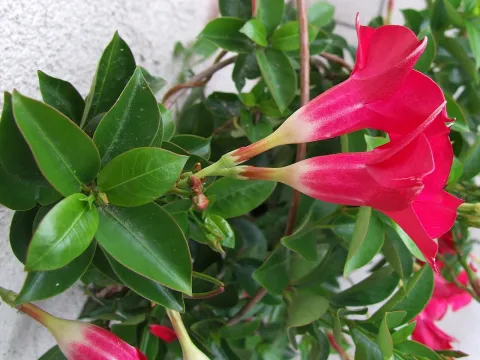
Dipladenia sanderi
Mandevilla sanderi
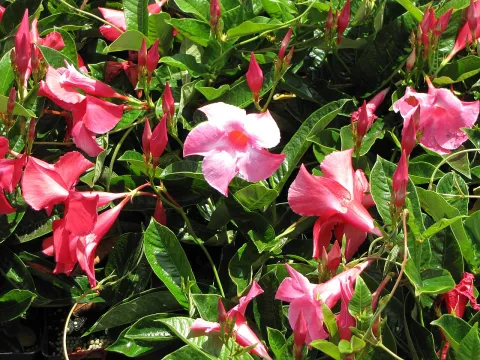
Dipladenia splendens
Mandevilla splendens
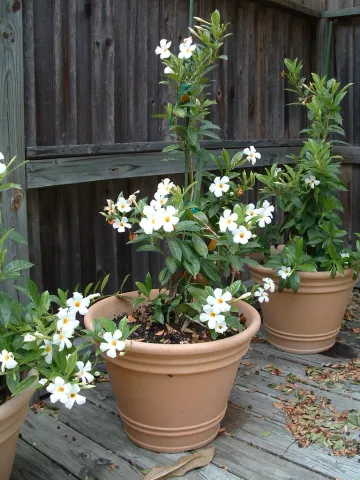
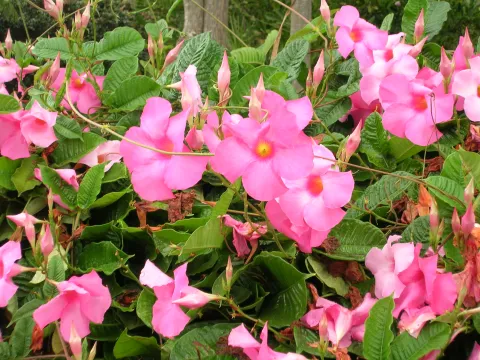
Mandevilla amabilis
Mandevilla × amabilis
Find out more
Find all our tips in the Monstera application