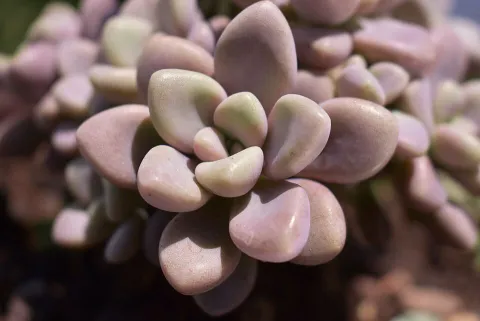
Graptopetalum paraguayense, a porcelain succulent
Graptopetalum paraguayense
- Exposures
- Sun, Half-shade
- Hardiness (USDA)
- 9a (-6.7°C ≤ T° < -3.9°C)
- Lifecycle
- Perennial
- Foliage
- Evergreen
- Family
- Crassulaceae
- Genus
- Graptopetalum
- Species
- Graptopetalum paraguayense
Other names:Byrnesia weinbergii, Cotyledon paraguayensis, Echeveria weinbergii, Graptopetalum weinbergii, Sedum paraguayense, Sedum weinbergii
Graptopetalum paraguayense doesn't owe its nickname of porcelain succulent to its blue or pink foliage, whose hues are reminiscent of the finest Chinese ceramics. This species of the Crassulaceae family, native to Mexico, has leaves so delicate they fall off as soon as you touch them.
How to recognize Graptopetalum paraguayense?
Graptopetalum paraguayense is a succulent perennial with a creeping habit. It measures 20 centimetres in height and 60 centimetres in spread.
The drooping stems reach two metres in length and two centimetres in diameter. Fleshy and cylindrical, they break easily when handled.
Leaves grow in a spiral, forming rosettes ten to fifteen centimetres in diameter. They, too, are fragile and detach if touched. Spatulate, they are covered with bloom. Their color varies between green and light gray, as in graptopetalum pachyphyllum. In hot, dry weather, the foliage turns pale pink.
Graptopetalum paraguayense flowers in spring. The white, five-petaled flowers are spotted with red and resemble stars. They appear on a fifteen-centimetre flowering stem and last only a few days. However, the branched stem can bear several flowers, which bloom for several weeks.
Graptopetalum parguayense is not toxic. The fat plant poses no danger when touched or ingested.
Our care tips
Graptopetalum paraguayense can be planted outdoors in regions with mild, dry winters.
 Misting
Graptopetalum paraguayense grow in arid regions and do not like humidity. No need to spray them.
 Repotting
In spring, transfer your Graptopetalum paraguayense to a larger pot, so that it can continue to grow.
Obtain a pierced pot one size larger than the previous one.
Fill the bottom with a very light, draining substrate such as commercially available potting soil for cacti and succulents. Plant your Graptopetalum paraguayense in the center and add potting soil. Stop a few centimetres below the rim of the pot to form a watering trough.
Tamp down and wait three or four days for the soil to dry before watering.
 Fertilization
You don't have to fertilize your plant to make it grow. However, if you want to stimulate its growth, you can give itfertilizer for cacti and succulents.
 Prune
Prune
Cut the flower stems flush once the flowers have faded, and remove dead leaves as you go along.
Use a clean, sharp tool to prevent the spread of disease and promote healing.
Use a clean, sharp tool to prevent the spread of disease and promote healing.
 Planting
Dig a hole slightly larger than the root ball. Plant your Graptopetalum paraguayense, taking care not to bury the leaves. Fill in with garden soil.
 Taking cuttings
Locate a healthy leaf on the outside of the plant. Cut it off at the base with a clean, sharp tool.
Leave it to dry for two days, until a growth forms at the tip.
Fill a perforated pot with potting soil for cacti and succulents. Place your leaf horizontally on the substrate, without burying it.
Place your cutting in a bright, dry, frost-free spot.
Moisten the soil by spraying it with water. But be careful! Too much water may cause your Graptopetalum paraguayense to rot.
Disease / Threat
Information
- Lifecycle
- Perennial
- Foliage
- Evergreen
- Exposures
- SunHalf-shade
- Substrates
- Calcareous earthSandy soil
- Planting methods
- Open groundIn potsIn tubsPlanter
- Category
- Succulent
- Tags
- BeginnerFloweryHard to kill
- Origin
- Central America
- Hardiness (USDA)
- 9a (-6.7°C ≤ T° < -3.9°C)
- Leaf colors
- Light greenRosePale pinkGreen-gray
- Flower colors
- WhiteRed
Discover plants from the same family
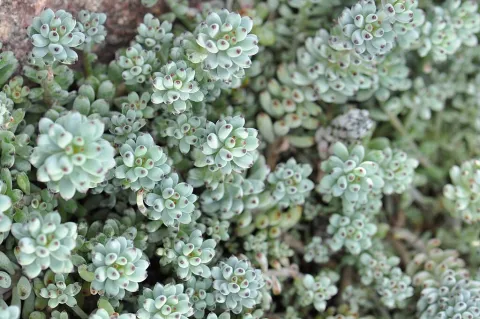
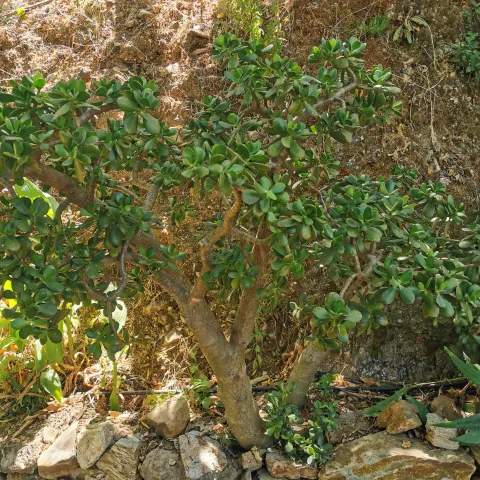
Jade tree
Crassula ovata
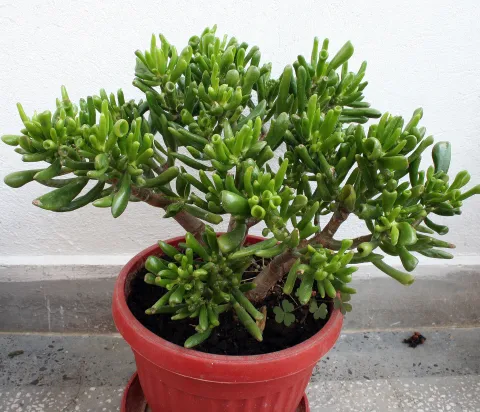
Crassula ovata 'Hobbit
Crassula ovata 'Hobbit'
Find out more
Find all our tips in the Monstera application