Capsicum annuum pepper

Black bell pepper Capsicum annuum

Green bell pepper Capsicum annuum

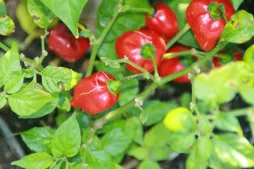
Capsicum annuum round fruit

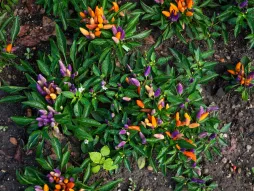
Capsicum annuum flowers
Contents
Find all our tips in the Monstera application


Capsicum annuum, the pepper shrub
Contents
Find all our tips in the Monstera application
Scientific classification
Family
Solanaceae
Type
Capsicum
Species
Capsicum annuum
Other name:Capsicum indicum var. vulgatum
If you can tell from their color and appearance that chillies and peppers belong to the same family, it's harder to believe that they all come from the same plant: Capscium annuum. This member of the Solanaceae family grows wild from the southern United States to northern Brazil, and includes thousands of cultivars, from sweet peppers to very hot chillies.
How to recognize Capsicum annuum
Capsicum annuum is a perennial plant that thrives in tropical climates, but is also cultivated in temperate regions:
- Outdoors as an annual vegetable plant;
- Indoors as an ornamental plant, in which case ornamental pepper lives for several years.
Capsicum annuum can grow up to a metre in height, with a maximum spread of 80 centimetres. It usually grows as a bush.
Its dark-green, smooth, slightly glossy foliage consists of oval to lanceolate leaves borne on long petioles.
The flowers are white, sometimes with a green or purple tinge, with five to eight petals fused at the base. Hermaphroditic, they can all produce a fruit after pollination.
Fruits come in a wide variety of shapes: square, conical, elongated or rounded. Initially green, they take on shades of red, yellow, orange, violet or even almost black when ripe, depending on the variety.
The different varieties of Capsicum annuum
There are over 2,300 varieties of Capscicum annuum. They generally fall into two categories:
- chilli pepper, with their high capsaicin content and pungent flavor;
- peppers, with virtually no capsaicin and a mild, possibly sweet taste.
Among the most popular varieties of chillies are :
- Anaheim or California chili pepper: a mild, elongated pepper up to 25 cm long.
- Piment d'Espelette: an early variety from the Basque country, bright red and fairly mild;
- Jalapeno pepper: a green then red Mexican pepper with a pronounced taste, highly productive and very resistant;
- Padron or Galician pepper: green, with varying degrees of heat depending on the variety.
In the vegetable garden, we often grow the following bell pepper varieties:
- Yolo Wonder: an early variety, highly resistant to disease. Its large, square fruits with thick flesh turn from green to red.
- Corno di Toro (Bull's Horn): an old variety that produces an elongated red or yellow bell pepper with fine, sweet flesh.
- Petit Marseillais: an old variety from the South of France with elongated, crumpled orange fruit, the flesh is fine, soft and sweet.
- California Wonder: perfect for pot cultivation, it produces large, square fruits, first green, then red.
Are chillies and peppers toxic?
Peppers are not toxic. The former are used as condiments, the latter as vegetables in many recipes (ratatouille, piperade, gratins, tarts, etc.).
However, chillies can be dangerous if they contain high levels of capsaicin:
- Massive ingestion can cause abdominal pain;
- Contact with eyes or mucous membranes can cause severe irritation.
Wash your hands thoroughly after handling, and avoid touching your face when cooking or harvesting chillies.
Moreover, the leaves, like those of other Solanaceae, contain a toxic quantity of solanine. Make sure your pets don't eat them.
Moreover, the leaves, like those of other Solanaceae, contain a toxic quantity of solanine. Make sure your pets don't eat them.
Our maintenance tips
Capsicum annuum are greedy plants. Don't grow them two years in a row in the same spot. Then plant bulbous or root vegetables to rebalance the soil.
They are also sensitive to frost. Wait until all risks have been eliminated before planting them in the ground.
They are also sensitive to frost. Wait until all risks have been eliminated before planting them in the ground.
 Watering
Water your plant generously during the growing season.
Keep the soil cool and moist, but not soggy.
Water, preferably with rainwater, at the foot of your Capsicum annuum.
Adapt your watering when the days get shorter.
Water the base of your Capsicum annuum when the substrate surface is dry. Do not wet the leaves to avoid the development of diseases and fungi. Watering is best done with rainwater at room temperature.
Water moderately to keep the soil fresh. Avoid watering if the ground is frozen to preserve the roots.
 Repotting
Obtain a pierced pot or tub 30 to 60 cm deep and 15 to 25 cm in diameter.
Pour clay balls or gravel at the bottom to make a drainage layer.
Fill your pot with a rich, light substrate. Use vegetable potting soil (80%) with a little perlite (20%).
Plant your Capsicum annuum. The crown should be level with the soil. Fruits can be large and heavy. Add a stake to prevent stem breakage. Pack gently and water.
You can mulch the base to retain moisture and cover the plant with a tunnel if the nights are still cool.
Pour clay balls or gravel at the bottom to make a drainage layer.
Fill your pot with a rich, light substrate. Use vegetable potting soil (80%) with a little perlite (20%).
Plant your Capsicum annuum. The crown should be level with the soil. Fruits can be large and heavy. Add a stake to prevent stem breakage. Pack gently and water.
You can mulch the base to retain moisture and cover the plant with a tunnel if the nights are still cool.
 Fertilization
Fertilize until the first fruits appear.
Apply a fertilizer rich in nitrogen and potassium, such as a special tomato fertilizer.
 Harvest
Harvesting begins in summer and lasts until the first frosts.
When the fruit has stopped growing and its skin is shiny, you can harvest it.
You can pick the fruit as soon as it's green, or wait until it changes color. The flavor will then be sweeter and the flesh thicker.
Slice off the stalk with a knife and remove the fruit carefully, so as not to damage your Capsicum annuum.
 Prune
Prune
Prune after the second wave of fruit appears.
When your plant has formed its first two waves of fruit, shorten the branches one leaf above the last fruit.
If you live in a region with little sunshine, deadhead your plants when they bear around ten fruits. This way, the plant will concentrate its energy on harvesting rather than growing.
 Plantation
When the risk of frost has passed, it's time to plant.
Prepare the soil by adding compost. Make a planting hole slightly larger than the root ball.
Plant your Capsicum annuum. The collar should be level with the ground and not buried. Add a stake to support the stems: fruit can become heavy and cause them to break. Pack and water.
If planting several specimens, space them at least 50 cm apart.
Mulch the base to retain moisture. You can also install a tunnel to protect your young plants from cool nights.
Plant your Capsicum annuum. The collar should be level with the ground and not buried. Add a stake to support the stems: fruit can become heavy and cause them to break. Pack and water.
If planting several specimens, space them at least 50 cm apart.
Mulch the base to retain moisture. You can also install a tunnel to protect your young plants from cool nights.
 Seedling
You can start seedlings indoors when the days get longer.
Capsicum annuum seedlings need a temperature of at least 20°C to germinate(ideally 24°C). Grow your seedlings indoors, using a heated mini-greenhouse or heat mat if necessary.
Pour a drainage layer into cups or a terrine, followed by potting soil for seedlings and plantations. Water: the substrate should be moist, but not soggy.
Plant your seeds. You can plant them in rows in your seed tray, or arrange three seeds per cup. Cover the seeds with a thin layer of potting soil (about 5 mm).
Water regularly to keep the soil fresh and aerate your mini-greenhouse to prevent rotting.
Pour a drainage layer into cups or a terrine, followed by potting soil for seedlings and plantations. Water: the substrate should be moist, but not soggy.
Plant your seeds. You can plant them in rows in your seed tray, or arrange three seeds per cup. Cover the seeds with a thin layer of potting soil (about 5 mm).
Water regularly to keep the soil fresh and aerate your mini-greenhouse to prevent rotting.
Diseases / Threats
Information
| Lifecycle | Perennial |
| Foliage | Evergreen |
| Exposure | |
| Substrat | |
| Planting methods |
Open ground In pots In tubs Planter |
| Categories |
Vegetable |
| Tags |
Beginner Fritillary Soiffarde Edible vegetable |
| Origins |
North America Central America South America |
| Hardiness (USDA) | 12a (10°C ≤ T° < 12.8°C) |
| Leaf color |
|
| Flower colors |
|
| Fruit colors |
|
Discover plants from the same family

Find out more