Melaleuca citrina, the bottle rinse
Melaleuca citrina
- Exposure
- Sun
- Hardiness (USDA)
- 9a (-6.7°C ≤ T° < -3.9°C)
- Lifecycle
- Perennial
- Foliage
- Evergreen
- Family
- Myrtaceae
- Genus
- Bottle rinser Melaleuca
- Species
- Bottle rinser Melaleuca citrina
Other names:Callistemon citrinus, Callistemon lanceolatus, Callistemon lanceolatus var. sparsus, Metrosideros citrina, Metrosideros lanceolata
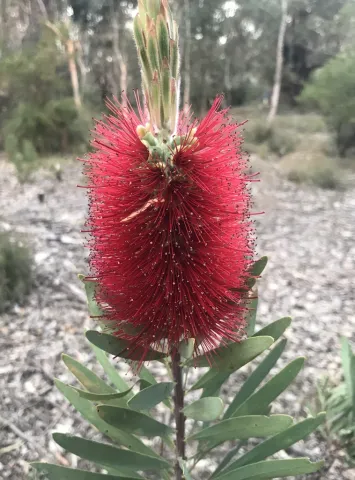
Sometimes called bottlebrush or Callistemon, Melaleuca citrina is an ornamental shrub native to Australia. Its spectacular, bottle-bottle-shaped blooms, lemony fragrance and great adaptability make it a real eye-catcher. More surprisingly, it is a pyrophyte plant, capable of using fire to ensure its reproduction.
How to recognize bottlebrush (Melaleuca citrina)?
Bottlebrush is an upright, bushy shrub. In its natural habitat, it can reach heights of up to eight meters. Cultivated outside its native range, Melaleuca citrina remains taller than melaleuca linearis. It is usually three meters high and wide.
Its reddish-brown bark is deeply fissured, with diamond-shaped cracks revealing yellow wood.
The alternate, lanceolate leaves are about seven centimetres long and greyish-green. When crumpled, they give off a lemony scent.
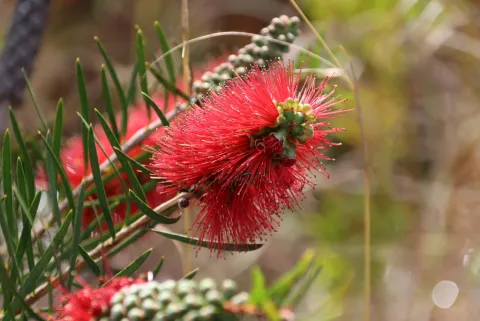
The flowers, too, give off a lemon scent. The bottlebrush blooms from autumn to winter, and can extend into spring depending on the climate. The inflorescences, grouped in cylindrical spikes ten centimeters long, are reminiscent of a bottlebrush, hence the plant's common name.
Each spike can bear up to 80 flowers, made up of numerous stamens (often more than forty per flower). The flowers are generally bright red in the botanical species, but can be pink or white in certain cultivars and hybrids.
The fruit of Melaleuca citrina is a hard, woody, cube-shaped capsule. This envelope is designed to open under the effect of heat. After a fire, the capsules release up to a hundred seeds, dispersed by the air currents generated by the smoke. This mechanism enables the plant to quickly colonize the soil after the fire has passed.
Is bottlebrush (Melaleuca citrina) toxic?
Bottlewash is not toxic to humans or pets. It poses no danger if touched or ingested, making it an ideal shrub for home gardens.
Our care tips
Bottle rinsers resistant to disease and drought. On the other hand, the plant fears the cold, especially when the soil is damp.
 Watering
Water your Bottle rinse before the substrate dries on the surface. You can use rainwater or mains water.
Bottle rinsers are water-hungry plants, especially in summer. Mulch the base to limit evaporation and reduce watering frequency.
 Repotting
Get a perforated pot. You can place a bed of clay balls or gravel at the bottom to improve drainage.
Mix a few handfuls of sand with universal potting soil. Pour a layer of this mixture into your pot and plant your Bottle rinse. Add substrate and pack lightly.
Water to help roots take root and expel air bubbles.
 Fertilization
You can stimulate the development of your plant during its growth phase, in spring and summer, with fertilizer.
Bottle rinsers are greedy plants. Feed them with a flowering plant fertilizer to support their growth.
 Planting
Once the last spring frosts have passed, you can plant.
Find a sunny spot protected from the wind.
Dig a hole three times the size of the root ball. Meanwhile, soak your Melaleuca citrina to rehydrate it.
Add clay balls or gravel to your garden soil to improve drainage. Line the bottom of the hole with compost, followed by a layer of substrate. Plant your shrub in the center. The root ball should reach ground level. Fill in with your mixture and tamp down.
Water copiously to eliminate air bubbles and encourage rooting.
 Taking cuttings
Cutting is carried out during the strong growth phase, generally in spring and early summer.
In a pierced pot, pour gravel or clay balls for drainage. Add a rich substrate, such as special cuttings soil or horticultural compost. Dig a hole using a pen or stake. Plant your young Melaleuca citrina and tamp lightly.
Water to encourage rooting.
Water to encourage rooting.
Disease / Threat
Information
- Lifecycle
- Perennial
- Foliage
- Evergreen
- Exposure
- Sun
- Substrates
- Calcareous earthHumus soilSandy soil
- Planting methods
- Open groundIn potsIn tubs
- Tag
- Flowery
- Origin
- Australia
- Hardiness (USDA)
- 9a (-6.7°C ≤ T° < -3.9°C)
- Leaf color
- Green-gray
- Flower colors
- WhiteRedRose
- Fruit color
- Brown
Discover plants from the same family
Find out more
Find all our tips in the Monstera application