Sedum burrito, a fat plant for hanging baskets
Sedum burrito
- Exposures
- Sun, Half-shade
- Hardiness (USDA)
- 11a (4.4°C ≤ T° < 7.2°C)
- Lifecycle
- Perennial
- Foliage
- Evergreen
- Family
- Crassulaceae
- Genus
- Orpin Sedum
- Species
- Sedum burrito
Sedum burrito belongs to the Crassulaceae family. Like its “big brother,” Morgan's stonecrop, it is native to Mexico and Honduras. Its long vines make for a striking and spectacular hanging plant.
How can you recognize Sedum burrito?
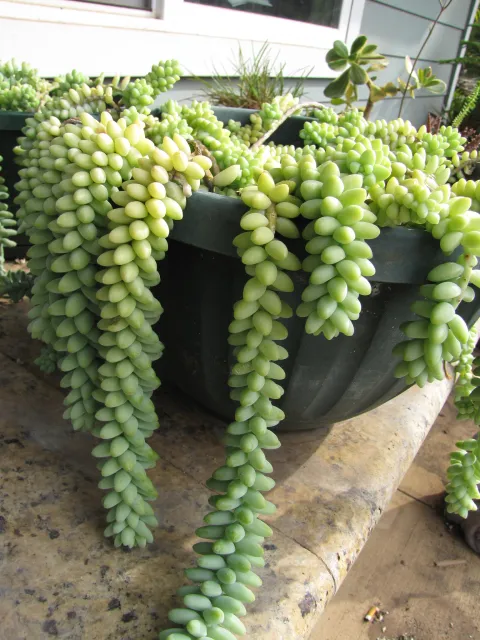
Sedum burrito is a succulent plant with a bushy, trailing habit. Its trailing stems grow up to 40 centimeters long.
The stem is hidden beneath the evergreen foliage. The fleshy leaves are shaped like grains of rice with rounded tips. Covered in a waxy coating, the leaf blades come in a variety of shades, ranging from light blue to light gray.
In summer, clusters of star-shaped flowers bloom at the tips of the stems. They are pink with yellow stamens.
Sedum burrito closely resembles Sedum morganianum. Some believe the two species are one and the same. Others consider Sedum burrito to be a hybrid derived from Sedum morganianum. A careful observer, however, can spot a few differences. Sedum burrito has leaves that are rounded at the tips, whereas those of Sedum morganianum have pointed tips. Additionally, Sedum burrito is smaller than Sedum morganianum.
But whether it's burrito or morganianum, Sedum is not a toxic plant. You can grow it without worry, even if you have young children or pets.
Our care tips
The best way to care for your Sedum burrito is to do little or nothing. The plant needs only occasional watering and plenty of light. It needs no fertilizer, and even less misting.
 Watering
Water only when the potting soil has completely dried out. Your plant prefers one copious watering to several less generous sessions. In this way, it can build up its water reserves and its roots won't rot. The substrate should remain moist for two days, the time it takes for your succulent to store water.
Place your Sedum burrito in its pot in your sink or in a container such as a bowl or terrine. Water the soil until the water begins to run into the container. Continue until you reach the height of the drainage layer (about two centimetres). Once this limit has been reached, stop watering and replace your pot in its saucer. Empty stagnant water when it appears.
To determine whether your fat plant is thirsty, observe its leaves. If they become less fleshy, thin or hollow, it's time to give them a drink.
 Misting
Sedum burrito grow in arid regions and do not like humidity. No need to spray them.
 Repotting
In spring, transfer your Sedum burrito to a larger pot, so that it can continue to grow.
Pour a draining substrate into a perforated pot. You can use potting soil for cacti and succulents. You can also make your own growing medium by mixing equal parts potting soil for green plants and sand.
Plant your Sedum burrito and fill in with substrate. Pack gently to avoid smothering the roots.
 Taking cuttings
You can take cuttings all year round.
Locate a healthy stem. Take a section at least five centimetres long.
Remove the leaves from the lower half and leave to dry for 24 to 48 hours in the open air. When a healing wedge appears, your cutting is ready.
Transplant your cutting into a draining substrate, such as potting soil for cacti and succulents, or a mixture of houseplant potting soil and sand. Press in the leafless part, taking care not to bury the limbs.
If your mother plant is balding, plant your graft in the same pot to rejuvenate the plant.
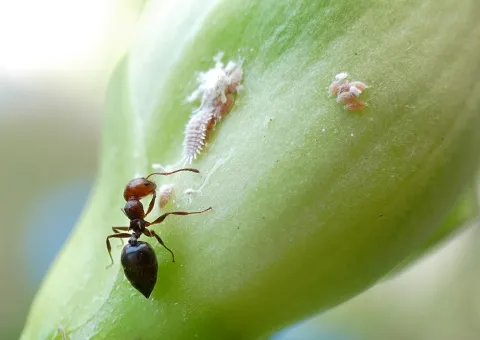
Disease / Threat
Information
- Lifecycle
- Perennial
- Foliage
- Evergreen
- Exposures
- SunHalf-shade
- Planting method
- In pots
- Categories
- IndoorSucculentHanging plants
- Tags
- BeginnerCold-sensitiveSmall pot
- Origin
- Central America
- Hardiness (USDA)
- 11a (4.4°C ≤ T° < 7.2°C)
- Leaf colors
- BluePale green
- Flower colors
- RoseYellow
Discover plants from the same family

Find all our tips in the Monstera application








