Plumbago blue flowers Plumbago auriculata

Plumbago auriculata in the ground

Blue flowers plumbago auriculata

Blue Plumbago auriculata in pot

Plumbago auriculata in bloom
Contents
Find all our tips in the Monstera application


Plumbago auriculata, a shrub with blue flowers
Contents
Find all our tips in the Monstera application
Scientific classification
Family
Plumbaginaceae
Type
Plumbago
Species
Plumbago auriculata
Other names:Plumbagidium auriculatum, Plumbago alba, Plumbago auriculata f. alba, Plumbago capensis, Plumbago capensis var. alba, Plumbago capensis f. alba, Plumbago grandiflora
Blue is a rare color in the garden... And that's exactly what makes it so precious. If you want to incorporate it into your beds and hedges, plant a Plumbago auriculata. This plant, native to an area stretching from Mozambique to South Africa, blooms pastel blue all summer long.
How to recognize Plumbago auriculata?
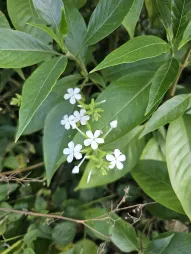
Plumbago auriculata is a sarmentose shrub. It can reach 5 meters in all directions when trained against a wall. Left free, it forms a bushy shrub around 2 meters high.
The stems are dark green, supple and highly branched. They are studded with lenticels.
The soft-green foliage is semi-evergreen. It disappears when temperatures drop below zero. But in regions with a Mediterranean or oceanic climate, it remains all year round. The leaves are oblong and spatulate, up to 6 cm long and 2 cm wide.
From April to November, the foliage gives way to a generous blooming season. The five-petaled flowers, grouped in panicles, display all the shades of a summer sky, from light to dark blue. If you like their delicate bouquets, but blue is not your favorite color, choose a cultivar with white flowers or a Ceylon plumbago (Plumbago zeylanica).
Whatever their color, the flowers have a special feature that makes them unique: they become sticky once they've wilted. They cling to everything within reach, a natural trick that facilitates seed dispersal. The seeds are contained in small, five-valve capsules covered with fine hairs.
Is Plumbago auriculata toxic?
Plumbago is not considered a toxic plant. However, its sap and tissues can be irritating to the skin in some sensitive individuals. It is therefore advisable to wear gloves if you plan to prune or repot it.
What's more, while the plant is not toxic, it is not edible either. Make sure young children and pets don't ingest it.
Our maintenance tips
If you have decided to trellis your Plumbago auriculata against a wall or pergola, install it at least 30 centimetres from its support. This will give it room to develop its stump.
 Watering
Water when substrate surface is dry. Use non-calcareous water at room temperature. You can use rainwater, for example.
Your Plumbago auriculata appreciates surface humidity, but hates having its roots immersed in water. After watering, empty any stagnant water from the saucer or planter.
 Repotting
Obtain a pierced pot. It should be slightly larger than the previous container or the root ball of your Plumbago auriculata.
Line the bottom with clay balls or gravel to improve drainage. Then pour in potting soil for Mediterranean plants. Plant your Plumbago auriculata and add substrate until you reach the top of the root ball. Remember to leave a few centimetres between the soil and the top of the pot to form a watering trough. Water to help the plant take root.
Have you decided to trellis your Plumbago auriculata on a trellis, wall or pergola? You'll need to guide and tie the branches so that they take hold. Use flexible ties (raffia, special plant ties) to avoid damaging the branches.
 Fertilization
You can stimulate the growth of your plant during its growth phase, in spring and summer, with fertilizer.
Apply a liquid fertilizer for flowering plants to promote the appearance of flower buds.
 Prune
Prune
Pruning is not compulsory, but it stimulates flowering and allows you to work out the shape of your Plumbago auriculata. Using a clean, sharp instrument:
- Remove old wood and dry stems;
- Cut back stems to 30 cm from the base.
 Plantation
Soak the root ball of your Plumbago auriculata to rehydrate it. Meanwhile, dig a hole three times as big. If you're planting several specimens, space them at least 1.5 m apart.
Place pebbles, gravel or clay balls at the bottom to improve drainage, and a layer of garden soil enriched with compost or potting soil. Plant your Plumbago auriculata. The top of the rootball should be level with the ground.
Fill the planting hole with a mixture of garden soil and compost (or universal potting soil). You can add sand or perlite if your soil is heavy.
If you have chosen to trellis your Plumbago auriculata, guide the branches onto the support. They can't hang on their own. You need to tie them up with flexible ties (raffia, special plant ties).
 Cutting
Cutting is carried out during the strong growth phase, generally in spring and early summer.
Take a current-year shoot about ten centimeters long. It should have no flower buds.
Thin out the lower part and keep only two or three leaves at the top.
To increase your chances of success, you can dip the lower end in cuttings hormone.
Plant your cutting in a mixture of sand and potting soil. Water to moisten the substrate.
The operation is more likely to be successful in a smothered environment. Cover the pot with a bell jar or translucent plastic bag. You can also place it in a clear plastic crate with a lid.
Place your cuttings in semi-shade.
Aerate every day for a minute or two to prevent rotting, and mist the substrate to keep it slightly moist.
Frequently asked questions
Plumbago is a fast-growing plant, especially in the right conditions. In warm, sunny climates, it can gain several dozen centimeters per year. Its vigor depends on exposure, heat and watering. In the open ground, it develops more rapidly than in pots.
Plumbago fears frost and must be protected as soon as temperatures drop below 5°C. In pots, place it in a bright, cool room, such as a veranda. In the ground, mulch generously and cover with a winter veil. Reduce watering during this resting period.
No. Plumbago is not invasive. It grows vigorously, but is easy to control with regular pruning. It does not produce aggressive shoots or uncontrolled seedlings in most climates. It integrates easily without crowding out other plants, whether in pots or in the ground.
Plumbago appreciates a very sunny position, sheltered from the wind. Ideally, place it against a warm wall or on a well-exposed terrace. It also requires light, well-drained soil.
Diseases / Threats
Information
| Lifecycle | Perennial |
| Foliage | Semi-evergreen |
| Exposure | |
| Substrats | |
| Planting methods |
Open ground In pots In tubs |
| Categories | |
| Tags |
Flowery Fritillary |
| Origin |
South Africa |
| Hardiness (USDA) | 11b (7.2°C ≤ T° < 10°C) |
| Leaf color |
|
| Flower color |
|
Discover plants from the same family
Ceylon plumbago
Discover
Find out more