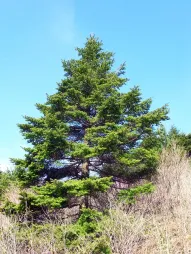
Laricio pine in the ground

Pinus nigra subsp. laricio

Pinus nigra laricio in the ground

Trunk cracked bark laricio pine

Pine cones Pinus laricio
Contents
Find all our tips in the Monstera application


Pinus nigra subsp. laricio, laricio pine
Contents
Find all our tips in the Monstera application
Scientific classification
Family
Pinaceae
Type
Pine - Pinus
Species
Black pine - Pinus nigra
Other names:Pinus laricio subsp. poiretiana, Pinus clusiana subsp. laricio, Pinus italica, Pinus laricio, Pinus laricio var. poiretiana, Pinus laricio var. typica, Pinus nigra var. laricio, Pin laricio
It is said that Phoenician navigators landed in Corsica, Sicily and Calabria to find a precious treasure: the laricio pine. This variety of Black pine (Pinus nigra) had a long, strong trunk, ideal for making the masts of their ships. Some of these giants escaped their maritime fate and still stand today in these regions. This majestic tree can live for many centuries.
How to recognize Pinus nigra subsp. Laricio, the laricio pine?
Pinus nigra subsp. Laricio is a conifer that can exceed 50 meters in height. Young trees have a pyramidal habit, while older pines have a slender, conical crown.
The straight trunk measures up to six meters in diameter. In mature trees, the lower part of the bole is devoid of branches. The bark is cracked, sometimes reddish-brown, sometimes silvery-brown.
The grey-green needles are inserted in pairs. They are flexible and non-stinging. They are between ten and fifteen centimetres long.
On the same specimen, the laricio pine bears both male and female flowers. The first, laden with pollen, hatch on the lower part of the tree, the second near the top.
Pine cones are ovoid in shape. They are shiny brown with rounded scales. They release their winged seeds when they reach maturity.
Like most conifers, Pinus nigra subsp. Laricio is non-toxic. You can safely enjoy its shade and the scent of its needles, even if you share your garden with pets.
Our maintenance tips
Think carefully before planting your Laricio pine. Once installed, you won't be able to move it.
 Watering
Feed your Laricio pine only when the substrate has dried thoroughly (at least five centimeters). Water generously with room-temperature rainwater and let the excess run off through the drainage holes.
Drain off any stagnant water in the dish or planter. It will rot the roots.
 Spray
Spray
Your Pinus nigra subsp. Laricio hates wet foliage. Don't mist the plant.
 Repotting
Get a perforated pot. You can place a bed of clay balls or gravel at the bottom to improve drainage.
Mix a few handfuls of sand with universal potting soil. Pour a layer of this mixture into your pot and plant your Laricio pine. Add substrate and pack lightly.
Water to help roots take root and expel air bubbles.
 Fertilization
To promote the growth of your Pinus nigra subsp. Laricio, apply fertilizer in spring and summer.
Fertilize your Laricio pine with a conifer fertilizer once a month. Follow the dosage and manufacturer's instructions to avoid damaging the foliage.
 Prune
Prune
Your Laricio pine does not need pruning. On the contrary, pruning could be detrimental to its growth.
You can, however, remove dead branches in early summer using a clean, sharp tool, such as pruning shears.
 Plantation
When the risk of frost has passed, it's time to plant.
Choose a sunny, isolated location. Laricio pines can reach several dozen meters in height when fully grown, and its deep root system can compete with other species.
Soak the rootball to rehydrate it and dig a hole at least twice as big. Remove stones, weeds and roots. You can add sand or compost to improve the soil.
Plant your Laricio pine. The top of the rootball should be level with the ground. Fill in the hole. Water generously toencourage rooting.
 Seedling
Once the risk of frost has passed, you can sow your Pinus nigra subsp. Laricio seeds.
Your seeds are more likely to germinate if you stratify them cold.
Fill an airtight bag (e.g. A freezer bag) with potting soil for seedlings and plantations. Moisten the substrate. Bury your seeds in the potting soil, close the bag and place it in a place where the temperature is between 0 and 5°C for three weeks (refrigerator, garage).
Check your seeds regularly to make sure the potting soil stays moist and doesn't rot. As soon as a seed germinates, you can plant it.
Fill a tray or bowl with seedbed potting soil. Plant your seeds about a centimetre deep, pointing downwards.
Place your seedlings in a bright spot, but not in direct sunlight. The temperature should be at least 15°C.
Place your seedlings in a bright spot, but not in direct sunlight. The temperature should be at least 15°C.
Water regularly to keep the substrate moist.
Disease / Threat
Information
| Lifecycle | Perennial |
| Foliage | Evergreen |
| Exposures | |
| Substrats | |
| Planting methods |
Open ground In pots In tubs |
| Category | |
| Tags |
Beginner Increvable Rustic |
| Origins |
North Africa Eastern Europe Southern Europe |
| Hardiness (USDA) | 4a (-34.4°C ≤ T° < -31.7°C) |
| Leaf color |
|
| Fruit color |
|
Discover plants from the same family


Find out more