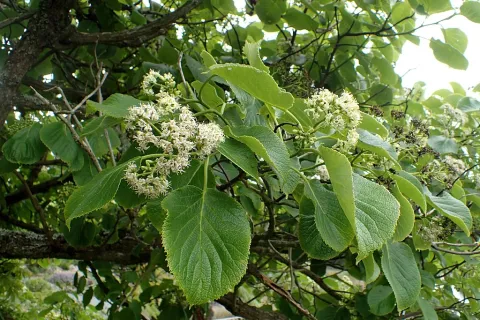
Ehretia acuminata, a tree with fragrant flowers
Ehretia acuminata
- Exposures
- Sun, Half-shade
- Hardiness (USDA)
- 7b (-15°C ≤ T° < -12.2°C)
- Lifecycle
- Perennial
- Foliage
- Deciduous
- Family
- Boraginaceae
- Genus
- Ehretia
- Species
- Ehretia acuminata
If you're walking between India and Australia, you'll probably come across an Ehretia acuminata. But this tree of the Boraginaceae family can also flourish and bloom in our latitudes.
How to recognize the Ehretia acuminata?
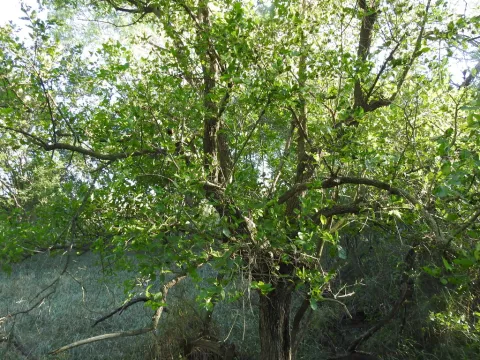
Ehretia acuminata is a deciduous tree with a rounded habit. Some claim to have encountered specimens up to 30 meters tall. However, it usually grows to between ten and fifteen meters.
The trunk is covered with gray bark. Deep vertical furrows run through the bark.
A one- to three-centimeter-long petiole supports the simple, alternate leaves. The elliptical, oblong or oval leaf blades measure up to thirteen centimetres long and four to six centimetres wide. The green leaves have serrated margins and pronounced veins.
From June onwards, the tree is adorned with fragrant white flowers. They bloom in cymes at the tips of the branches. Highly melliferous, they attract insects and pollinators.
The inflorescence then produces orange fruits. The drupes divide into two parts, each containing two seeds. Although not very tasty, the fruits are edible.
Unlike ehretia microphylla, Ehretia acuminata is not thought to have medicinal properties. But the tree is not toxic. It presents no danger to humans or animals.
Our care tips
Ehretia acuminata are easy to care for. After planting, you won't have to do much.
 Watering
Ehretia acuminata are the enemy of excess water. Before giving your specimen a drink, always make sure the soil is at least five centimetres dry.
Like many plants, the plant prefers rainwater. But it's fine with tap water. Just make sure it's at room temperature.
Remove any water stagnating in the cup under the pot. It can rot the roots.
 Misting
Your Ehretia acuminata hates wet foliage. Don't mist the plant.
 Repotting
Obtain a perforated pot. Make a drainage layer at the bottom with clay balls or gravel.
Cover with a mixture of potting soil and garden soil. The different varieties of Ehretia acuminata like well-drained soil. If yours is heavy, add gravel or river sand to lighten it.
Plant your plant at Ehretia acuminata and fill the pot with your substrate. Water for the first time to eliminate air bubbles and facilitate rooting.
 Planting
Once the last spring frosts have passed, you can plant.
Choose an isolated location, sheltered from the wind. It should be exposed to sun or half-shade.
Soak the rootball in water at room temperature. Meanwhile, dig a planting hole. Plant your Ehretia acuminata and fill it in.
Press down and water generously to encourage rooting.
Information
- Lifecycle
- Perennial
- Foliage
- Deciduous
- Exposures
- SunHalf-shade
- Substrates
- Clay soilHumus soilLoamy soilSandy soil
- Planting method
- Open ground
- Tags
- Edible fruitBeginnerFlowery
- Origins
- Central AsiaSouth AsiaSoutheast AsiaAustralia
- Hardiness (USDA)
- 7b (-15°C ≤ T° < -12.2°C)
- Leaf color
- Dark green
- Flower color
- White
- Fruit color
- Orange
Discover plants from the same family
Find out more
Find all our tips in the Monstera application