Crassula capitella thyrsiflora, a red pagoda succulent
Crassula capitella subsp. thyrsiflora
- Exposure
- Sun
- Hardiness (USDA)
- 9b (-3.9°C ≤ T° < -1.1°C)
- Lifecycle
- Perennial
- Foliage
- Evergreen
- Family
- Crassulaceae
- Genus
- Crassula
- Species
- Crassula capitella
Other names:Purgosea thyrsiflora, Crassula thyrsiflora, Turgosea thyrsiflora
How about adding a touch of Asia to your garden or sunroom? The rosettes of Crassula capitella subsp. Thyrsiflora stack up to form a red pagoda! But don't be fooled by appearances! This subspecies of Crassula capitella isn't native to China or Indonesia but to southern Africa, just crassula lanuginosa.
How can you recognize Crassula capitella subsp. Thyrsiflora, the “red pagoda”?
Crassula capitella thyrsiflora is a bushy succulent plant. It does not grow taller than 20 centimeters.
Crassula capitella thyrsiflora grows from rosettes of compact, tightly packed leaves. The fleshy, triangular leaf blades overlap one another along the stem. Green with a pink tinge at the base, the leaves become increasingly red and smaller toward the top. This contrast and the geometric pattern they form have earned the plant its nickname, the “red pagoda.”
White flowers appear at the tips of unbranched, spike-shaped inflorescences in summer and fall.
The plant is not known to be toxic and can be grown around children and pets. In southern Africa, the dried and ground roots of Crassula capitella subsp. thyrsiflora were even used to heal wounds.
Our care tips
Crassula capitella thyrsiflora are very slow-growing. So you won't have to take them home very often. But you will have to be patient to see new leaves appear!
 Watering
Make sure the soil is completely dry before watering. Pour room-temperature water over the potting soil, without wetting the foliage.
Do not leave standing water in the cup.
Do not leave standing water in the cup.
 Misting
Crassula capitella thyrsiflora grow in arid regions and do not like humidity. No need to spray them.
 Repotting
Every year in the spring, repot your Crassula capitella subsp. Thyrsiflora to give it more space.
Choose a pierced pot and line the bottom with a layer of clay balls or gravel.
Then pour in a draining substrate, such as potting soil for cacti and succulents, or potting soil for green plants enhanced with sand and perlite.
Plant your Crassula capitella thyrsiflora and add substrate if necessary. Water to remove air bubbles and encourage rooting.
 Fertilization
To promote the growth of your Crassula capitella subsp. Thyrsiflora, apply fertilizer in spring and summer.
Add cactus and succulent fertilizer to watering water.
If you're repotting every year, there's no need to add fertilizer. Your plant will find sufficient nutrients in its substrate.
 Planting
When the risk of frost has passed, it's time to plant.
Crassula capitella thyrsiflora They love light but dislike direct sunlight, especially during the hottest part of the day. To ensure your plant gets plenty of light without damaging its foliage, choose a spot in partial shade or with bright, indirect light.
Dig a hole slightly larger than the root ball. Plant your Crassula capitella thyrsiflora and backfill the hole.
Water without saturating the soil to encourage root growth.
 Taking cuttings
Propagation by cuttings is carried out during the strong growth phase, generally in spring and early summer.
Locate a healthy, flowerless stem. Using clean, sharp pruning shears, remove a section about ten centimeters long.
Remove the leaves at the bottom of the stem. Leave to dry for at least 24 hours, until a callus forms at the base.
Choose a pierced pot suited to the size of your cuttings. Choose a terracotta model. This material promotes uniform drying of the soil and reduces the risk of root rot.
Line the bottom with a bed of clay balls or gravel. Then pour in a substrate made up of equal parts potting soil, garden soil and sand. Plant your cutting and tamp it down. You can add a layer of sand to the surface.
Place your cutting in a bright spot away from direct sunlight. The temperature should be at least 18 degrees.
Disease / Threat
Information
- Lifecycle
- Perennial
- Foliage
- Evergreen
- Exposure
- Sun
- Substrate
- Sandy soil
- Planting method
- In pots
- Category
- Succulent
- Tags
- BeginnerSmall pot
- Origin
- South Africa
- Hardiness (USDA)
- 9b (-3.9°C ≤ T° < -1.1°C)
- Leaf colors
- Light greenRedRose
- Flower color
- White
Discover plants from the same family
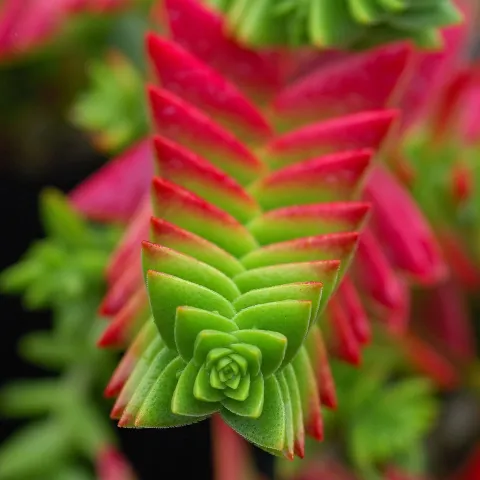

Crassula 'Campfire'
Crassula capitella ‘Campfire’
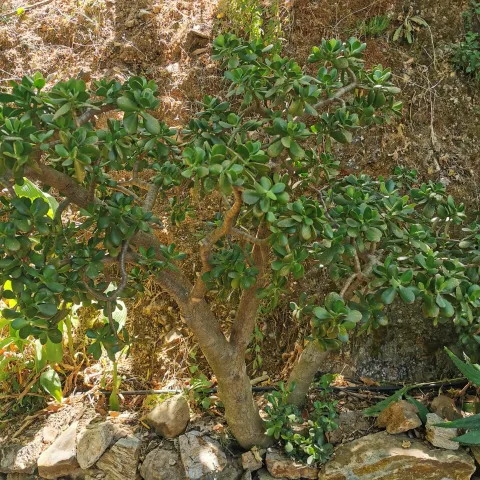
Jade tree
Crassula ovata
Find out more
Find all our tips in the Monstera application








