Crassula capitella, a plant that turns red in the sun
Crassula capitella
- Exposure
- Sun
- Hardiness (USDA)
- 9b (-3.9°C ≤ T° < -1.1°C)
- Lifecycle
- Perennial
- Foliage
- Evergreen
- Family
- Crassulaceae
- Genus
- Crassula
- Species
- Crassula capitella
Other names:Turgosea capitella, Crassula capitella subsp. capitella, Crassula capitella subsp. meyeri, Crassula capitella subsp. thyrsiflora
As its name suggests, Crassula capitella belongs to the Crassulaceae family. This succulent, native to South Africa, grows wild on the dry slopes of Botswana and northern Namibia. There, it basks in the sun, which causes its leaves to turn from green to red.
How can you recognize Crassula capitella?
Crassula capitella is a succulent plant with an upright or prostrate growth habit. It reaches a height of 5 to 40 centimeters, but can form mats up to one meter in diameter.
Its base consists of a rosette of leaves. Roots develop at the nodes of the stems, even before they touch the ground. The stems are smooth and sometimes dotted with curved hairs, as in crassula lanuginosa.
The leaves, which are also smooth and hairy, are propeller-shaped or lanceolate-linear. The fleshy , lime-green leaf blades turn a bright red when exposed to light. They measure up to 10 centimeters long and 4 centimeters wide.
From mid-summer through fall, Crassula capitella produces tubular flowers with cream or white petals. These flowers are grouped in a spike-shaped inflorescence.
Crassula capitella is considered non-toxic, making it safe to grow around children and pets.
Our care tips
Crassula capitella are very slow-growing. So you won't have to take them home very often. But you will have to be patient to see new leaves appear!
 Watering
Make sure the soil is completely dry before watering. Pour room-temperature water over the potting soil, without wetting the foliage.
Do not leave standing water in the cup.
Do not leave standing water in the cup.
 Misting
Crassula capitella grow in arid regions and do not like humidity. No need to spray them.
 Repotting
Every year in the spring, repot your Crassula capitella to give it more space.
Choose a pierced pot and line the bottom with a layer of clay balls or gravel.
Then pour in a draining substrate, such as potting soil for cacti and succulents, or potting soil for green plants enhanced with sand and perlite.
Plant your Crassula capitella and add substrate if necessary. Water to remove air bubbles and encourage rooting.
 Fertilization
To promote the growth of your Crassula capitella, apply fertilizer in spring and summer.
Add cactus and succulent fertilizer to watering water.
If you're repotting every year, there's no need to add fertilizer. Your plant will find sufficient nutrients in its substrate.
 Planting
When the risk of frost has passed, it's time to plant.
Crassula capitella They love light but dislike direct sunlight, especially during the hottest part of the day. To ensure your plant gets plenty of light without damaging its foliage, choose a spot in partial shade or with bright, indirect light.
Dig a hole slightly larger than the root ball. Plant your Crassula capitella and backfill the hole.
Water without saturating the soil to encourage root growth.
 Taking cuttings
Propagation by cuttings is carried out during the strong growth phase, generally in spring and early summer.
Locate a healthy, flowerless stem. Using clean, sharp pruning shears, remove a section about ten centimeters long.
Remove the leaves at the bottom of the stem. Leave to dry for at least 24 hours, until a callus forms at the base.
Choose a pierced pot suited to the size of your cuttings. Choose a terracotta model. This material promotes uniform drying of the soil and reduces the risk of root rot.
Line the bottom with a bed of clay balls or gravel. Then pour in a substrate made up of equal parts potting soil, garden soil and sand. Plant your cutting and tamp it down. You can add a layer of sand to the surface.
Place your cutting in a bright spot away from direct sunlight. The temperature should be at least 18 degrees.
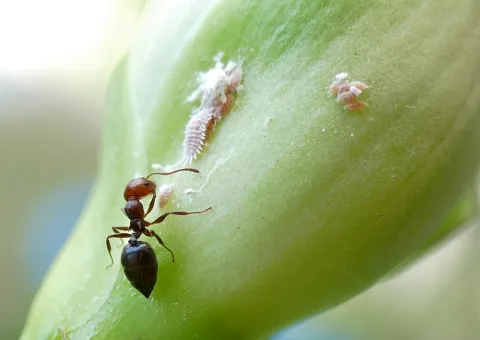
Disease / Threat
Information
- Lifecycle
- Perennial
- Foliage
- Evergreen
- Exposure
- Sun
- Substrate
- Sandy soil
- Planting method
- In pots
- Category
- Succulent
- Tags
- BeginnerSmall pot
- Origin
- South Africa
- Hardiness (USDA)
- 9b (-3.9°C ≤ T° < -1.1°C)
- Leaf colors
- Light greenRed
- Flower colors
- WhiteCream
Discover plants from the same family

Crassula 'Campfire'
Crassula capitella ‘Campfire’

Crassula capitella thyrsiflora
Crassula capitella subsp. thyrsiflora
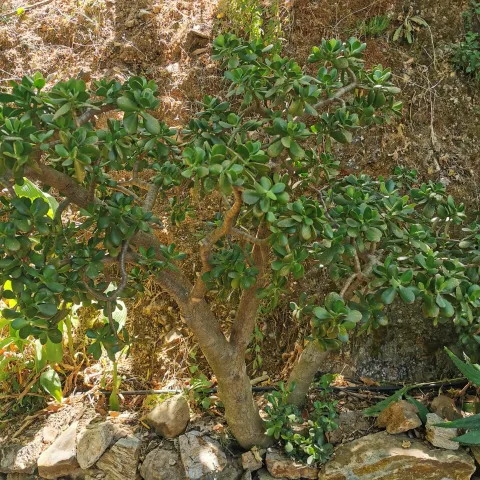
Jade tree
Crassula ovata
Find out more
Find all our tips in the Monstera application








