Begonia x lucerna, a begonia with delicately spotted leaves
Begonia × lucerna
- Exposure
- Half-shade
- Hardiness (USDA)
- 11a (4.4°C ≤ T° < 7.2°C)
- Lifecycle
- Perennial
- Foliage
- Evergreen
- Family
- Begonias Begoniaceae
- Genus
- Begonia
- Species
- Begonia × lucerna
Other names:Begonia lucernae, Begonia « corallina »
Created in the 19th century by a Swiss botanist, Begonia x lucerna is a cross between coccinea and teuscheri begonias. Its strong points? Mottled leaves reminiscent of angels' wings and colorful blooms.
How to recognize Begonia x lucerna?
Larger than Begonia aconitifolia, Begonia x lucerna can reach 2 m in height. It is a shrubby perennial with a bushy habit.
Begonia x lucerna belongs to the bambousiform group of begonias. Its thick stems have widely spaced internodes and resemble bamboo canes.
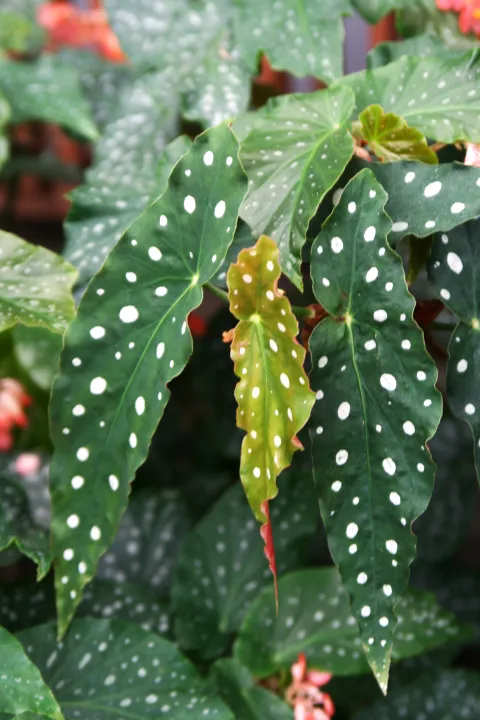
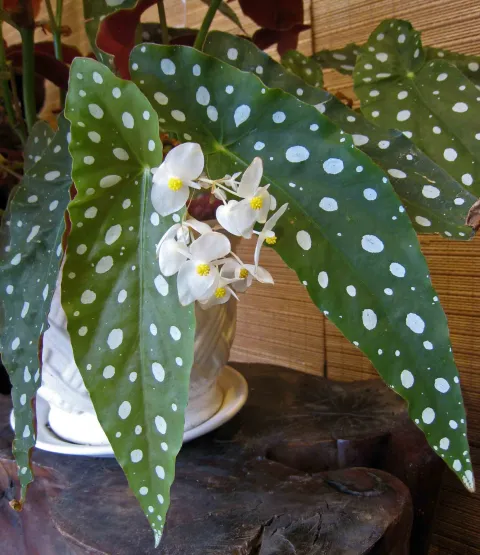
Its asymmetrical, elongated leaves measure up to 30 cm long. Sometimes bright green, sometimes dark green, they have a wine-red underside and are spotted with white spots.
Begonia x lucerna is not only grown for its decorative foliage. When the plant blooms, it is adorned with pink or red flowers. They appear in bouquets in the leaf axils.
Is Begonia x lucerna toxic?
Unfortunately for lovers of spectacular foliage and animals, Begonia x lucerna is toxic. If ingested, it causes digestive problems. Its sap can also cause skin irritation in sensitive individuals.
Make sure your dog or cat doesn't nibble your plant, and wear gloves when pruning and repotting.
Our care tips
Begonia × lucerna are tropical plants. They need high humidity but don't like wet foliage. You shouldn't mist them or water their leaves. And to keep their shape harmonious, remember to turn the pot a quarter turn every month.
 Watering
Begonia × lucerna are the enemy of excess water. Before giving your specimen a drink, always make sure the soil is at least five centimetres dry.
Like many plants, the plant prefers rainwater. But it's fine with tap water. Just make sure it's at room temperature.
During hot spells, water more regularly.
During hot spells, water more regularly.
Remove any water stagnating in the cup under the pot. It can rot the roots.
 Misting
Your Begonia × lucerna hates wet foliage. Don't mist the plant.
 Repotting
In spring, transfer your Begonia × lucerna to a larger pot, so that it can continue to grow.
Begonia × lucerna like to be cramped. Re-pot when the substrate has become too poor or if the roots escape from the container. Choose a pierced terracotta pot two or three centimetres larger than the root ball. Line the bottom with a bed of clay balls for drainage.
Your plant needs a light, rich, draining substrate. You can use potting soil for green or flowering plants with a little perlite. Pour in a layer of soil and place your specimen in the center. Fill in with the rest of the mixture, tamp down and water for the first time.
To increase humidity, place your pot on a dish filled with moist clay balls.
 Fertilization
You can stimulate the development of your plant during its growth phase, in spring and summer, with fertilizer.
Feed your Begonia × lucerna with a fertilizer for green or flowering plants.
 Prune
Prune
Remove wilted flowers.
If you want your plant to keep a compact habit, don't hesitate to prune it. Cut above a node with a clean, sharp tool, such as secateurs or scissors.
 Taking cuttings
Cutting is carried out during the strong growth phase, generally in spring and early summer.
Take a fifteen-centimeter section of stem or liana with at least three leaves.
Place your cutting in a glass filled with water at room temperature. Make sure the nodes are fully submerged; they are where the roots will grow.
Place the glass in a bright spot, but out of direct sunlight. Change the water regularly to keep it clear until roots appear.
Frequently asked questions
Can I keep a Begonia x lucerna from one year to the next?
Yes, Begonias are perennial plants that can live for several years. However, Begonia x lucerna does not tolerate frost. If you want to preserve it, you'll need to grow it indoors.
Is Begonia x lucerna a houseplant?
Begonia x lucerna is not hardy. It cannot withstand frost or temperatures below 5°C. In most climates, it is grown as a houseplant. However, if you live in a region where it never freezes, you can try planting it outdoors. Just find a spot away from direct sun and wind.
Diseases / Threats
Information
- Lifecycle
- Perennial
- Foliage
- Evergreen
- Exposure
- Half-shade
- Substrate
- Humus soil
- Planting method
- In pots
- Tags
- FloweryCold-sensitiveToxic
- Origin
- Eastern Europe
- Hardiness (USDA)
- 11a (4.4°C ≤ T° < 7.2°C)
- Leaf colors
- Dark greenWhite
- Flower color
- Rose
Discover plants from the same family
Begonia maculata 'Wightii'
Begonia maculata ‘Wightii’
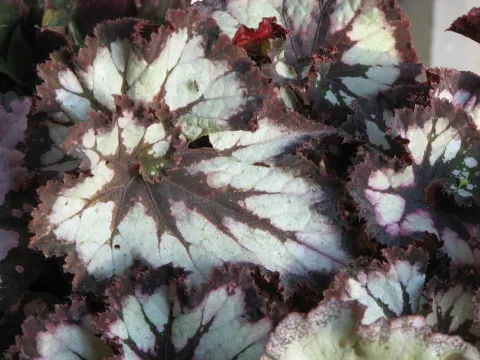
Royal Begonia
Begonia rex
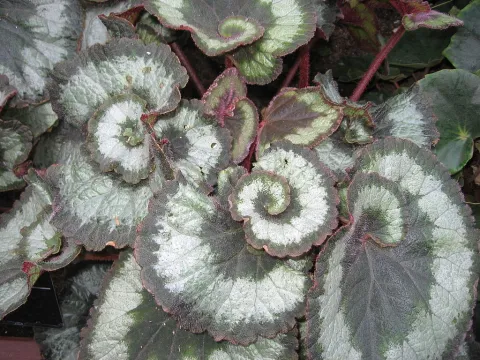
Begonia 'Escargot
Begonia rex 'Escargot'
Find out more
Find all our tips in the Monstera application