Anacampseros rufescens 'Sunrise', a rainbow succulent
Anacampseros rufescens 'Sunrise'
- Exposure
- Sun
- Hardiness (USDA)
- 10b (1.7°C ≤ T° < 4.4°C)
- Lifecycle
- Perennial
- Foliage
- Evergreen
- Family
- Anacampserotaceae
- Genus
- Anacampseros
- Species
- Anacampseros rufescens
The power of plants to lift our spirits no longer needs to be proven. But Anacampseros 'Sunrise' is said to be even stronger. As its name promises, this cultivar of Anacampseros rufescens could bring your loved one back! Myth or reality? A mystery. One thing's for sure: its green and pink foliage is a real shot of color and cheer for your home.
How to recognize Anacampseros 'Sunrise'?
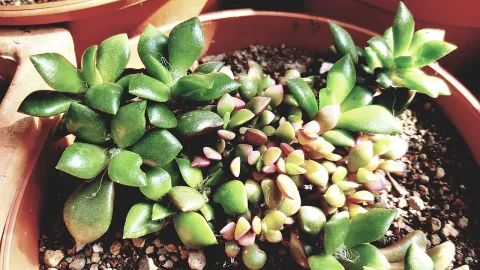
A succulent plant barely ten centimetres tall in all directions, Anacampseros 'Sunrise' has a compact, bushy habit.
As with the botanical variety, the leaves are fleshy, pointed and no more than a centimetre long. But their colors are much brighter! The 'Sunrise' cultivar has soft green foliage with bright pink highlights. In sunlight, these colors intensify to give the plant an almost fluorescent appearance.
Fine white hairs emerge between the leaf blades. These filaments act like a natural shield, protecting the succulent from extreme temperatures and capturing the slightest trace of ambient humidity.
The base of the plant thickens over time to form a small, rigid caudex. The oldest leaves fall away, revealing the stem.
The deep-pink flowers are borne on a flowering spike about ten centimetres long. With their five petals, they resemble stars.
Is Anacampseros 'Sunrise' toxic?
No. Anacampseros 'Sunrise' is not a known toxic plant. It is believed to be harmless to humans and animals.
Our care tips
Your plant needs watering in winter only when the temperature is above 18°C. If it spends the off-season outdoors or in an unheated greenhouse, you can stop watering between November and March.
 Watering
Water your Anacampseros 'Sunrise when the soil has dried deeply. Use water at room temperature to avoid damaging the roots. If you can, use rainwater or non-calcareous water.
Never leave water standing in the saucer or planter, as this will rot the roots.
 Misting
Your Anacampseros rufescens 'Sunrise' hates wet foliage. Don't mist the plant.
 Repotting
Every year in the spring, repot your Anacampseros rufescens 'Sunrise' to give it more space.
Obtain a pierced pot one size larger than the previous one.
Fill the bottom with a very light, draining substrate such as commercially available potting soil for cacti and succulents. Plant your Anacampseros 'Sunrise in the center and add potting soil. Stop a few centimetres below the rim of the pot to form a watering trough.
Tamp down and wait three or four days for the soil to dry before watering.
 Fertilization
To promote the growth of your Anacampseros rufescens 'Sunrise', apply fertilizer in spring and summer.
Apply a cactus and succulent fertilizer to support growth. Be sure to follow the manufacturer's recommended dosage to avoid damaging the foliage.
 Planting
When the risk of frost has passed, it's time to plant.
Choose a place where rainwater runs off easily, the top of an embankment or a location with chalky soil.
Dig a hole slightly larger than the root ball. Prepare a draining substrate, e.g. A mixture of sand and garden soil. Plant your Anacampseros 'Sunrise and fill in. Tamp and water. This first watering helps to promote contact between the soil and the roots.
 Sowing
Your seedlings need warmth. Summer is the best time to get started.
Fill a perforated pot with potting soil for cacti and succulents. You can also mix horticultural potting soil for seedlings (two-thirds) with gravel or sand (one-third). Water the soil to keep it moist, but not soggy.
Place your seeds on the substrate. If they're very small, you don't need to cover them with soil.
Seedlings take better if they 're stifled. Place your pot in a mini greenhouse or cover them with a transparent plastic bag. Your seeds also need heat to grow. You can use a heating mat to maintain a temperature of between 23 and 27°C. Place the cuttings in semi-shade.
Open your greenhouse for a few minutes a day and spray the substrate to keep it moist.
 Taking cuttings
Cutting is carried out during the strong growth phase, generally in spring and early summer.
Locate a healthy, flowerless branch. Cut a section with several leaves about 10 centimetres long. Use a clean, sharp tool to facilitate healing.
Leave your cutting to dry for 24 to 72 hours, until a callus forms.
Pour a well-draining substrate into a perforated pot. Potting soil for cacti and succulents, for example.
Plant your Anacampseros 'Sunrise in the center and tamp it down.
Diseases / Threats
Information
- Lifecycle
- Perennial
- Foliage
- Evergreen
- Exposure
- Sun
- Substrate
- Calcareous earth
- Planting methods
- Open groundIn potsIn tubs
- Tag
- Cold-sensitive
- Origin
- South Africa
- Hardiness (USDA)
- 10b (1.7°C ≤ T° < 4.4°C)
- Leaf colors
- Light greenRose
- Flower color
- Rose
Discover plants from the same family
Find out more
Find all our tips in the Monstera application