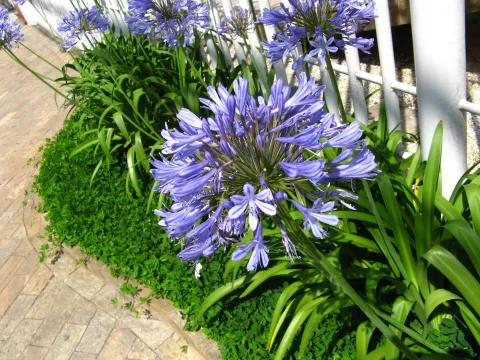
Agapanthus praecox, early agapanthus
Agapanthus praecox
- Exposure
- Sun
- Hardiness (USDA)
- 9b (-3.9°C ≤ T° < -1.1°C)
- Lifecycle
- Perennial
- Foliage
- Semi-evergreen
- Family
- Amaryllidaceae
- Genus
- Agapanthus
- Species
- Agapanthus praecox
Other names:Tulbaghia africana f. praecox, Tulbaghia praecox, Agapanthus africanus var. maximus, Agapanthus africanus var. minimus, Agapanthus comptonii, Agapanthus giganteus, Agapanthus multiflorus
It's difficult to tell Agapanthus praecox agapanthus africanus. Even professionals get them mixed up, and one is often sold under the other's name. Indeed, these two plants from the Amaryllidaceae family are native to the Cape Province and both have bluish flowers. But Agapanthus praecox stands out due to its large size.
How can you recognize Agapanthus praecox?
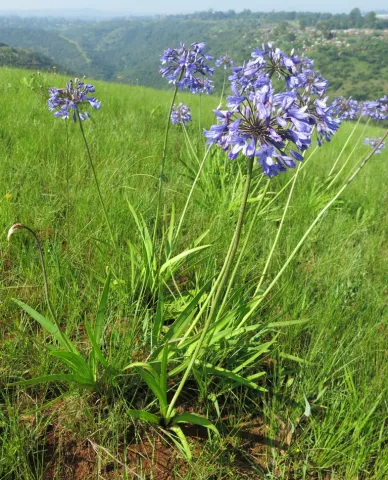
Agapanthus praecox is a bushy perennial. In the wild, this agapanthus grows up to 1.5 meters tall with a spread of 60 centimeters. However, dwarf varieties are available commercially that do not exceed 50 centimeters in height.
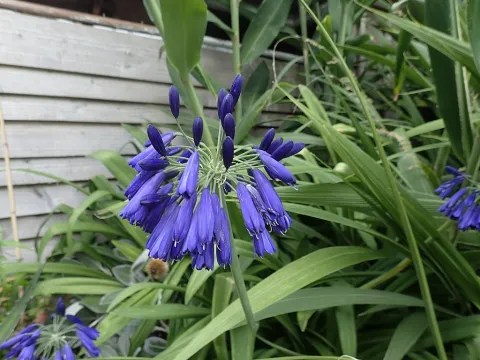
The plant is stemless. The leaves emerge from the rhizomatous base to form a rosette. They are dark green, strap-shaped leaves 40 centimeters long.
Flowering occurs in summer. A flower stalk over one meter tall rises from the center of the foliage. It is topped by an umbrella-shaped cluster of flowers ranging in color from white to indigo, including pale blue. The six-lobed flowers resemble little bells. They attract bees, butterflies, and other pollinating insects.
The flowers then develop into oblong capsules. When the fruit opens, it releases black, winged seeds.
The sap of Agapanthus praecox is toxic. It causes digestive problems when ingested and irritation upon contact with the skin and mucous membranes. Be sure to protect yourself when pruning your agapanthus and keep your pets away from its foliage.
Our care tips
Agapanthus praecox can have deciduous or semi-evergreen foliage. If you live in a region where it freezes, prefer the former. They are hardier and equally resistant to sea spray and drought.
 Watering
Water your plant generously during the growing season.
The plant should be watered when the surface of the root ball is dry (about one centimeter deep). Water with non-calcareous room-temperature water, such as rainwater or demineralized water.
To prevent root rot, never leave standing water in the saucer or at the bottom of the planter.
Reduce watering during dormancy.
Agapanthus praecox live in desert regions. They tolerate drought, but dread excess water. The substrate must remain completely dry for a few days between waterings.
When watering, use water at room temperature to avoid stressing the plant.
Roots run deep. You therefore need to moisten the entire root ball. Pour in water until the excess runs out through the drainage hole. Stop watering and empty any water that accumulates in the saucer or planter. It may rot the roots.
 Repotting
Soak your Agapanthus praecox. Choose a pot with drainage holes that is taller than it is wide. Its diameter should be slightly larger than the root ball, but it should be deeper to allow the root system to develop.
Line the bottom of the pot with a rich, well-draining substrate, such as potting soil for Mediterranean plants. Plant your African Lily. The root ball should sit a few centimeters below the rim of the pot. Add potting soil to bring the level up to the top of the root ball.
Water generously to encourage root growth and dislodge air pockets. Mulch with a mineral or organic material to keep the soil cool.
 Fertilization
You can stimulate the growth of your plant during its growth phase, in spring and summer, with fertilizer.
Fertilize your African Lily every month. Use a flowering plant fertilizer to stimulate flowering.
 Prune
To encourage the growth of your African Lily, prune regularly.
Remove dried leaves.
Cut back flower stems when flowers have wilted. If you use a tool, make sure it's clean and sharp.
 Planting
Once the last spring frosts have passed, you can plant.
Soak your Agapanthus praecox. Dig a planting hole at least 30 centimeters deep. Remove stones and weeds. If you're planting multiple specimens, space them 50 centimeters apart.
Plant your African Lily. The root ball should be level with the ground. Fill in the hole with garden soil. You can add compost if your soil is poor or sand if it is heavy. Water thoroughly to remove air pockets and help the plant establish itself.
You can also mulch around the base with a mineral material (slate, gravel, pebbles) or organic material (leaves, hemp, wood chips) to keep the soil cool. This will also prevent weeds from growing!
 Taking cuttings
Propagation by cuttings is carried out during the strong growth phase, generally in spring and early summer.
Rhizomes are underground stems. To access them, you'll need to dig up your plant. Proceed delicately so as not to damage the roots.
Observe the root system to detect the natural demarcation between rhizomes. Once you've identified two distinct roots, gently separate them using your hands.
Get a pot with drainage holes. Its diameter should match the size of the cutting, but it should be deep (about 30 centimeters) so the roots can grow.
Fill it with a rich, well-draining substrate, such as potting soil for Mediterranean plants.
Place your c Agapanthus praecox e in the center. Add potting mix and gently pack it down. Water to encourage rooting and remove air pockets.
You can apply organic or inorganic mulch to keep the soil cool and reduce the need for watering.
Disease / Threat
Information
- Lifecycle
- Perennial
- Foliage
- Semi-evergreen
- Exposure
- Sun
- Substrates
- Humus soilSandy soil
- Planting methods
- Open groundIn potsIn tubs
- Categories
- RhizomeHerbaceousFlowery
- Tags
- BeginnerFloweryToxic
- Origin
- South Africa
- Hardiness (USDA)
- 9b (-3.9°C ≤ T° < -1.1°C)
- Leaf color
- Dark green
- Flower colors
- WhiteBlue
- Fruit color
- Light green
Discover plants from the same family

Find out more
Find all our tips in the Monstera application