Plumeria alba, a white frangipani tree
Plumeria alba
- Exposure
- Sun
- Hardiness (USDA)
- 11a (4.4°C ≤ T° < 7.2°C)
- Lifecycle
- Perennial
- Foliage
- Deciduous
- Family
- Apocynaceae
- Genus
- Frangipani Plumeria
- Species
- Plumeria alba
Other names:Plumeria alba var. jacquiniana, Plumeria hypoleuca var. angustifolia, Plumeria revolutifolia
While the almond and vanilla scent of frangipani flowers is reminiscent of the galette des Rois, their appearance evokes tropical gardens and heavenly beaches. Native to Puerto Rico, Plumeria alba is no exception. Its blooms instantly transport you to the other side of the world.
How to recognize Plumeria alba, the temple flower?
Plumeria alba is a flowering shrub with a spreading, rounded habit. It grows to no more than two meters in all directions when cultivated in pots. In its natural habitat, however, it can reach six meters in height.
The deciduous, leathery, linear leaves grow from the tips of the branches. Foliage is dark green with striations on the upper side, and a lighter, glossier green on the reverse.
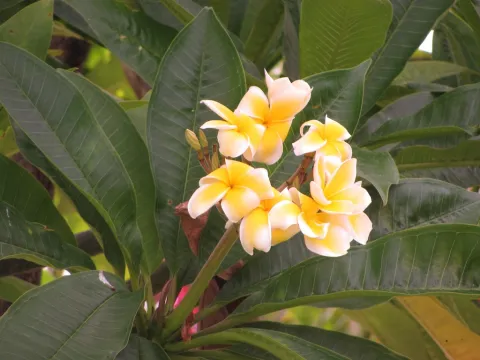
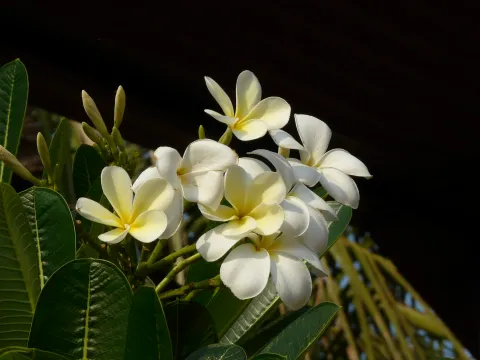
Throughout summer and into early autumn, Plumeria alba is adorned with waxy, fragrant flowers. White, with pink, yellow or red centers. The five obtuse, fleshy sepals do not overlap. This distinguishes Plumeria alba from white-flowering Plumeria rubra.
Is Plumeria alba toxic?
Plumeria alba contains an irritating sap. This white latex, which runs off during pruning, causes skin irritation in people with sensitive skin. The plant is also toxic to animals if ingested. It can cause stomach ache, nausea and vomiting.
The flowers are edible, however, and are sometimes used in pastries or to decorate dishes.
Our care tips
Plumeria alba is an outdoor plant that needs plenty of light, at least 6 hours of sun a day, to thrive. On the other hand, it is sensitive to cold.
If temperatures fall below 10°C in your area, grow your plant in a pot. This way, you can easily bring it into a conservatory, heated greenhouse or bright interior during the winter.
 Watering
Let the soil dry out on the surface between waterings. Water your Plumeria alba with non-hard water, such as collected rainwater. To avoid water stress, make sure the water is at room temperature.
If you use a saucer or a planter, remove any standing water from the bottom. It may cause the roots to rot.
 Misting
To provide your Plumeria alba with the necessary humidity, mist its foliage with non-calcareous water at room temperature. If filtered water is not available, you can collect rainwater and use it for misting.
 Repotting
Plumeria alba need a light, perfectly draining substrate. We recommend using :
- 2/3 potting soil for cacti and succulents or Mediterranean plants;
- 1/3 perlite or sand.
Choose a pierced pot, slightly larger than the previous one. A terracotta pot is ideal for aeration and substrate drying.
Fill the pot, install your Plumeria alba, tamp gently and water to help the plant take root.
 Fertilization
To promote the growth of your Plumeria alba, apply fertilizer in spring and summer.
Apply a liquid fertilizer for flowering plants every two weeks to encourage flowering.
 Prune
Prune
You can remove wilted flowers as they appear.
Pruning is not necessary. Moreover, too severe pruning prevents summer flowering.
If you wish to control shape or development, prune gradually: part one year, the rest the following year.
 Planting
When the risk of frost has passed, it's time to plant.
Soak the root ball of your Plumeria alba to rehydrate it. Meanwhile, dig a hole at least 50 cm deep and wide and remove weeds, roots and stones.
Plant your Plumeria alba, making sure that the collar is level with the ground. Fill in with garden soil enriched with compost. If you're planting several specimens, space them at least three meters apart.
Mulch to protect from the cold and water to encourage rooting.
 Taking cuttings
Cutting is carried out during the strong growth phase, generally in spring and early summer.
Select a healthy, vigorous stem. Take a section about 20 cm long, cutting just below a node.
Run the cutting under water to stop the latex leaking out. Remove all leaves so that the plant can concentrate its energy on rooting.
Leave the cutting to dry for 1-2 weeks, until the wound has healed.
In a pierced pot, pour a light substrate composed of :
- 2/3 potting soil for cacti, succulents or Mediterranean plants
- 1/3 perlite
Moisten the substrate by spraying. Make a pre-hole with your finger or a stick, then insert the cutting.
Place in a well-lit spot, at a temperature of at least 25°C. Keep the substrate slightly but not excessively moist.
When the first leaves appear, the cutting has taken root. You can then reduce watering and grow your Plumeria alba as a mature plant.
Frequently asked questions
Is it possible to plant a frangipani in France?
You can only plant a frangipani such as Plumeria alba in the ground in regions where it doesn't freeze. In fact, the plant dies below 0°C. More often than not, frangipani are grown in pots so that they can be stored in a conservatory or heated greenhouse in winter.
Is Plumeria alba an indoor or outdoor plant?
Plumeria alba is an outdoor plant. In fact, it's a shrub that can reach two meters in height, making it unsuitable for small spaces and apartments. What's more, frangipani needs a lot of light, making it difficult to grow indoors. But it doesn't tolerate frost. If you live in a region with cool winters, grow your shrub in pots so that it can spend spring and summer outdoors. Bring it indoors in a greenhouse or veranda when the mercury dips below 10°C.
What does frangipani smell like?
Frangipani flowers have a scent similar to that of certain jasmines: a mixture of almond and vanilla.
Diseases / Threats
Information
- Lifecycle
- Perennial
- Foliage
- Deciduous
- Exposure
- Sun
- Substrates
- Humus soilSandy soil
- Planting methods
- Open groundIn potsIn tubs
- Tags
- FloweryCold-sensitiveToxicEdible flower
- Origin
- Central America
- Hardiness (USDA)
- 11a (4.4°C ≤ T° < 7.2°C)
- Leaf color
- Dark green
- Flower color
- White
Discover plants from the same family
Find out more
Find all our tips in the Monstera application