Aeonium haworthii, a multifaceted succulent
Aeonium haworthii
- Exposures
- Sun, Half-shade
- Hardiness (USDA)
- 9b (-3.9°C ≤ T° < -1.1°C)
- Lifecycle
- Perennial
- Foliage
- Evergreen
- Family
- Crassulaceae
- Genus
- Aeonium
- Species
- Haworth's Aeonium Aeonium haworthii
Other name:Sempervivum haworthii
The Crassulaceae family is found all over the world. In the Canaries, it can count on Aeonium haworthii and its green and red leaves to represent it with dignity.
How to recognize Aeonium haworthii?
Aeonium haworthii is a succulent shrub with a bushy habit, measuring up to 60 cm in height and 40 cm in spread.
The lignified stem gives rise to aerial roots and slender, twisting branches. These support rosettes of concave leaves.
The fleshy, spatulate leaves are bluish-green. Their margins are edged with a red border and very fine cilia.
Outside its natural habitat, Aeonium haworthii flowers less readily than aeonium cuneatum. Nevertheless, you may see pale yellow or pinkish flowers grouped in a flattened bouquet.
The plant is not toxic to humans or pets. You can grow and handle it without fear.
Our care tips
If you live in a frost-free region, you can plant your Haworth's Aeonium in the ground, provided the soil remains dry.
Elsewhere, it's best to opt for a pot culture and bring your Haworth's Aeonium into your conservatory or living room when temperatures drop. The good news is that it's in winter, when the plant is growing, that it reveals all its beauty!
 Watering
When it's very hot, your plant needs to be watered accordingly, as it goes into vegetative mode to protect itself.
Potted plants need regular watering. However, to avoid root rot, allow the substrate to dry out between waterings.
You can use mains water. If it's hard, use reclaimed rainwater instead.
Don't forget to remove any stagnant water from the dish.
It is advisable not to water during this period.
 Misting
Your Aeonium haworthii hates wet foliage. Don't mist the plant.
 Repotting
Re-pot your Haworth's Aeonium in a pierced pot. Line the bottom with pebbles or clay balls to improve drainage.
Aeonium haworthii appreciate well-drained soil. You can use a substrate for cacti and succulents, or mix garden soil with river sand.
Pour a little potting soil into the pot and plant your specimen. Don't hesitate to push in the stem a third of the way up. This way, the plant will be more stable and produce more roots. Fill with potting soil and press down to remove air bubbles.
 Prune
To encourage the growth of your Haworth's Aeonium, prune regularly.
Carefully remove dead leaves when they appear.
Cut flower stems short at the end of the season.
 Planting
Your Aeonium haworthii loves light and hates humidity. Plant it in the sun and in a place where water won't stagnate after a shower, such as an embankment or the top of a slope.
Dig a hole twice the size of the root ball. Place pebbles or clay balls at the bottom to improve drainage. Plant your Aeonium haworthii and fill in with garden soil. You can add sand to lighten the soil. Press down to remove air bubbles.
 Taking cuttings
Cutting is carried out during the strong growth phase, generally in spring and early summer.
The mother plant produces shoots. Separate them with a clean knife. Leave to dry for 24 to 48 hours in the open air, until a wedge forms at the base.
Prepare a perforated pot. Place clay balls or pebbles in the bottom for drainage. Then fill with a light substrate, such as potting soil for cacti and succulents. Use a pencil or pick to make a hole.
Plant your Haworth's Aeonium. Bury the stem about a third of the way up. This way, your plant will form more roots and be more stable. But don't bury the leaves! Place your cutting in a bright room with a temperature of between 15 and 18°.
Wait a few weeks before watering, to allow the roots to form.
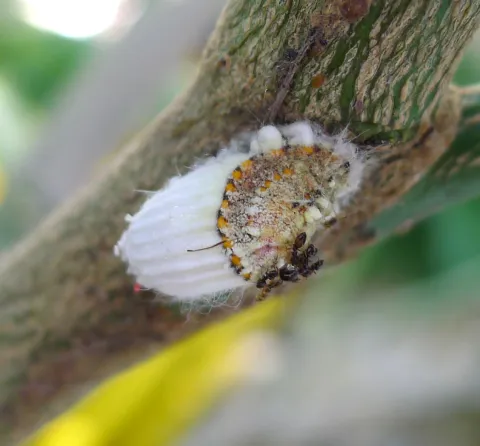
Disease / Threat
Information
- Lifecycle
- Perennial
- Foliage
- Evergreen
- Exposures
- SunHalf-shade
- Substrates
- Calcareous earthHumus soilSandy soil
- Planting methods
- Open groundIn potsIn tubs
- Tags
- Cold-sensitiveSmall pot
- Origin
- Southern Europe
- Hardiness (USDA)
- 9b (-3.9°C ≤ T° < -1.1°C)
- Leaf colors
- RedGlaucous green
- Flower color
- Yellow
Discover plants from the same family


Aeonium 'Zwartkop'
Aeonium arboreum 'Zwartkop'

Find out more
Find all our tips in the Monstera application








