Gonialoe sladeniana, a colorful little succulent
Gonialoe sladeniana
- Exposure
- Sun
- Hardiness (USDA)
- 9b (-3.9°C ≤ T° < -1.1°C)
- Lifecycle
- Perennial
- Foliage
- Evergreen
- Family
- Asphodelaceae
- Genus
- Gonialoe
- Species
- Gonialoe sladeniana
Other names:Aloe sladeniana, Tulista sladeniana, Aloe carowii
The late Queen of England made up for her small stature by wearing colorful outfits so she could be seen by everyone from a distance. It seems that Gonialoe sladeniana has adopted the same technique. This plant, no taller than a double decimeter, boasts variegated foliage and colorful blooms. A great way to stand out in the Namib Desert—or right in your own backyard!
How can you recognize Gonialoe sladeniana?
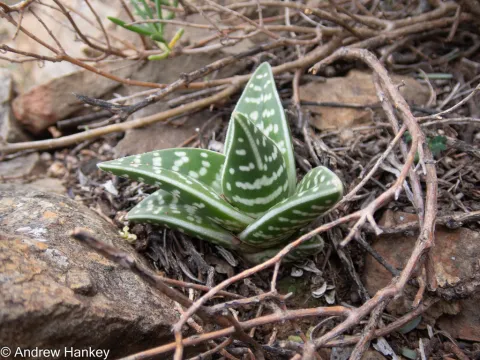
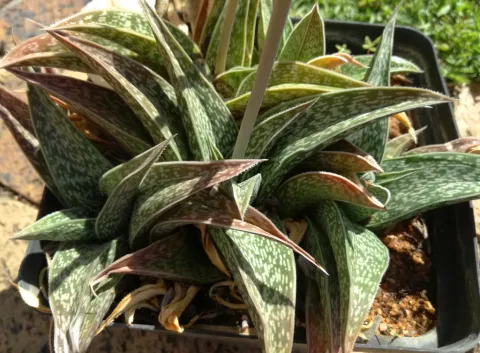
Gonialoe sladeniana is a succulent plant with a bushy growth habit. Smaller than gonialoe variegata, it reaches a maximum height of fifteen centimeters.
Gonialoe sladeniana is stemless. It forms a rosette of leaves arranged in three rows.
The triangular, fleshy leaves have a ridge on their underside. The leaf blades measure up to nine centimeters long by four wide. Dark green or grayish-green in color, they are dotted with white spots. Their white margins are finely toothed.
Flowering occurs in winter. A flower stalk at least 50 centimeters tall emerges from the rosette. It quickly becomes covered with pale pink flowers.
The plant is toxic to animals if ingested. It contains saponins, a substance that causes digestive upset. Be sure to keep your Gonialoe sladeniana out of reach of your dog or cat.
Our care tips
The Gonialoe sladeniana like light. But too much light can turn their leaves red. If you want your plant to keep its foliage green, avoid placing it in full sun.
 Watering
Water only when the soil has completely dried out. Use room-temperature water with low calcium content, such as rainwater.
Water generously to allow the leaves to soak up the water. Make sure any excess water has drained away before replacing your Gonialoe sladeniana. If necessary, remove any water that has accumulated in the saucer or planter.
 Misting
The Gonialoe sladeniana grow in arid regions and do not like humidity. No need to spray them.
 Repotting
In spring, transfer your Gonialoe sladeniana to a larger pot, so that it can continue to grow.
In a pierced pot, pour a layer of well-draining substrate. You can use commercially available potting soil for cacti and succulents, or make your own growing medium by mixing ordinary potting soil and sand.
Plant your Gonialoe sladeniana in the center and add soil. Be careful not to bury the leaves, and leave a watering basin.
Water generously to encourage rooting and expel air bubbles.
 Fertilization
You can stimulate the development of your plant during its growth phase, in spring and summer, with fertilizer.
You can feed your Gonialoe sladeniana with a fertilizer for cacti and succulents.
 Prune
Remove wilted flower stems. Cut flush with a clean, sharp tool (scissors, pruning shears, etc.), taking care not to damage the leaves.
 Planting
Once the last spring frosts have passed, you can plant.
The Gonialoe sladeniana like sun and hate having their roots in water. For your plant to flourish, choose a bright location with well-drained soil.
Dig a hole the size of the root ball. Plant your Gonialoe sladeniana without burying the crown. Fill in and press down.
If you want to achieve a ground-cover effect, space the plants about 50 centimetres apart.
 Sowing
Your seedlings need warmth. Summer is the best time to get started.
Prepare a mixture containing:
- One-third potting soil;
- One-third sand;
- One-third drainage material (gravel, perlite, or pozzolan).
Fill small pots with drainage holes with your substrate. Plant your seed.
Keep your seedlings in a bright room with a temperature of at least 20 degrees.
Mist the soil to keep it moist, but not soggy.
 Taking cuttings
Locate a young shoot and carefully separate it from the mother plant. Take care to remove its roots without damaging the rest of the root system.
In a pierced terracotta pot, pour a bed of clay balls or gravel to optimize drainage.
Prepare a mixture of one-third potting soil, one-third garden soil and one-third sand. Pour it into your pot, on top of the drainage layer. Plant your cutting and tamp it down.
Place the pot in a room where the temperature is always above 18 degrees. The location should be bright and out of direct sunlight. You can, for example, place your cutting behind a curtained window.
To avoid drowning the roots, always check the condition of the substrate before watering: the surface must be dry.
Disease / Threat
Information
- Lifecycle
- Perennial
- Foliage
- Evergreen
- Exposure
- Sun
- Substrates
- Calcareous earthSandy soil
- Planting methods
- Open groundIn potsIn tubsPlanter
- Category
- Succulent
- Tags
- BeginnerFloweryToxic
- Origin
- South Africa
- Hardiness (USDA)
- 9b (-3.9°C ≤ T° < -1.1°C)
- Leaf colors
- WhiteDark greenGreen-gray
- Flower color
- Pale pink
Discover plants from the same family
Find out more
Find all our tips in the Monstera application