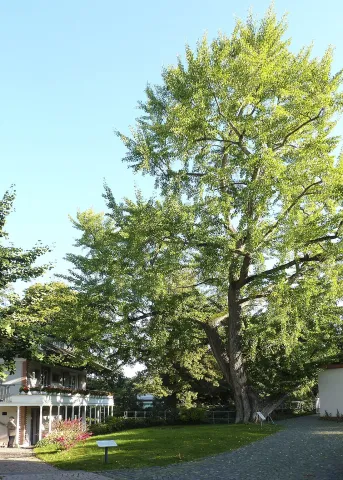
Ginkgo biloba 'Blagon', a small tree with 1,000 écus
Ginkgo biloba 'Blagon'
- Exposure
- Sun
- Hardiness (USDA)
- 5a (-28.9°C ≤ T° < -26.1°C)
- Lifecycle
- Perennial
- Foliage
- Deciduous
- Family
- Ginkgoaceae
- Genus
- Ginkgo
- Species
- Ginkgo biloba
Other name:Ginkgo biloba Fastigiata Blagon
Ginkgo biloba is one of the oldest trees known (it was already found in the time of the dinosaurs). But the 'Blagon' variety is much more recent. Selected in France in the 1990s , this male clone is distinguished by its compact habit and, above all, by the absence of unpleasant-smelling ovules.
How to recognize Ginkgo biloba 'Blagon'?
Smaller than the botanical ginkgo biloba, Ginkgo biloba 'Blagon' is at best 15 m tall and has a wingspan of 2. It retains a narrow, compact, columnar habit in adulthood.
Its flat leaves resemble fans. They have two lobes, but no midrib. In spring and summer, the foliage is green, turning golden in autumn before fading in winter.
Ginkgo biloba 'Blagon' is a sterile horticultural variety. It does not produce the fleshy, yellow ovules, which give off a rotten or vomit-like smell when they decompose on the ground.
Is Ginkgo biloba 'Blagon' toxic?
Ginkgo biloba ovules contain toxic substances that cause skin irritation if touched, and digestive disorders if eaten. As the 'Blagon' variety is sterile, it is safe for us and our pets.
Our care tips
Ginkgos biloba 'Blagon These are very hardy trees. Once planted in the ground, they require almost no care. When grown in pots, however, regular watering and repotting are necessary.
 Watering
Water when the substrate is dry on the surface, for about three centimeters. Use non-calcareous water, such as rainwater, filtered water or mineral water.
Don 't let water stagnate in the planter or saucer, as it may rot the roots.
 Repotting
Obtain a deep pierced pot of at least 30 liters, slightly larger than the previous one.
You can place a layer of clay balls or gravel at the bottom to improve drainage.
Then pour in a rich, well-draining substrate, such as shrub or citrus potting soil. Plant your Ginkgo biloba 'Blagon'. Tute it to help the trunk grow straight.
Press down and water generously, until water runs off through the drainage holes. Copious watering flushes out air bubbles and encourages rooting.
 Fertilization
You can stimulate the growth of your plant during its growth phase, in spring and summer, with fertilizer.
The substrate is rapidly depleting. As you don't repot every year, feed your Ginkgo biloba 'Blagon with a soluble tree and shrub fertilizer.
 Prune
Pruning is not mandatory. However, you can remove dead wood and tangled branches.
 Planting
Once the last spring frosts have passed, you can plant.
Choose a secluded spot, at least 3 meters from other plants and your house.
Soak the rootball to rehydrate it.
Dig a hole 2.5 times deeper than the root ball. Work the soil to loosen and aerate it. Place a layer of compost or manure at the bottom to enrich it, and cover with a little soil.
Plant your Ginkgo biloba 'Blagon'. The root ball should be completely buried. Add a stake to help the trunk grow straight.
Fill in with garden soil and form a watering basin. Water copiously to expel air bubbles and encourage rooting.
You can mulch the soil to keep it fresh.
 Taking cuttings
Cutting is carried out during the strong growth phase, generally in spring and early summer.
Locate a semi-arched stem. Take a 10-15 cm section with at least 2 or 3 knots. Use a clean, sharp tool such as pruning shears.
Remove half the foliage at the bottom. Reduce the size of the leaves you keep by 50% to limit evapotranspiration.
Fill a bucket or pierced pot with potting soil for seedlings and cuttings. Make a hole in the center with a pick. Plant your Ginkgo biloba 'Blagon cutting and water.
Cuttings take better if they've been suffocated. You can place your pot in a transparent crate or cover it with a translucent plastic bag.
Remember to water regularly to keep the soil moist and aerate for a few minutes each day to prevent rotting.
Grow young shoots in the open air when the first signs of recovery appear.
Frequently asked questions
Are Ginkgo biloba roots invasive?
Ginkgo biloba roots are no more invasive than those of other trees. You can plant your tree close to a house or terrace without any major risk, as long as you respect a standard planting distance(around 3 to 5 meters). Its taproot, however, needs to be planted in deep soil.
Can Ginkgo biloba withstand frost?
Yes, Ginkgo biloba is very cold-resistant. This tree can withstand temperatures from -20°C to -30°C. Mature specimens are particularly hardy, but young plants require light winter protection (mulch, winter fleece) during their first few years.
Information
Discover plants from the same family
Find out more
Find all our tips in the Monstera application