Cyclamen purpurascens, the Alpine cyclamen
Cyclamen purpurascens
- Exposures
- Half-shade, Shade
- Hardiness (USDA)
- 6b (-20.6°C ≤ T° < -17.8°C)
- Lifecycle
- Perennial
- Foliage
- Evergreen
- Family
- Primulaceae
- Genus
- Cyclamen
- Species
- Cyclamen purpurascens
A summer-flowering Cyclamen, Cyclamen purpurascens belongs to the Primulaceae family. This variety grows naturally in European undergrowth, from France to Hungary.
How to recognize Cyclamen purpurascens, the Alpine cyclamen?
Cyclamen purpurascens is an upright perennial no more than 15 cm high.
Underground, it develops a tuberous reserve organ, the corm, which gives rise to fibrous roots and aerial buds.
Unlike the Persian Cyclamen (Cyclamen persicum), Cyclamen purpurascens has evergreen foliage. The fleshy, cordate or kidney-shaped leaves are dark green on the upper surface. They are ornamented with light-green veins and patterns. The underside is purplish red.
Cyclamen purpurascens blooms in summer. The flowers consist of five tepals fused together at the base. They are purple with dark throats.
Alpine Cyclamen is a toxic plant, especially the root. It contains cyclamine, a dangerous substance with curare-like effects. When ingested, it causes digestive disorders (vomiting, nausea, diarrhea), respiratory problems and even muscular paralysis.
Our care tips
Avoid wetting the foliage when watering your Cyclamen purpurascens. Use a long-spout sprinkler and water around the edge of the pot. You can also water by capillary action.
 Watering
Adjust watering when the plant is flowering or producing flower buds.
To find out if your plant is thirsty, stick your finger in the soil. When the surface is dry (about three centimetres), then you need to water your Cyclamen purpurascens. Cyclamen purpurascens like moisture, but not stagnant water. Make sure that the potting soil remains moist, but that the rootlets are not drowned.
If you can, use non-calcareous water such as rainwater or filtered water.
Also make sure that water doesn't stagnate in the saucer or planter.
If you can, use non-calcareous water such as rainwater or filtered water.
Also make sure that water doesn't stagnate in the saucer or planter.
Feed your Cyclamen purpurascens only when the substrate has dried thoroughly (at least five centimeters). Water generously with room-temperature rainwater and let the excess run off through the drainage holes.
Drain off any stagnant water in the dish or planter. It will rot the roots.
Adjust watering during summer.
It is advisable not to water during this period.
 Repotting
Get a perforated pot. You can line the bottom with clay balls or gravel to optimize drainage.
Fill your pot with a mixture of houseplant potting soil (75%) and heather soil (25%). Plant your tuber. The rounded side should be at the bottom. Cover with three to four centimetres of soil.
The soil is already moist, so you don't need to water.
 Fertilization
Feed your Cyclamen purpurascens with a fertilizer for green or flowering plants.
 Prune
You can remove wilted flowers as they appear.
 Planting
Dig a hole about 15 centimetres deep. Plant your bulb. The rounded side is the underside and should face the ground. The hollow side is the top and should face upwards. Cover your bulb with garden soil to reach ground level.
 Sowing
Your seedlings need warmth. Summer is the best time to get started.
Soak seeds in lukewarm water for 48 hours.
Pour seedling soil into pots. Plant two to three seeds per pot.
Keep the substrate moist by spraying regularly.
Diseases / Threats

Information
- Lifecycle
- Perennial
- Foliage
- Evergreen
- Exposures
- Half-shadeShade
- Substrate
- Humus soil
- Planting methods
- Open groundIn potsIn tubsPlanter
- Categories
- BulbFlowery
- Tags
- BeginnerFloweryHardyToxic
- Origins
- Eastern EuropeWestern Europe
- Hardiness (USDA)
- 6b (-20.6°C ≤ T° < -17.8°C)
- Leaf color
- Dark green
- Flower color
- Violet
Discover plants from the same family

Naples Cyclamen
Cyclamen hederifolium
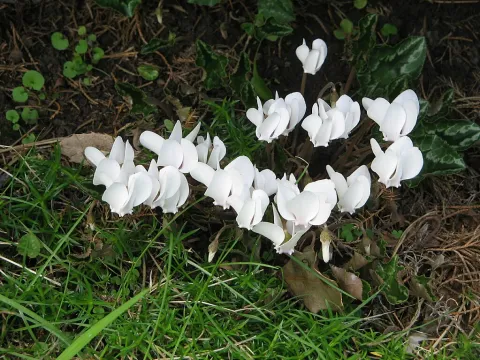
White Naples Cyclamen
Cyclamen hederifolium 'Album'

Persian Cyclamen
Cyclamen persicum

Caucasian Cyclamen
Cyclamen coum
Find out more
Find all our tips in the Monstera application








