Crassula ovata 'Minor', the dwarf jade tree
Crassula ovata 'Minor'
- Exposures
- Sun, Half-shade
- Hardiness (USDA)
- 11a (4.4°C ≤ T° < 7.2°C)
- Lifecycle
- Perennial
- Foliage
- Evergreen
- Family
- Crassulaceae
- Genus
- Crassula
- Species
- Crassula ovata
Other names:Crassula ovata 'Crosby's compact', Crassula ovata 'Minima'
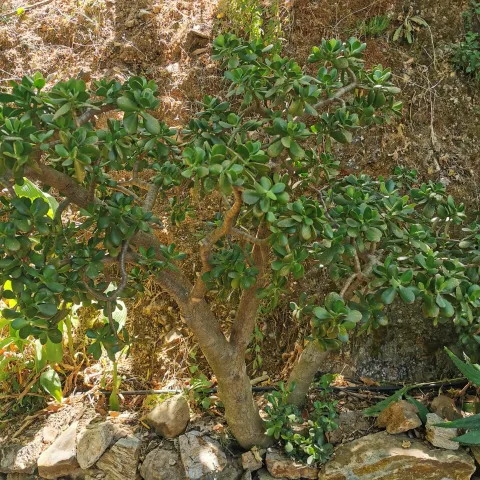
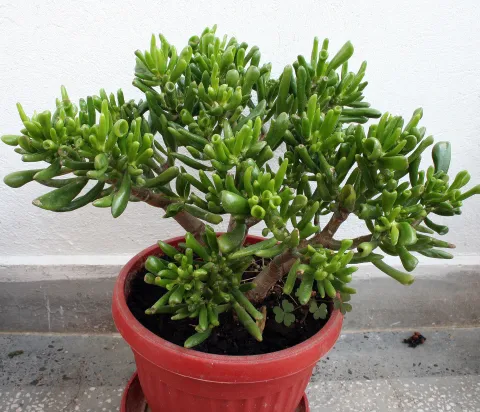
Crassula ovata 'Minor' is a dwarf Jade tree. As a cultivated variety, it differs from the botanical variety in that it is slightly smaller and has slightly smaller leaves. However, it has the same emerald-green foliage.
How can you recognize Crassula ovata 'Minor'?
Crassula ovata 'Minor' is a compact succulent shrub ideal for bonsai cultivation. It does not exceed 90 centimeters in height when mature.
The smooth, gray trunk becomes woody and branches out over time. The fleshy, oval-shaped leaves stand upright at the tips of the branches. The dark green leaf blades share the same characteristic as those of Crassula ovata 'Hobbit' they turn red in the summer when the sun is at its strongest.
But the color change isn't the only surprise this shrub has in store for you! In winter, the plant is adorned with corymbs of star-shaped flowers. White in color, they reveal pearly pink highlights.
Crassula ovata 'Minor' is toxic to humans and animals. Its sap causes burns to the skin and mucous membranes. It can also cause stomachaches.
Our care tips
Your Crassula ovata 'Minor' needs only two things: abundant watering and plenty of light. Don't hesitate to take your plant outside in summer to enjoy the sunny days!
 Watering
Only water your Crassula ovata 'Minor' when the substrate is dry. If you're not sure what your plant needs, observe it: when it's thirsty, its leaves become hollow and stunted.
Avoid tap water, which is often too hard. Instead, use room-temperature rainwater or demineralized water.
Thirty minutes after watering, empty any stagnant water from the saucer or planter to prevent root rot.
 Misting
Crassula ovata 'Minor' grow in arid regions and do not like humidity. No need to spray them.
 Repotting
In spring, transfer your Crassula ovata 'Minor' to a larger pot, so that it can continue to grow.
Choose a pierced terracotta or plastic pot. The latter has the advantage of retaining moisture longer. Place a layer of clay balls at the bottom (about a quarter of the way up). Top up with special potting soil for cacti or fat plants. You can also mix ordinary substrate with sand or perlite.
Plant your succulent and tamp down to eliminate air pockets. Then water for the first time.
 Fertilization
You can stimulate the development of your plant during its growth phase, in spring and summer, with fertilizer.
If you want to stimulate the growth of your Crassula ovata 'Minor', mix a liquid fertilizer for cacti and succulents with the water when watering.
 Cleaning
To promote photosynthesis, remove any dust that accumulates on the leaves with a feather duster or a clean, damp cloth.
 Prune
Remove dry leaves. They exhaust the plant and slow its growth. If you use an instrument (pruning shears, scissors), make sure it's clean.
If you wish to control the development or shape of your plant, you can work on it. Just be sure to cut between two nodes or at the base of the trunk.
Always use a clean, sharp tool (pair of scissors, pruning shears).
Always use a clean, sharp tool (pair of scissors, pruning shears).
 Planting
Once the last spring frosts have passed, you can plant.
Where's the best place to plant your Crassula ovata 'Minor'? A sunny spot at the top of a slope, to encourage rainwater drainage.
Dig a large hole to give the roots room to spread out. As for repotting, place a layer of gravel at the bottom, followed by a layer of substrate. Place your plant in the center and cover with soil, possibly enriched with leaf compost. Press down to eliminate air pockets and water.
 Taking cuttings
Propagation by cuttings is carried out during the strong growth phase, generally in spring and early summer.
Using disinfected and sharpened pruning shears or scissors, remove a ten-centimeter stem (two leaf levels).
To allow the graft to heal, lay it flat in a ventilated room, out of direct sunlight, for two days.
Prepare a pierced terracotta pot. Block the hole with a pebble and lay a bed of gravel. Pour in a substrate composed of one third potting soil, one third soil and one third sand to promote drainage. Plant your offshoot, tamp it down and add a layer of sand to the surface.
Place your new succulent in a bright room, but without direct sunlight and with a temperature of at least 18 degrees.
Between two applications of water, check that the substrate has dried out, as you would with a mature plant.
Disease / Threat
Information
- Lifecycle
- Perennial
- Foliage
- Evergreen
- Exposures
- SunHalf-shade
- Substrate
- Sandy soil
- Planting methods
- Open groundIn pots
- Tags
- BeginnerHard to killSmall pot
- Origin
- South Africa
- Hardiness (USDA)
- 11a (4.4°C ≤ T° < 7.2°C)
- Leaf color
- Dark green
- Flower colors
- WhiteRose
Discover plants from the same family


Find out more
Find all our tips in the Monstera application