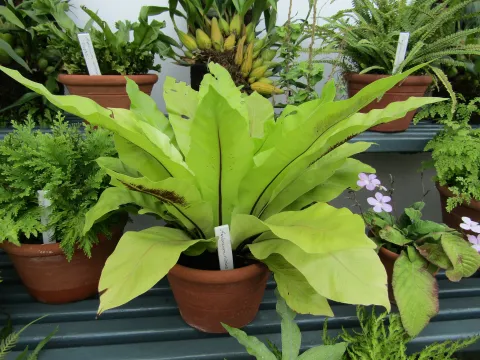
Asplenium antiquum 'Crissie', a bird's nest fern with forked fronds
Asplenium antiquum 'Crissie'
- Exposures
- Half-shade, Shade
- Hardiness (USDA)
- 11b (7.2°C ≤ T° < 10°C)
- Lifecycle
- Perennial
- Foliage
- Evergreen
- Family
- Aspleniaceae
- Genus
- Doradilla Asplenium
- Species
- Asplenium antiquum
Other name:Asplenium nidus 'Crissie'
Asplemium antiquum 'Crissie' thrives in the tropical forests of Japan, Polynesia and Australia. This fern of the Aspleniaceae family can be recognized at a glance by its elkhorn fronds.
How to recognize Asplenium antiquum 'Crissie'?
Asplenium antiquum 'Crissie' is an epiphytic fern with a compact habit. It can reach a height of 90 centimetres and a spread of 1.5 metres.
The leaves emerge from the rosette. Initially folded into a crozier shape, they then reveal a bright green frond with a raised central vein. Coriaceous, long and narrow, their tips are divided into several forks. Some see it as an elk horn, others as a ninja turtle hand. One thing's for sure, this feature makes it easy to distinguish Asplenium antiquum 'Crissie' from botanical asplenium antiquum or asplenium nidus 'Crispy Wave.
Asplenium antiquum 'Crissie' is harmless to humans and animals. Its evergreen foliage is non-toxic to the touch and if ingested. So you can grow it without risk even if you live with dogs, cats and babies.
Our care tips
Asplenium antiquum 'Crissie love humidity and hate direct sunlight. If your bathroom has a window, it's the ideal place to watch your fern flourish.
 Watering
Asplenium antiquum 'Crissie like to keep the soil always moist. Don't wait for the substrate to dry before getting out your watering can. Water without soaking to keep the soil wet.
Use non-calcareous water at room temperature, preferably rainwater. Be careful not to wet the heart of the plant, which is sensitive to rot.
Don't forget to empty the water that stagnates in the saucer or pot cover. It could kill the roots.
 Misting
To increase humidity, mist the leaves at Asplenium antiquum 'Crissie' with rainwater or demineralized water. Do not use tap water. Too hard, it leaves marks on the foliage.
 Repotting
Every year in the spring, repot your Asplenium antiquum 'Crissie' to give it more space.
Choose a pierced plastic pot two to five centimetres larger than the previous one. This material has the advantage of retaining moisture and is suitable for the requirements of your Asplenium antiquum 'Crissie'. Place a drainage layer (gravel, clay balls, pozzolan, etc.) at the bottom.
Fill the pot with a light, neutral substrate. For example, you can mix houseplant potting soil, peat or dried leaves and sand. You can also add charcoal to prevent fungus growth. Plant your specimen in the center. Add substrate, tamp down and water for the first time to help the plant take root.
To increase humidity, place your pot on a dish filled with moist clay balls.
 Fertilization
To promote the growth of your Asplenium antiquum 'Crissie', apply fertilizer in spring and summer.
Apply a liquid green plant fertilizer to support growth. Your fern doesn't need much. Halve the manufacturer's recommended dose.
 Cleaning
 the leaves with a clean, damp cloth removes dust and limits pest attacks.
Disease / Threat
Information
- Lifecycle
- Perennial
- Foliage
- Evergreen
- Exposures
- Half-shadeShade
- Substrates
- Clay soilHumus soilSandy soil
- Planting methods
- In potsIn tubs
- Categories
- IndoorHerbaceous
- Tags
- Cold-sensitiveThirsty
- Origins
- East AsiaAustralia
- Hardiness (USDA)
- 11b (7.2°C ≤ T° < 10°C)
- Leaf color
- Light green
Discover plants from the same family

Bird's nest fern
Asplenium nidus

Asplenium nidus 'Crispy Wave
Asplenium nidus 'Crispy Wave'
Find out more
Find all our tips in the Monstera application








