Agave americana variegata, the agave with green and yellow leaves
Agave americana subsp. americana
- Exposure
- Sun
- Hardiness (USDA)
- 9a (-6.7°C ≤ T° < -3.9°C)
- Lifecycle
- Perennial
- Foliage
- Evergreen
- Family
- Asparagaceae
- Genus
- Agave
- Species
- American Agave Agave americana
Other names:Agave altissima, Agave americana var. elegantissima, Agave americana foliis-variegatis, Agave americana var. marginata, Agave variegata
Agave americana variegata, in Latin Agave americana subsp. Americana, is a subspecies of Agave americana (Agave americana) that grows naturally in Arizona, Texas and Mexico. Like its big sister, it has large, fleshy leaves. But its leaves are more colorful.
How to recognize Agave americana variegata (Agave americana subsp. Americana)?
Agave americana variegata forms a rosette of leaves up to two meters high and three meters wide. This succulent perennial plant has an upright, splayed habit.
Leaves can reach two meters long and 20 centimeters wide. Stiff and succulent, they are edged with spines and terminate in a sharp sting. Agave americana and Agave americana variegata can be distinguished by the color of their foliage. Solid green in the former, with yellow margins in Agave americana variegata.
After ten or fifteen years, Agave americana flowers. It produces a ten-metre-high flowering spike on which white flowers grow in a panicle. But this flowering is a swan song. The monocarpic plant dies a few months later. Before that, it produces shoots at its base, in order to multiply.
Americana variegata sap contains saponins and calcium oxalate crystals. These toxic substances cause irritation when they come into contact with the skin, and discomfort if ingested. In addition, prickly thorns can cause injury. Keep your plant away from pets and wear gloves when repotting.
Our care tips
Agave americana variegata are low-maintenance plants. However, they are sensitive to cold and excess humidity. Unless you live in a region with dry, mild winters, grow your plant in a pot. You'll then be able to bring it in before the first frost.
 Watering
Agave americana variegata plants need copious watering when the soil is completely dry. To know if your plant is thirsty, look at it: when it lacks water, its leaves change appearance. They become hollow, wrinkled or point downwards.
Water with room-temperature water, preferably non-calcareous, until the substrate is saturated with water, then allow the plant to drain before replacing it. Don't forget to drain off any water stagnating at the bottom of the planter or saucer. It could rot the roots.
 Spray
Spray
Agave americana variegata grow in arid regions and do not like humidity. No need to spray them.
 Repotting
Every spring, repot your Agave americana subsp. Americana to give it more space.
Obtain a pot with holes deep enough to accommodate the roots of your Agave americana variegata. Preferably use a terracotta model to ensure even drying of the potting soil after watering.
Pour a drainage layer (clay balls, gravel, etc.) into the bottom of the pot to allow excess water to drain off, followed by potting soil. Choose a light, well-draining substrate, such as a mix for cacti and succulents, or ordinary potting soil with sand. Plant your Agave americana variegata in the center and add soil. Stop a few centimetres from the edge and tamp gently to remove air bubbles.
Wait a few days after repotting before watering. The potting soil is already damp and agave americana variegata do not like excess humidity.
 Fertilization
To promote the growth of your Agave americana subsp. Americana, apply fertilizer in spring and summer.
Add cactus and succulent fertilizer to watering water.
If you're repotting every year, there's no need to add fertilizer. Your plant will find sufficient nutrients in its substrate.
 Prune
Prune
To encourage the growth of your Agave americana variegata, prune regularly.
Using a clean, sharp pruning shears, remove the wilted leaves.
 Plantation
When the risk of frost has passed, it's time to plant.
Your Agave americana subsp. Americana loves light and hates humidity. Plant it in the sun and in a place where water won't stagnate after a shower, such as an embankment or the top of a slope.
Dig a hole twice the size of the root ball. Place pebbles or clay balls at the bottom to improve drainage. Plant your Agave americana subsp. Americana and fill in with garden soil. You can add sand to lighten the soil. Press down to remove air bubbles.
 Cutting
Cutting is carried out during the strong growth phase, generally in spring and early summer.
The mother plant produces shoots. Separate them with a clean knife. Leave to dry for 24 to 48 hours in the open air, until a wedge forms at the base.
Obtain a pierced pot adapted to the size of your cutting. Fill it with a light, draining substrate, such as a mixture of sand and potting soil for cuttings, or potting soil for cacti and succulents. Plant your Agave americana subsp. Americana and tamp it down.
The substrate is already damp and agave americana variegata dislikes excess water. Wait at least a week before watering.
Disease / Threat
Information
- Lifecycle
- Perennial
- Foliage
- Evergreen
- Exposure
- Sun
- Substrates
- Calcareous earthSandy soil
- Planting methods
- Open groundIn potsIn tubs
- Category
- Succulent
- Tags
- BeginnerFritillaryLarge potToxic
- Origins
- North AmericaCentral America
- Hardiness (USDA)
- 9a (-6.7°C ≤ T° < -3.9°C)
- Leaf colors
- Dark greenYellow
- Flower color
- White
Discover plants from the same family
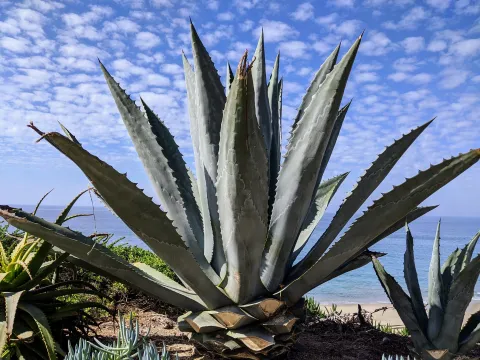
American Agave
Agave americana
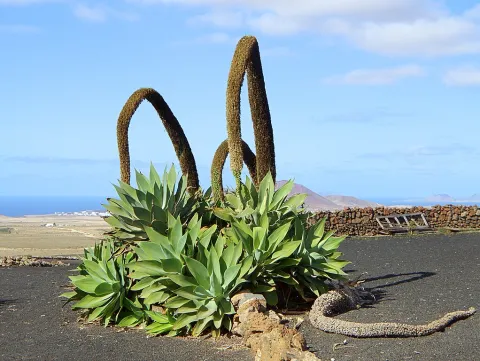
Swan-necked Agave
Agave attenuata
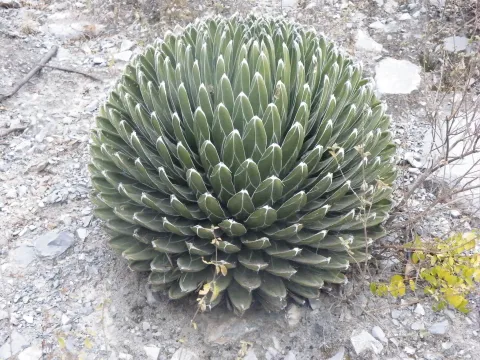
Queen Victoria Agave
Agave victoriae-reginae
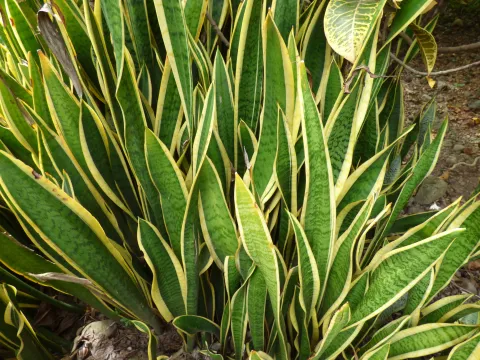
Mother-in-law's language
Sansevieria trifasciata
Find out more
Find all our tips in the Monstera application