Aeonium urbicum, the giant Aeonium
Aeonium urbicum
- Exposures
- Sun, Half-shade
- Hardiness (USDA)
- 9b (-3.9°C ≤ T° < -1.1°C)
- Lifecycle
- Perennial
- Foliage
- Evergreen
- Family
- Crassulaceae
- Genus
- Aeonium
- Species
- Aeonium urbicum
Aeonium urbicum, a plant of the Crassulaceae family, spreads its broad rosettes of leaves over the island of Tenerife. The foliage is slightly different when this succulent grows in the north or south of the island.
How to recognize Aeonium urbicum?
Aeonium urbicum is a succulent plant with a tree-like habit. It can grow up to two meters high in its natural environment.
Some Aeoniums, such as Aeonium virgineum, appear aculeate. But not Aeonium urbicum! It's impossible to miss its thick, rigid, brown stem: it can grow up to a metre high.
The stem rarely branches. At the top, it bears a single rosette of leaves50 centimetres in diameter.
The succulent leaves are up to 25 centimetres long. As with aeonium leucoblepharum, color depends on where the plant grows. In the north of the island, Aeonium urbicum has dark green foliage. In the south, the leaves are brown in summer.
Aeonium urbicum is a monocarpic plant: it flowers once and then dies. It blooms at the top of a 40-centimetre flowering spike. Flowers with white or pink petals form a pyramidal spike.
Aeonium is non-toxic. It is harmless to animals if ingested, and to the skin on contact.
Our care tips
If you live in a frost-free region, you can plant your Aeonium urbicum in the ground, provided the soil remains dry.
Elsewhere, it's best to opt for a pot culture and bring your Aeonium urbicum into your conservatory or living room when temperatures drop. The good news is that it's in winter, when the plant is growing, that it reveals all its beauty!
 Watering
When it's very hot, your plant needs to be watered accordingly, as it goes into vegetative mode to protect itself.
When the soil is dry on the surface, for about five centimetres, water generously, but without flooding the pot. Use non-calcareous water, such as rainwater. If you don't have any, you can use tap water that has been left to stand for 24 hours. Always ensure that the water is at room temperature.
As with most plants, stagnant water causes roots to rot. If your Aeonium urbicum pot is on a saucer, empty it after watering. If your plant is too large to be moved, raise the pot above the saucer (by placing it on gravel or clay balls) or remove the saucer.
Do not water during this period.
 Misting
Your Aeonium urbicum hates wet foliage. Don't mist the plant.
 Repotting
Re-pot your Aeonium urbicum in a pierced pot. Line the bottom with pebbles or clay balls to improve drainage.
Aeonium urbicum appreciate well-drained soil. You can use a substrate for cacti and succulents, or mix garden soil with river sand.
Pour a little potting soil into the pot and plant your specimen. Don't hesitate to push in the stem a third of the way up. This way, the plant will be more stable and produce more roots. Fill with potting soil and press down to remove air bubbles.
 Prune
To encourage the growth of your Aeonium urbicum, prune regularly.
Remove dried leaves.
Cut back flower stems when flowers have wilted. If you use a tool, make sure it's clean and sharp.
 Planting
Choose a sunny, well-drained location, such as the top of a slope or embankment.
Dig a hole two to three times larger than the root ball. Place pebbles at the bottom to improve drainage.
Plant your Aeonium urbicum and backfill. If your soil is heavy, mix it with river sand. Tamp down to remove air bubbles.
 Taking cuttings
Cutting is carried out during the strong growth phase, generally in spring and early summer.
Remove a shoot. Use a clean, sharp knife if necessary.
Leave the young shoot to dry for 24 to 48 hours, until it has healed.
Leave the young shoot to dry for 24 to 48 hours, until it has healed.
Prepare a perforated pot. Place clay balls or pebbles in the bottom for drainage. Then fill with a light substrate, such as potting soil for cacti and succulents. Use a pencil or pick to make a hole.
Plant your Aeonium urbicum. Bury the stem about a third of the way up. This way, your plant will form more roots and be more stable. But don't bury the leaves! Place your cutting in a bright room with a temperature of between 15 and 18°.
Wait a few weeks before watering, to allow the roots to form.
Disease / Threat
Information
- Lifecycle
- Perennial
- Foliage
- Evergreen
- Exposures
- SunHalf-shade
- Substrates
- Calcareous earthHumus soilSandy soil
- Planting methods
- Open groundIn potsIn tubs
- Tags
- Cold-sensitiveLarge pot
- Origin
- Southern Europe
- Hardiness (USDA)
- 9b (-3.9°C ≤ T° < -1.1°C)
- Leaf colors
- Light greenRedBrown
- Flower color
- White
Discover plants from the same family
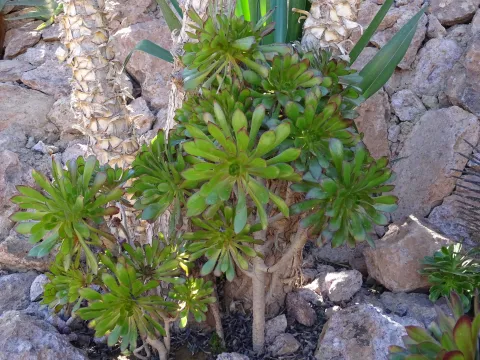
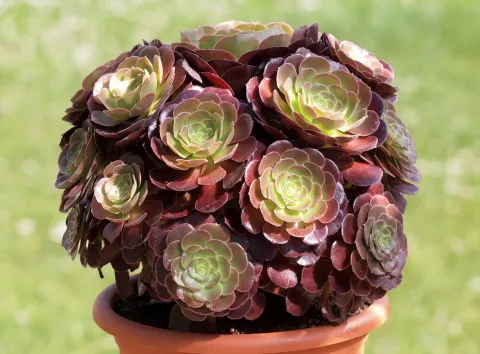
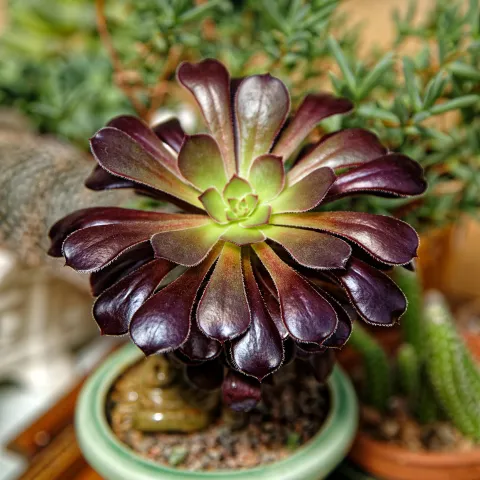
Aeonium 'Zwartkop'
Aeonium arboreum 'Zwartkop'
Find all our tips in the Monstera application