Aeonium canariense subsp. virgineum, an Aeonium with delicate foliage
Aeonium canariense subsp. virgineum
- Exposures
- Sun, Half-shade
- Hardiness (USDA)
- 10a (-1.1°C ≤ T° < 1.7°C)
- Lifecycle
- Perennial
- Foliage
- Evergreen
- Family
- Crassulaceae
- Genus
- Aeonium
- Species
- Canary Aeonium Aeonium canariense
Other names:Aeonium canariense var. virgineum, Aeonium virgineum, Sempervivum canariense subsp. virgineum, Sempervivum virgineum
Aeonium canariense subsp. Virgineum grows in the Canary archipelago, north and northwest of Gran Canaria. This member of the Crassulaceae family is distinguished by its delicate, almond-green, velvety foliage.
How to recognize Aeonium canariense subsp. Virgineum?
A succulent plant with a flared habit, Aeonium virgineum grows to no more than 20 centimetres in height and 50 centimetres in diameter.
At first glance, Aeonium canariense virgineum appears acaule. The rosette of leaves actually grows on a short, unbranched stem.
The spatulate leaves are covered with down and bloom. Almond-green, the foliage turns red in bright light.
Aeonium canariense virgineum flowers in summer. The inflorescence is smaller than that of aeonium canariense. It measures just 45 centimetres high and 15 centimetres wide. Conical in shape, it shelters flowers with pale yellow petals.
Aeonium virgineum is non-toxic. You can handle it without gloves and grow it without fear, even if you live with young children or pets.
Our care tips
If you live in a frost-free region, you can plant your Aeonium canariense virgineum in the ground, provided the soil remains dry.
Elsewhere, it's best to opt for a pot culture and bring your Aeonium canariense virgineum into your conservatory or living room when temperatures drop. The good news is that it's in winter, when the plant is growing, that it reveals all its beauty!
 Watering
During periods of extreme heat, you should adjust the way you water your plant, as it enters a vegetative state to protect itself.
Aeonium canariense virgineum are the enemy of excess water. Before giving your specimen a drink, always make sure the soil is at least five centimetres dry.
Like many plants, the plant prefers rainwater. But it's fine with tap water. Just make sure it's at room temperature.
Remove any water stagnating in the cup under the pot. It can rot the roots.
Do not water during this period.
 Misting
Your Aeonium canariense subsp. Virgineum hates wet foliage. Don't mist the plant.
 Repotting
Re-pot your Aeonium canariense virgineum in a pierced pot. Line the bottom with pebbles or clay balls to improve drainage.
Aeonium canariense virgineum appreciate well-drained soil. You can use a substrate for cacti and succulents, or mix garden soil with river sand.
Pour a little potting soil into the pot and plant your specimen. Don't hesitate to push in the stem a third of the way up. This way, the plant will be more stable and produce more roots. Fill with potting soil and press down to remove air bubbles.
 Prune
To encourage the growth of your Aeonium canariense virgineum, prune regularly.
Remove dried leaves.
Cut back flower stems when flowers have wilted. If you use a tool, make sure it's clean and sharp.
 Planting
Choose a sunny, well-drained location, such as the top of a slope or embankment.
Dig a hole two to three times larger than the root ball. Place pebbles at the bottom to improve drainage.
Plant your Aeonium canariense virgineum and backfill. If your soil is heavy, mix it with river sand. Tamp down to remove air bubbles.
 Taking cuttings
Propagation by cuttings is carried out during the strong growth phase, generally in spring and early summer.
Remove a shoot. Use a clean, sharp knife if necessary.
Leave the young shoot to dry for 24 to 48 hours, until it has healed.
Leave the young shoot to dry for 24 to 48 hours, until it has healed.
Prepare a pot with drainage holes. Place clay pellets or small stones at the bottom for drainage. Then fill it with a lightweight substrate, such as potting mix for cacti and succulents. Make a small hole in the soil using a pencil or a stick.
Plant your Aeonium canariense virgineum. Bury the stem about one-third of the way down. This will help your plant develop more roots and make it more stable. But be careful! Don't bury the leaves! Place your cutting in a bright room with a temperature between 15 and 18°.
Wait a few weeks before watering, to allow time for roots to form.
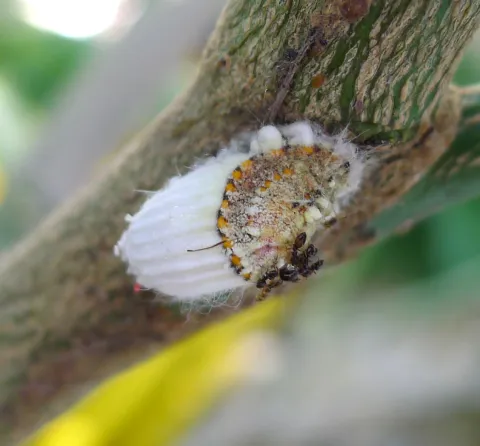
Disease / Threat
Information
- Lifecycle
- Perennial
- Foliage
- Evergreen
- Exposures
- SunHalf-shade
- Substrates
- Calcareous earthHumus soilSandy soil
- Planting methods
- Open groundIn potsIn tubs
- Category
- Succulent
- Tag
- Cold-sensitive
- Origin
- Southern Europe
- Hardiness (USDA)
- 10a (-1.1°C ≤ T° < 1.7°C)
- Leaf color
- Light green
- Flower color
- Pale yellow
Discover plants from the same family

Aeonium canariense
Aeonium canariense subsp. canariense


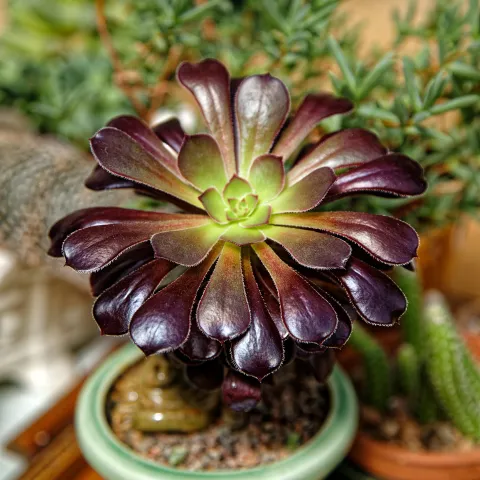
Aeonium 'Zwartkop'
Aeonium arboreum 'Zwartkop'
Find out more
Find all our tips in the Monstera application








